

Minority Rule™: Now Rebranded as Freedom

Minority Rule™: Now Rebranded as Freedom
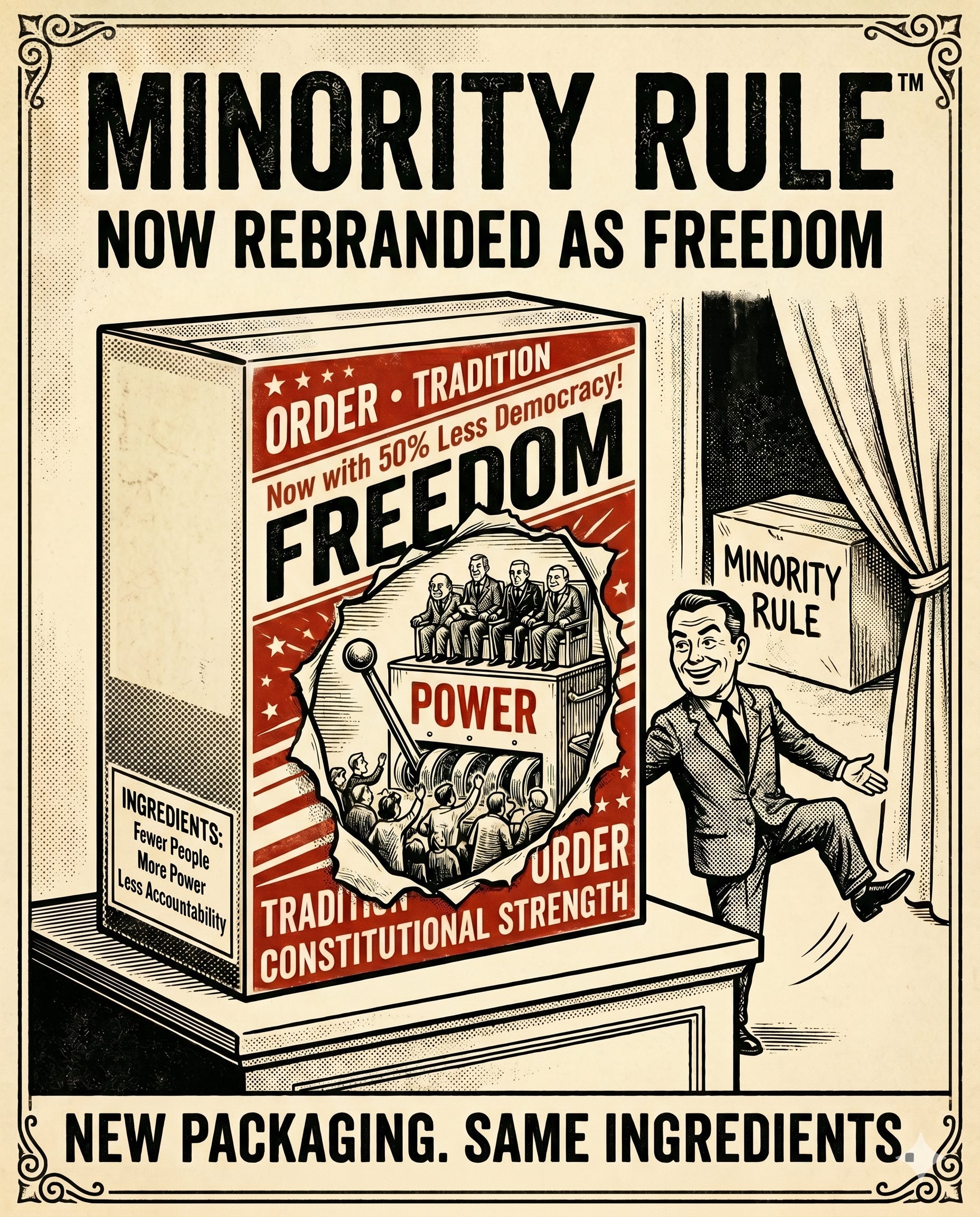
There is an old rule in marketing that says if people dislike the product, you have three options.
Improve the product.
Find a different audience.
Or rename the problem until it sounds like a benefit.
The first option requires work. The second requires luck. The third requires a strategist, a focus group, and a conference room where no one has been assigned the role of conscience.
This is how you end up with “pre-owned” cars instead of used ones, “convenience fees” instead of charges for the privilege of paying, and “rightsizing” instead of the sentence, “A spreadsheet has decided your children will be switching dental plans.”
The language changes because the emotional experience changes with it. Words do not merely label products. They walk into the room first, adjust the lighting, select the music, and tell us how to feel before the product arrives.
That is not automatically sinister. Good communication helps people understand complexity. Good branding can make a useful product easier to recognize, a valuable idea easier to remember, and a worthy cause easier to support.
But there is a line. On one side is persuasion. On the other hand, there is manipulation.
And somewhere near the middle, wearing a fleece vest and advancing through a slide deck titled RESTORING FREEDOM, is minority rule’s marketing department.
Because minority rule has a product problem.
Most people don’t want it.
They may tolerate it temporarily when their side benefits. They may accept particular institutions that produce it. They may rationalize it through history, law, religion, federalism, geography, tradition, expertise, property, judicial review, or the solemn insistence that a gentleman who died in 1787 would have agreed with their preferred tax policy.
But stated plainly, the proposition performs badly:
“Fewer people should have more power over more people.”
No one puts that on a yard sign.
No candidate walks onto a stage beneath a banner reading:
YOUR VOTE SHOULD MATTER LESS, BUT IN A CONSTITUTIONALLY APPROPRIATE WAY
No political movement introduces itself by saying, “We have carefully reviewed public opinion and concluded that the public is the main obstacle.”
That would be honest.
It would also test like a seafood buffet left in a hot car.
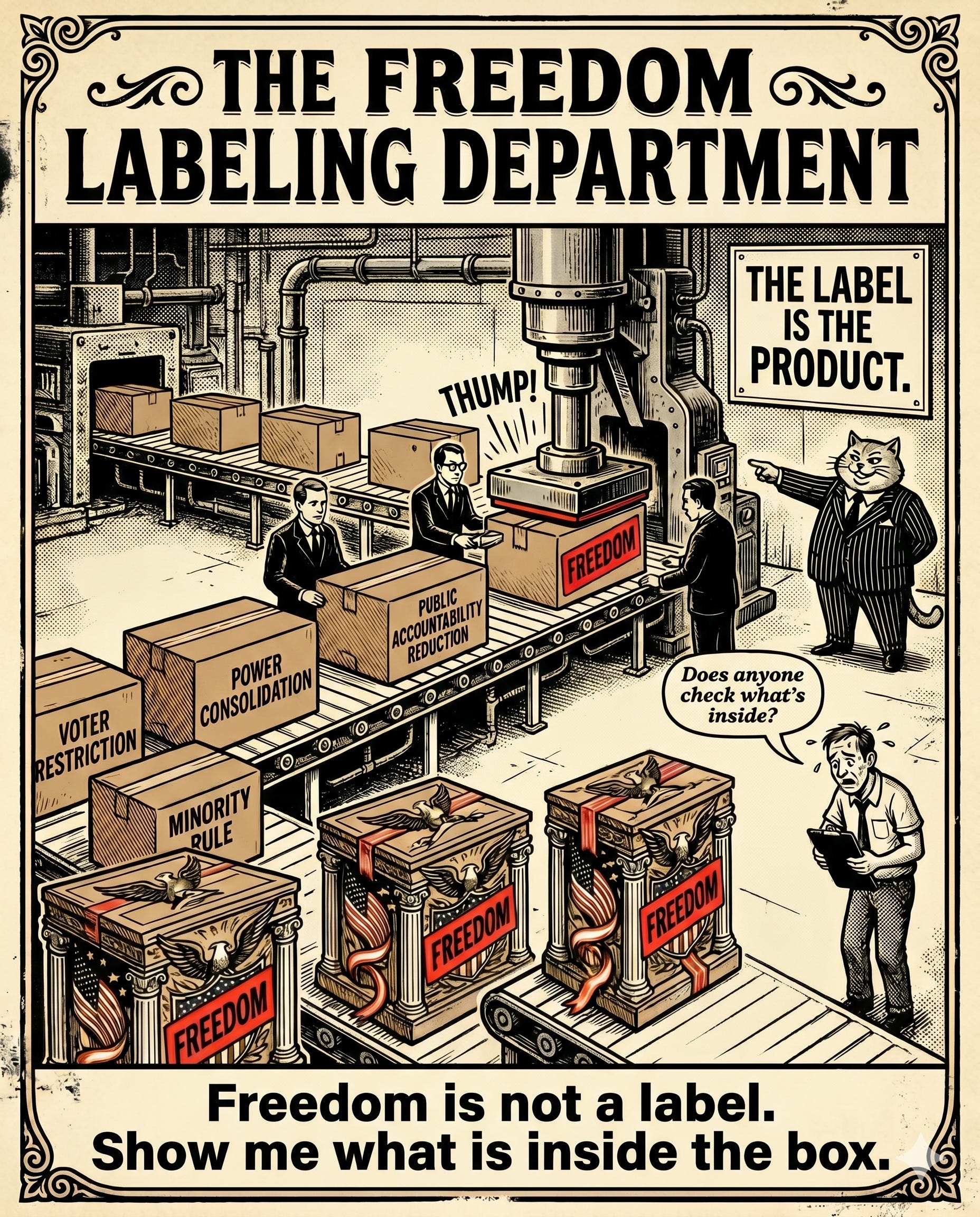
So the product gets rebranded. Minority rule becomes ‘constitutional order’.
Entrenched power becomes ‘stability’.
Voter restriction becomes ‘election integrity’.
Institutional capture becomes ‘restoration’.
Ignoring public opinion becomes ‘protecting liberty’.
And when all else fails, the word freedom is sprayed across the package like enough cologne to conceal the smell of a small electrical fire, signifying the real meaning may be shorting out.
The product is ugly. The packaging is magnificent.
Marketing works partly because people do not encounter ideas as raw data. We encounter them inside stories, symbols, emotional associations, familiar categories, and judgments borrowed from people we trust.
A frame is not merely a description. It is an invitation to see the subject from a particular angle.
Consider the difference between these two statements:
A smaller political faction has secured enough institutional leverage to govern despite lacking majority support.
And:
Constitutional safeguards are protecting liberty from temporary majorities.
Do you hear the difference? Same neighborhood, but entirely different emotional payloads.
The first sentence invites questions about legitimacy, representation, and accountability.
The second arrives with marble columns, a sunrise, and a string quartet playing softly behind James Madison’s silhouette.
The genius is not that the second statement must be false in every instance. Constitutional safeguards can protect liberty from majoritarian abuse. That is one of their legitimate purposes.
The genius is that a true principle can be used as emotional camouflage for a different project.
That is the dark art.
You borrow the moral authority of a real democratic safeguard, then use it to shield an arrangement that makes democratic accountability weaker. You take a word people trust, freedom, order, integrity, tradition, and attach it to something they might reject under its factory name.
The package says liberty.
The ingredients say concentrated power.
The small print on the rearview mirror says, “Objects may be closer than they look.”
When persuasion becomes civic vandalism
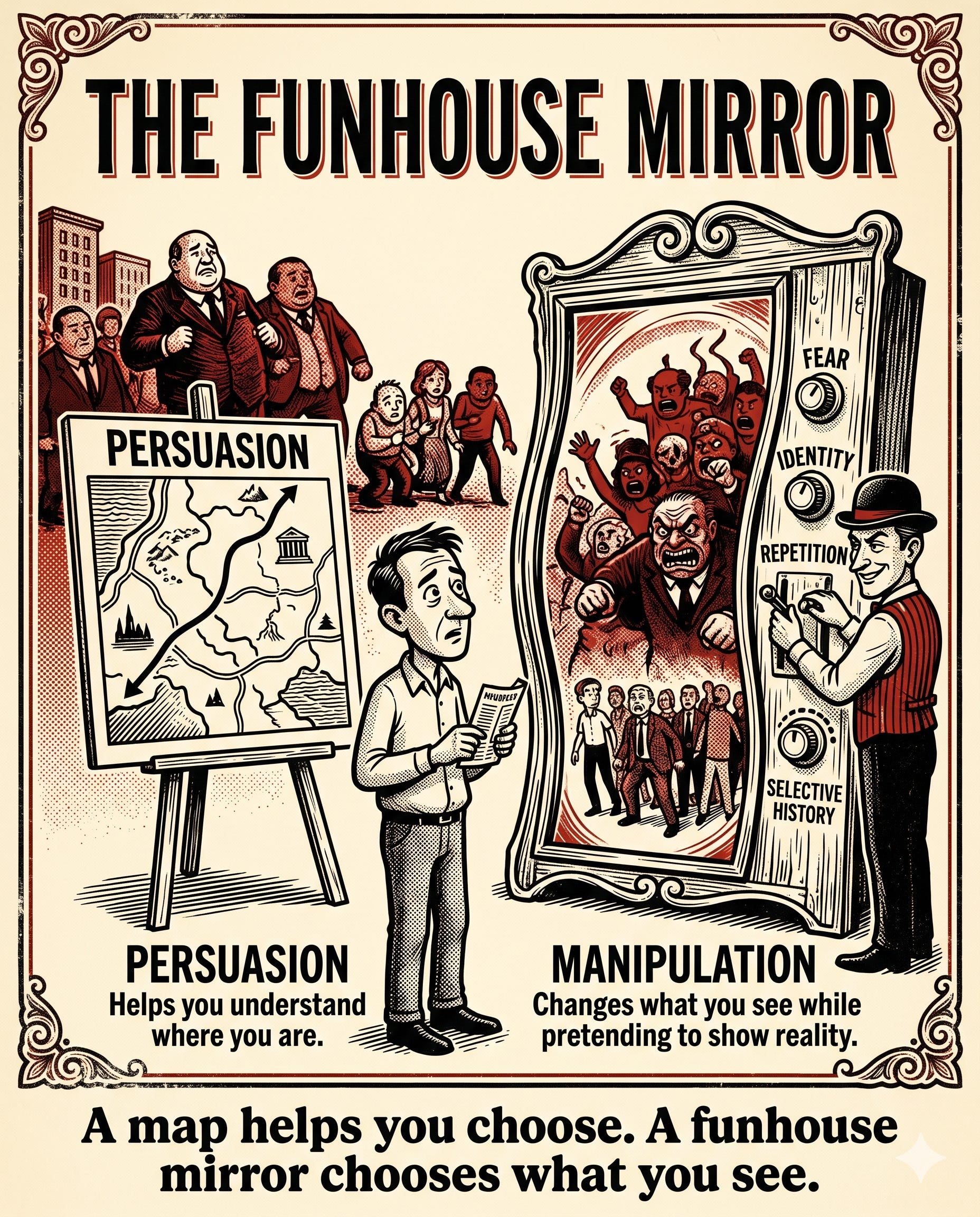
I have spent much of my career around marketing, brand strategy, positioning, media, and the professional machinery of persuasion. I believe in that work.
Persuasion is not inherently corrupt. Human beings are not filing cabinets waiting for information to be sorted alphabetically. We think in narrative, analogy, emotion, identity, and metaphor. The person who explains something clearly and memorably is not cheating. They are communicating.
The ethical problem begins when the communicator no longer wants the audience to understand the choice.
The goal becomes engineering assent by hiding costs, exaggerating threats, shifting attention, creating false associations, or making the audience feel that one option is dangerous before the evidence has even entered the conversation.
Philosophers disagree about the exact boundaries of manipulation, but several recurring ideas matter here: influence can become manipulative when it bypasses or undermines reason, uses trickery, distorts emotional judgment, or pressures people through vulnerabilities rather than offering an honest account of the choice. [1]
That distinction is useful because political marketing often defends itself with the same excuse used by every questionable salesperson since the invention of the wagon:
“We’re just persuading.”
No.
Sometimes you’re persuading.
Sometimes you’re clarifying.
Sometimes you’re offering a compelling interpretation of facts.
And sometimes you are putting the word FREEDOM on a box containing fewer choices and hoping the font does the ethics. And that’s pure manipulation.
More specifically, it is civic vandalism. What I define as using the tools of communication to damage the public’s ability to understand its own government.
A vandal with spray paint damages a wall. A propagandist with professional messaging discipline can damage the meaning of a word. The second job pays better and usually includes dental.
Freedom, now with less freedom
Political language loves abstract nouns because abstract nouns cannot file complaints.
Freedom.
Order.
Security.
Integrity.
Tradition.
These words are emotionally powerful and semantically flexible. Their vagueness is not a flaw. It is an argument inventory with available meaning to be filled in as needed.
“Freedom” can mean protection from government intrusion. It can also be used to defend government intrusion into the lives of people you dislike.
“Local control” can mean communities deciding for themselves. It can also disappear the moment a local community makes the wrong decision.
“States’ rights” can mean federal restraint. It can also become strangely quiet when state power needs to be overridden for the preferred national policy.
“Judicial restraint” can mean courts respecting democratic choices, right up until a democratic choice conflicts with the movement’s goals, at which point the judiciary discovers a thrilling new appetite for intervention.
None of this requires the words themselves to be meaningless. The words are valuable because they have meaning.
That is what makes them worth stealing.
If I create a product called Liberty Max, you may reasonably assume it contains liberty. If the product instead gives a smaller faction durable power over a larger public, the name does not explain the contents.
It’s distracting you from them.
Political marketing often works like food photography. The actual burger is gray, compressed, and quietly reconsidering its life. The photograph contains perfect grill marks, dewy lettuce, and a bun receiving light directly from heaven.
Minority rule is the burger.
Freedom is the food stylist.
The psychology of noble packaging
Why does this work?
Because people rarely evaluate political language in a vacuum. We use mental shortcuts. We react to social identity, threat, familiarity, repetition, authority, and emotionally loaded categories.
If a policy is described as protecting freedom, opposing it begins to feel anti-freedom.
If a restriction is framed as election integrity, questioning it can feel like questioning honest elections.
If concentrated power is described as strong leadership, resistance begins to resemble weakness or sabotage.
The phrase creates the courtroom, selects the judge, and seats the jury before the argument begins.
This is especially potent when the frame activates fear.
Fear narrows attention. It makes threat detection feel more urgent than nuance. It encourages people to accept restraints they might otherwise question because the restraint has been presented as protection from something worse.
The marketer does not have to prove that majority rule is a mob.
The marketer only has to place a mob in your head, turn down the lights, and ask whether you are really willing to take the risk.
At that point, minority rule no longer looks like the competing danger.
It looks like security.
The smaller faction becomes the guardrail.
The public becomes the cliff.
Very elegant.
And very upside down.
The focus group from hell
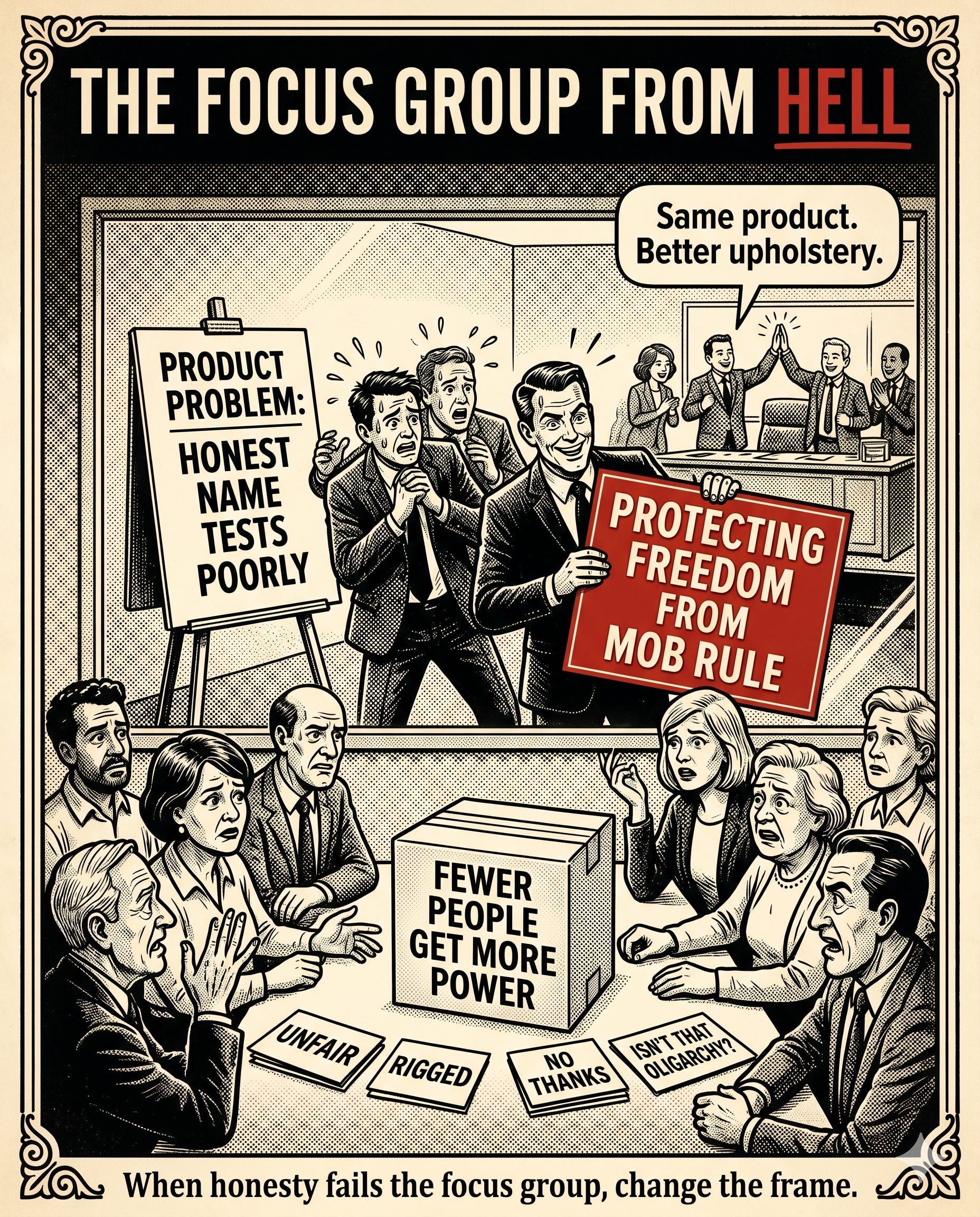
Imagine the meeting.
The conference room is called Madison, although nobody present has read more than four consecutive paragraphs of his.
On the wall is a presentation:
PRODUCT CHALLENGE
Minority rule has unfavorable associations.
Under that:
unfair
anti-democratic
rigged
oligarchic
hard to explain at the neighborhood barbecue
A consultant clicks to the next slide.
CONSUMER INSIGHT
People dislike losing political power.
Good work, team.
Next slide:
REPOSITIONING OPPORTUNITY
People will accept reduced political power when presented as protection from chaos, corruption, outsiders, fraud, disorder, social change, or other people having political power.
Now we’re cooking!
The team develops several possible names:
Minority Rule Classic
Rejected.
Government by Those Who Know Better
Too European.
Managed Popular Sovereignty
Strong among donors, weak among people who use doors themselves.
Freedom
There it is.
Short.
Emotional.
Positive.
Impossible to oppose without sounding like the villain in a movie about a small town.
Someone adds an eagle.
Someone else adds “constitutional.”
A third person suggests a child looking toward a sunrise.
The product is ready.
No changes to the product were required.
The Deprogramming Translation
Not everyone who repeats these phrases is consciously participating in a scheme. Many people inherit language from trusted figures, communities, media, religious leaders, political parties, or the confident person at work who owns a podcast microphone.
The point is not to claim that every speaker secretly means the worst possible thing.
The point is to identify what the language is doing.
That is the spell-breaking move.
Phrase 1
The phrase:
“We are protecting freedom.”
The emotional payload:
The policy is morally aligned with individual liberty, and opposition threatens your independence.
The hidden move:
Use the positive emotional power of “freedom” to avoid specifying who gains power, who loses it, and what choices are actually being restricted.
The reality check:
A policy does not protect freedom merely because its advocates use the word. Follow the power: whose choices expand, whose shrink, and who becomes harder to hold accountable?
The one-line response:
Freedom is not a label. Show me what is inside the box.
Phrase 2
The phrase:
“We need constitutional safeguards against temporary majorities.”
The emotional payload:
The public is impulsive; insulated institutions are wiser and safer.
The hidden move:
Turn a legitimate argument for rights and limits into a general excuse for making public preferences easier to ignore.
The reality check:
Constitutional safeguards should prevent domination by any faction, not create permanent governing advantages for one.
The one-line response:
A safeguard protects the rules. It should not choose the winner.
Phrase 3
The phrase:
“We are restoring order.”
The emotional payload:
Something has become chaotic, dangerous, or socially unmoored, and stronger control is necessary.
The hidden move:
Make concentrated power feel like relief by exaggerating disorder or defining dissent as disorder.
The reality check:
Order without accountability is not democratic stability. It is obedience with a public relations department.
The one-line response:
Before applauding order, ask who is being ordered.
Phrase 4
The phrase:
“We are defending tradition.”
The emotional payload:
A valuable inheritance is under attack by reckless change.
The hidden move:
Make existing power arrangements feel natural, sacred, or timeless, even when they were constructed to benefit particular groups.
The reality check:
Traditions can preserve wisdom. They can also preserve advantage. Age is not a moral argument.
The one-line response:
Some traditions are foundations. Others are furniture nobody has been allowed to move.
Phrase 5
The phrase:
“We are saving the republic.”
The emotional payload:
The constitutional system is endangered by democratic excess.
The hidden move:
Use reverence for republican institutions to make reductions in democratic accountability feel patriotic.
The reality check:
A republic without meaningful public consent, fair representation, and accountability can become a shell for rule by the few.
The one-line response:
If saving the republic requires silencing the public, check the return address.
How to spot the rebrand
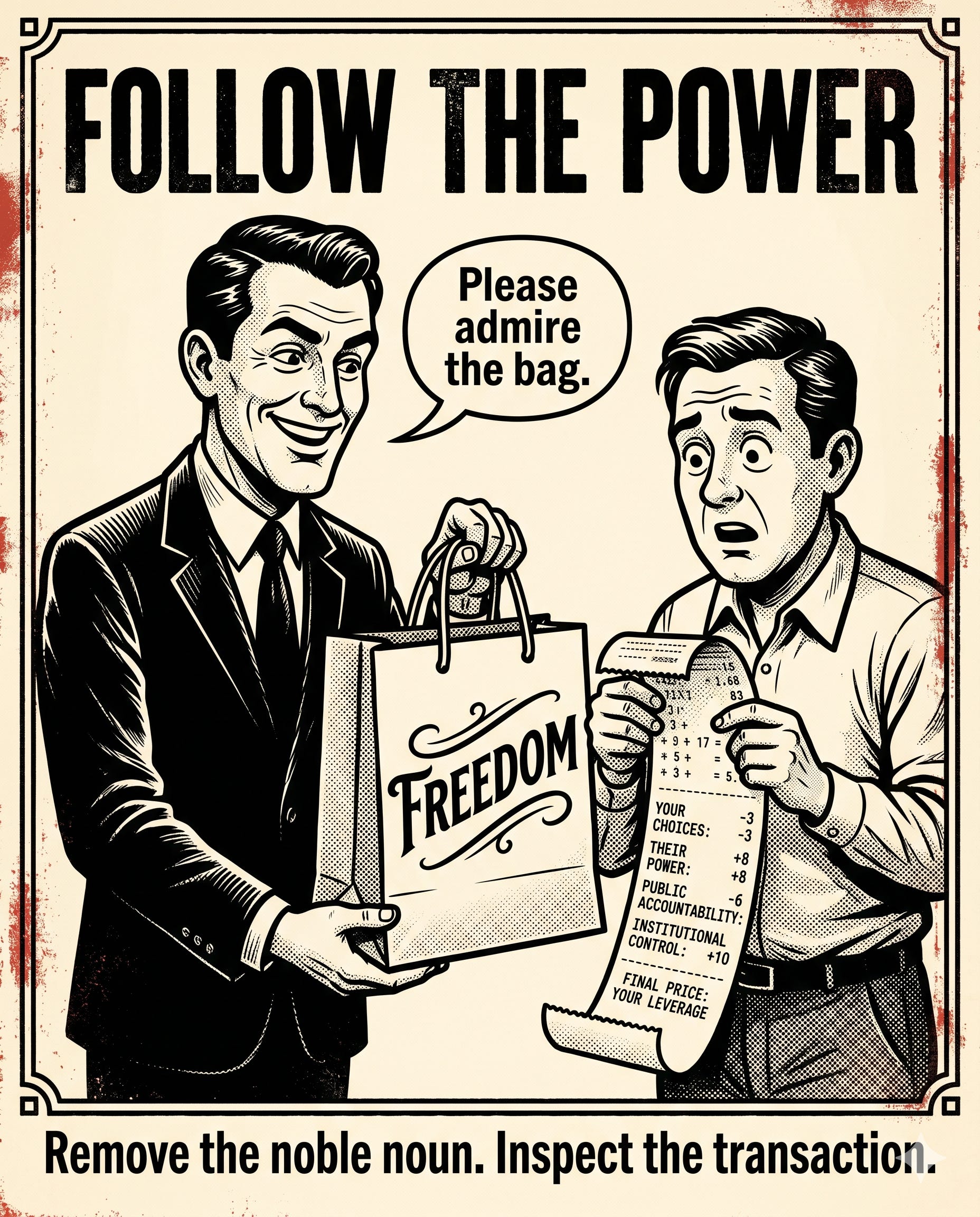
The easiest way to detect political language laundering is to remove the noble noun and inspect the underlying transaction.
When someone says freedom, ask:
Freedom for whom, from what, and at whose expense?
When someone says order, ask:
Who defines disorder?
When someone says integrity, ask:
What specific problem is being solved, and what evidence shows it exists?
When someone says tradition, ask:
Which tradition, from when, benefiting whom?
When someone says constitutional, ask:
What provision, what principle, and why does this interpretation always seem to place power in the same hands?
This is not cynicism. It is ingredient-label democracy.
You are not rejecting the words. You are demanding that the contents match the packaging.
A movement genuinely defending liberty should be able to explain which liberties it protects.
A policy genuinely protecting election integrity should be able to identify the threat, demonstrate the remedy, and account for the eligible citizens burdened by it.
A constitutional argument should survive outside the emotional fog of Founder cosplay.
A tradition worth preserving should tolerate questions about who paid for it.
If the answer to every question is another slogan, you are no longer looking at a governing philosophy.
You are standing in the cereal aisle of authoritarianism.
The moral injury of weaponized persuasion
The damage extends beyond one election or one policy.
When communicators repeatedly use trusted words to conceal opposite outcomes, they degrade the words themselves.
Freedom becomes factional.
Integrity becomes suspicious.
Constitutional becomes tribal.
Patriotism becomes a sales territory.
Eventually, people stop hearing moral principles and start hearing brand signals. The shared vocabulary necessary for democratic argument dissolves into competing passwords.
That is a profound injury because democracy depends on more than procedures. It depends on enough shared meaning for disagreement to remain intelligible.
Citizens need to be able to argue about freedom while agreeing that the word refers to something beyond whatever helps their team.
They need to argue about constitutional government while accepting that constitutional limits bind allies as well as opponents.
They need to debate election integrity without treating access and security as mutually exclusive products sold by rival companies.
Once language becomes a pure weapon, every principle turns into camouflage, and the side with the larger media apparatus gets to manufacture reality by repetition.
At that point, public debate resembles a department store where every shelf has been relabeled FREEDOM, including the cage aisle.
With great power comes a quarterly media buy
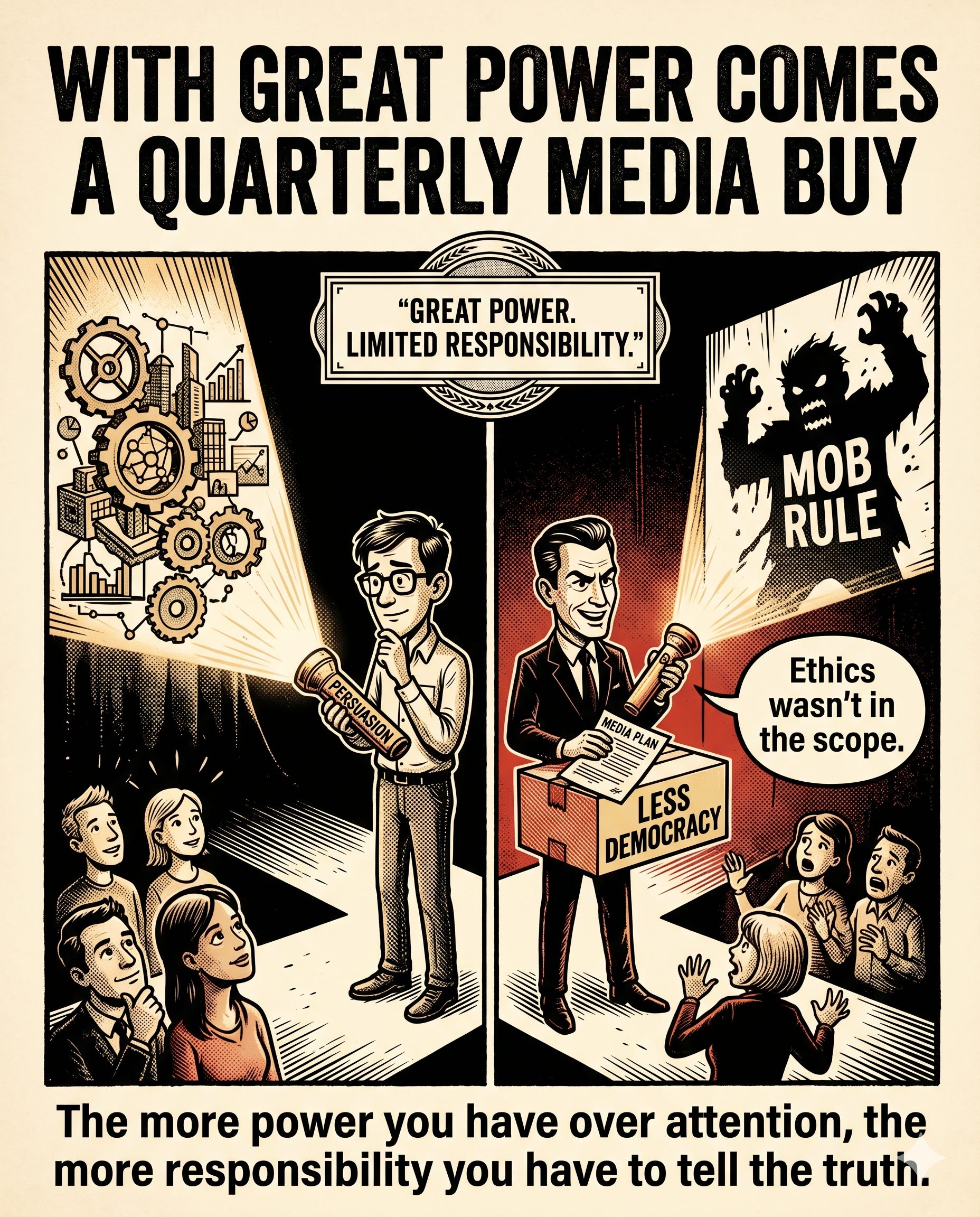
There is a reason the old comic-book line about power and responsibility survives.
It names a real moral relationship.
The more influence you can exercise over others, the greater your obligation to consider what you are doing to their ability to choose, reason, and act freely.
Marketers have power.
Strategists have power.
Speechwriters, media executives, political consultants, platform designers, pollsters, pastors, influencers, comedians, journalists, and algorithm engineers have power.
Not sovereign power, and not always coercive power, but interpretive power: the power to decide which facts enter the frame, which emotions get attached to them, which alternatives seem imaginable, and which questions never receive enough oxygen to form.
Used responsibly, that power can illuminate.
Used irresponsibly, it can make people cheer while their own leverage disappears.
There is something uniquely rotten about using the science of human attention, the psychology of fear, the art of narrative, and the discipline of branding to convince people that losing democratic power is an expression of freedom.
It is not simply dishonest; it is a betrayal of the craft.
It is persuasion turning against the autonomy that makes persuasion legitimate.
It is Spider-Man joining the billboard industry and using his powers to sell bridge insurance immediately after cutting the cables.
The product underneath
Strip away the slogans, and the proposition remains:
Some people believe the public cannot be trusted with too much influence because the public may choose badly.
That concern is not absurd. Democracies can make terrible decisions. Majorities can violate rights. Public passions can become cruel, frightened, and destructive.
That is why constitutional rights, courts, institutional checks, due process, equal protection, and the rule of law matter.
But the answer to democratic fallibility is not to hand durable power to a smaller faction and assume scale creates virtue.
A minority can be ignorant, cruel, and corrupt, and can become a corrosive mob with reserved VIP parking.
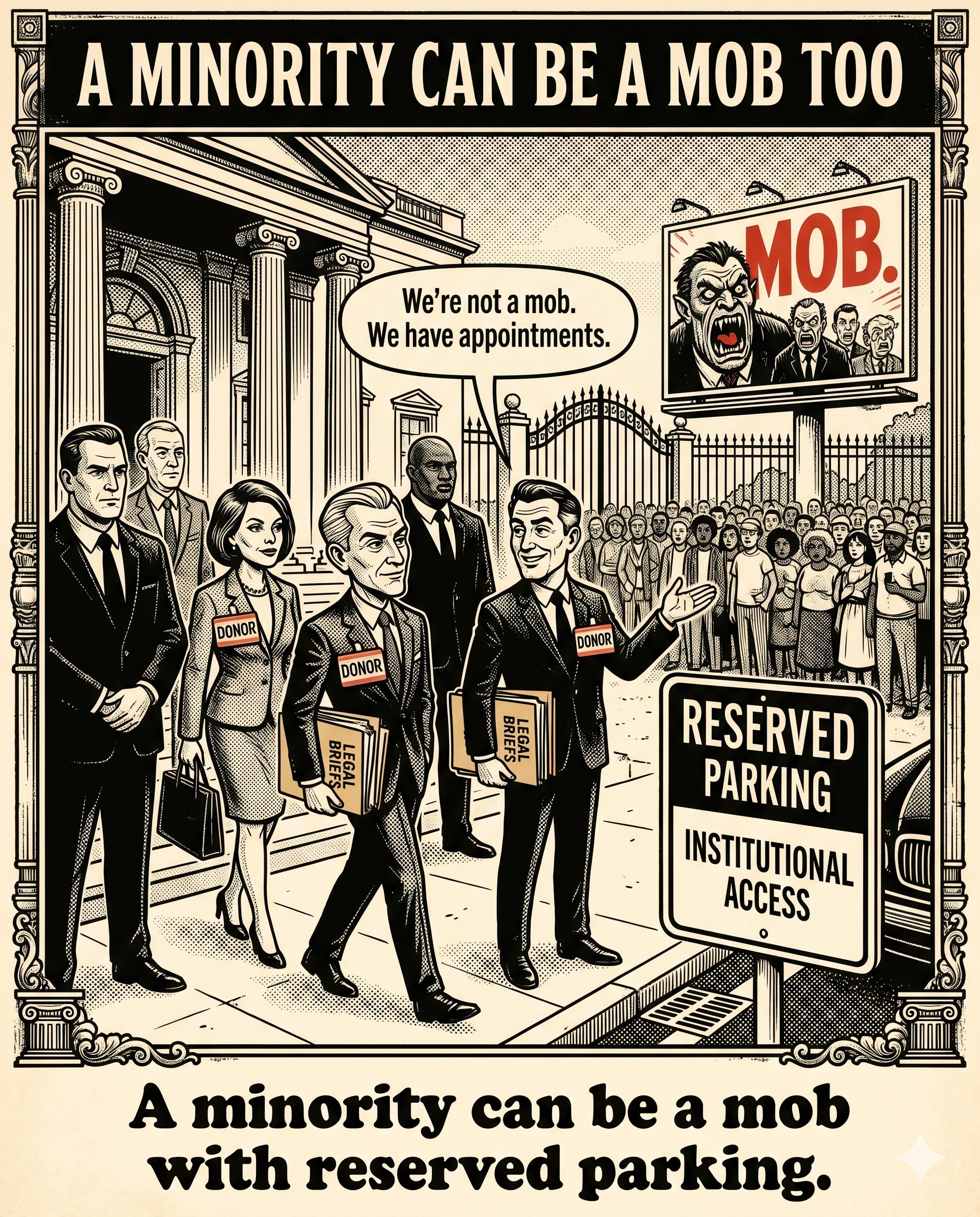
The challenge of democratic government is not to eliminate power from the public and deposit it with the people who claim superior judgment. It is to structure power so no faction, majority or minority, can easily convert temporary advantage into permanent domination.
That project requires rights and representation, limits and accountability, stability and responsiveness.
A constitution and a public that still matters.
The words are meant to work together.
The marketers are the ones trying to make you choose.
New packaging. Same ingredients.
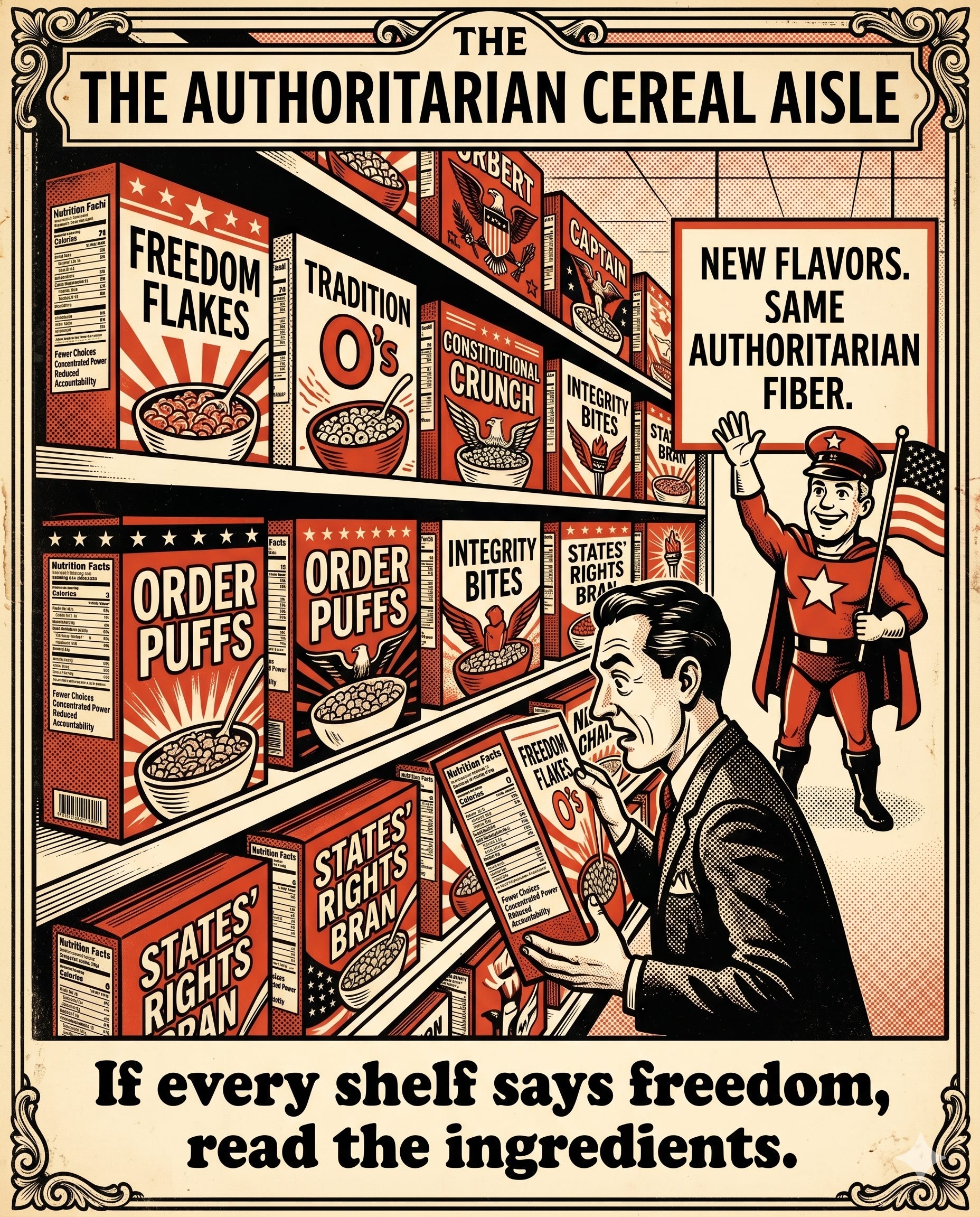
Minority rule will continue to rebrand because the real name will continue to test poorly.
There will always be a new phrase to represent a new threat or emergency. There will also always be a new theory explaining why this particular reduction in accountability is necessary to preserve liberty. Marketers skirting on the edge of propaganda engineering will always craft a new set of respectable words to be placed over an old transaction model:
Fewer people.
More power.
Less accountability.
The answer is not to abandon words like freedom, order, integrity, tradition, republic, or constitutional government. Because those words belong to everyone.
The answer is to reclaim them from the packaging department.
Open the box.
Read the ingredients.
Follow the power.
And whenever someone sells you less democracy under the brand name Freedom™, remember the first rule of political advertising:
If they cannot improve the product, they will improve the lighting.
Break the spell.
The Receipts
Manipulation is not the same as rational persuasion. The Stanford Encyclopedia of Philosophy explains that theories of manipulation often focus on influence that bypasses or undermines reason, employs trickery, distorts beliefs or emotions, or applies pressure short of coercion. Its examples include exaggerating advantages, understating costs, and inducing emotional states that make one choice seem more appropriate than it is.
The ethical concern is autonomy, not merely whether influence occurred. The Stanford discussion of paternalism notes that manipulation is often criticized because it fails to respect people as rational, capable choosers. The central objection is not that psychology was used, but that psychological techniques may replace transparent reasons with hidden steering.
Democratic backsliding is not an abstract historical concern. Freedom House reported in March 2026 that global freedom declined for a twentieth consecutive year during 2025, citing weakened constitutional safeguards, military coups, and violence against peaceful protesters. It found deterioration in political rights and civil liberties in 54 countries, compared with improvement in 35.