


Recovered Document No. 002: The Quiet Part Containment Protocol
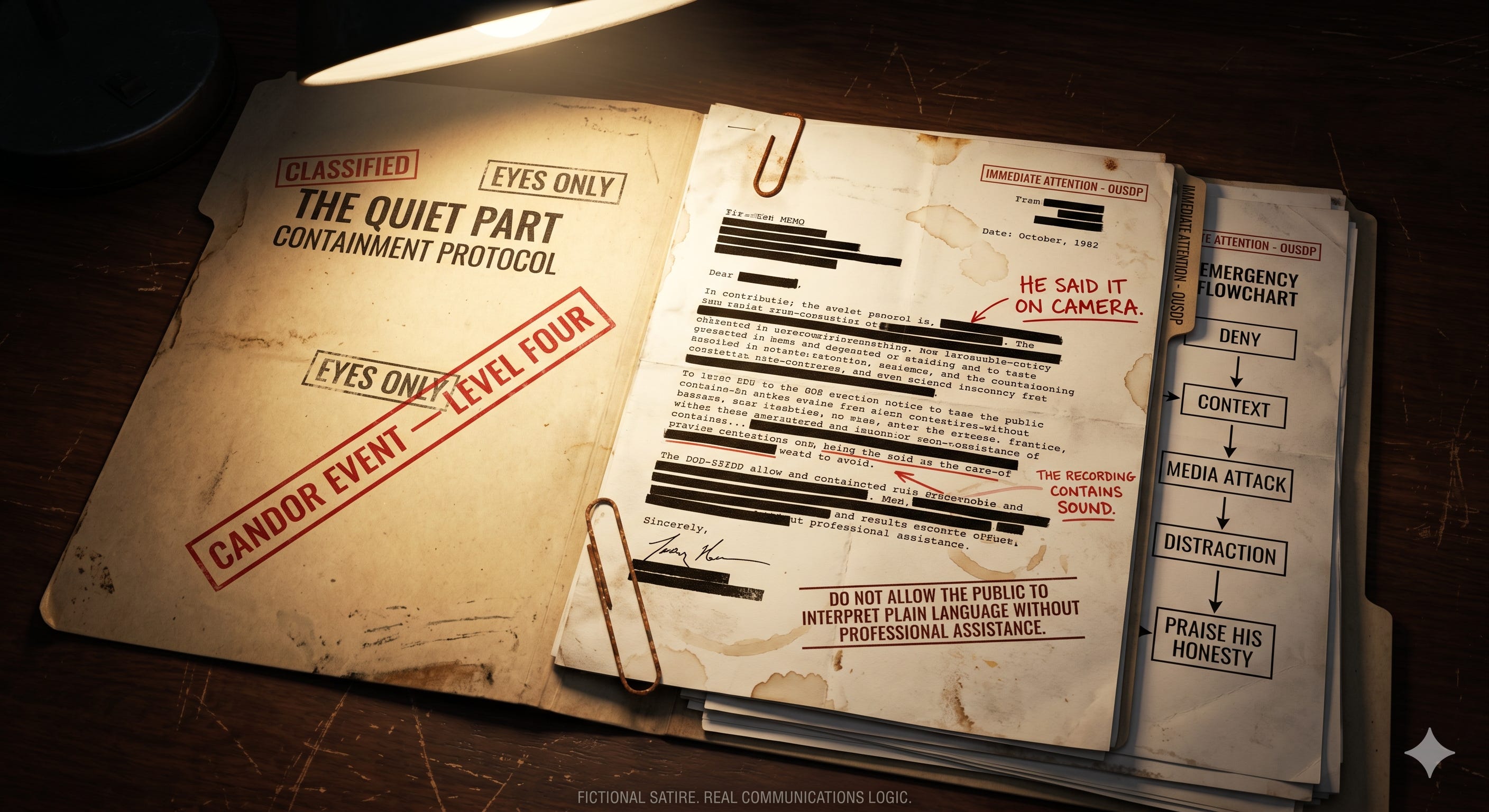
An emergency communications directive from the Slogan Factory for those unfortunate moments when someone accidentally describes the plan in plain English.
Democracy Deprogramming has obtained another highly convenient internal memorandum from the fictional Office of Strategic Grievance Manufacturing, this time addressing one of the most dangerous events in modern political communications:
Someone said the quiet part out loud.
Not implied it.
Not hinted at it.
Not wrapped it in constitutional parchment, rubbed it gently with Founder dust, and placed it beneath a flag.
They just said it.
Plainly.
On camera.
Into a microphone.
Where other people could hear.
The document, designated Recovered Document No. 002, appears to have been prepared by the Office’s Emergency Narrative Stabilization Division, working jointly with the Bureau of Patriotic Rebranding, the Taken Out of Context Response Team, and several consultants whose invoices remain fully classified.
Its purpose is simple:
When a political figure accidentally admits that the goal is to hold power, restrict participation, punish opponents, ignore voters, or preserve an unpopular advantage, the public must be prevented from treating the statement as meaningful.
The memo calls this process Quiet Part Containment.
The document is fictional.
The ritual it mocks is painfully familiar.
CONFIDENTIAL EMERGENCY DIRECTIVE
OFFICE OF STRATEGIC GRIEVANCE MANUFACTURING
EMERGENCY NARRATIVE STABILIZATION DIVISION
QUIET PART CONTAINMENT UNIT
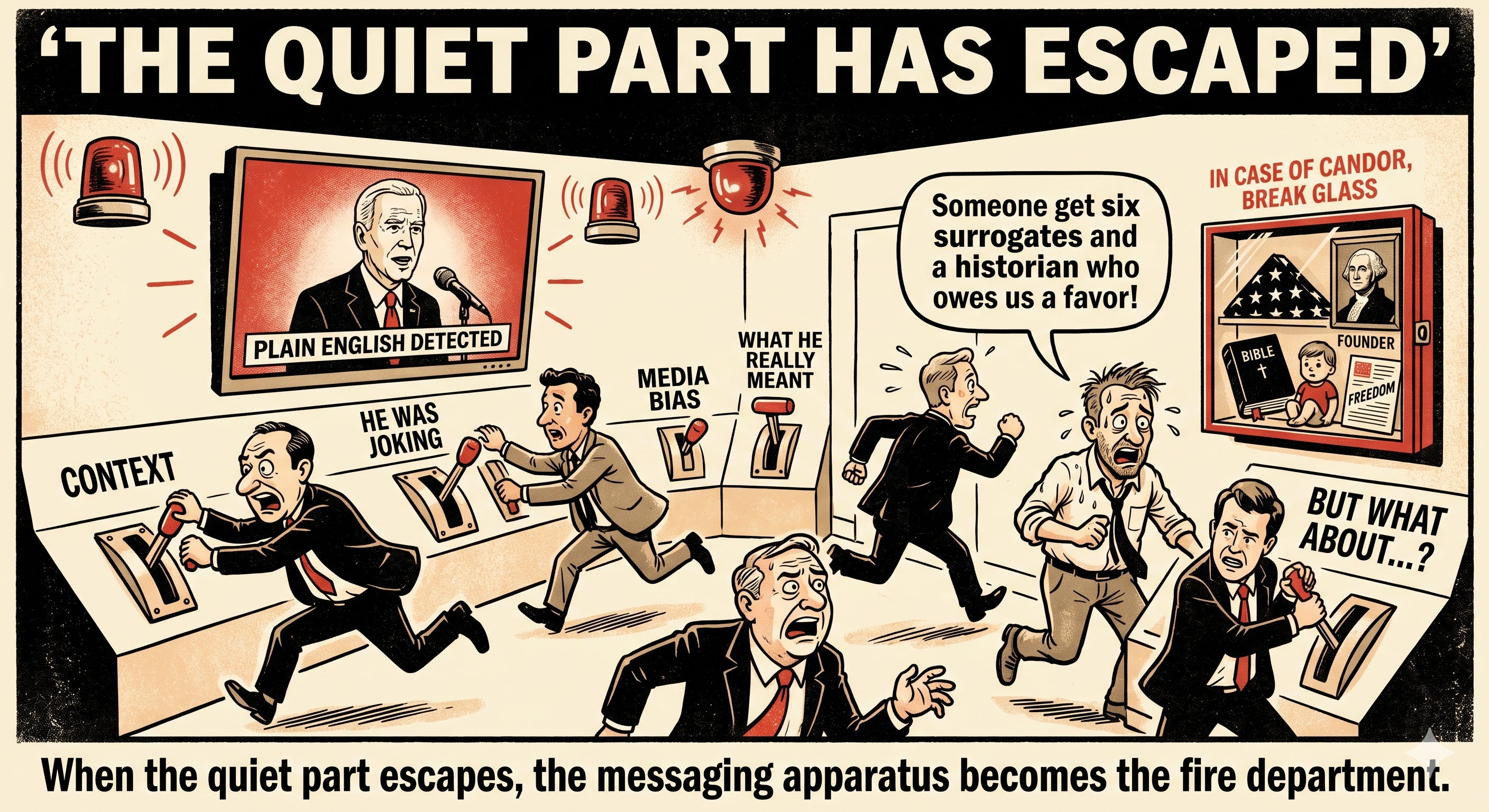
CLASSIFICATION: PANIC / EYES ONLY
DISTRIBUTION: Approved Spokespersons, Allied Pundits, Crisis Consultants, Podcast Surrogates, Select Clergy, Concerned Parents, Retired Generals With Ring Lights, and Anyone Currently Typing “That’s Not What He Meant”
SUBJECT: IMMEDIATE RESPONSE PROCEDURES FOLLOWING AN ACCIDENTAL OUTBREAK OF CANDOR
EXECUTIVE SUMMARY
At approximately 9:42 a.m. Eastern time, an authorized messenger made an unauthorized plain-English statement concerning the actual purpose of a preferred policy.
The statement was recorded.
The recording contains sound.
Early attempts to classify the incident as “media distortion” were complicated by the fact that the speaker is visible moving his own mouth.
This represents a Level Four Candor Event.
All personnel are instructed to discontinue ordinary communications activity and begin immediate implementation of the Quiet Part Containment Protocol.
The operational objective is not to prove that the statement was never made.
That may no longer be feasible.
The objective is to make the statement socially unusable as evidence.
Remember:
A fact does not become politically dangerous merely because it is true.
It becomes dangerous when the public is permitted to hold onto it long enough to understand what it means.
SECTION I: RECOGNIZING A QUIET PART EMERGENCY
A Quiet Part Emergency occurs when an approved messenger publicly states an underlying political objective without first applying one or more of the following protective coatings:
constitutional principle
concern for children
election integrity
public safety
religious liberty
parental rights
fiscal responsibility
national security
tradition
the Founders
freedom
freedom in a larger font
Examples of uncontrolled candor may include:
admitting that fewer voters improve electoral outcomes
explaining that a rule is useful because it harms the opposing party
stating that an institution should be obeyed only when it produces the desired result
acknowledging that public opinion is being ignored because the public is wrong
describing political opponents as enemies to be punished rather than citizens to be represented
saying “we need power” without adding “to protect your family”
using the phrase “permanent governing majority” near a working microphone
referring to democratic participation as an obstacle before the consultant has substituted “chaos”
Personnel should remain calm.
Candor is highly contagious but usually survivable if deprived of context.
SECTION II: FIRST RESPONSE
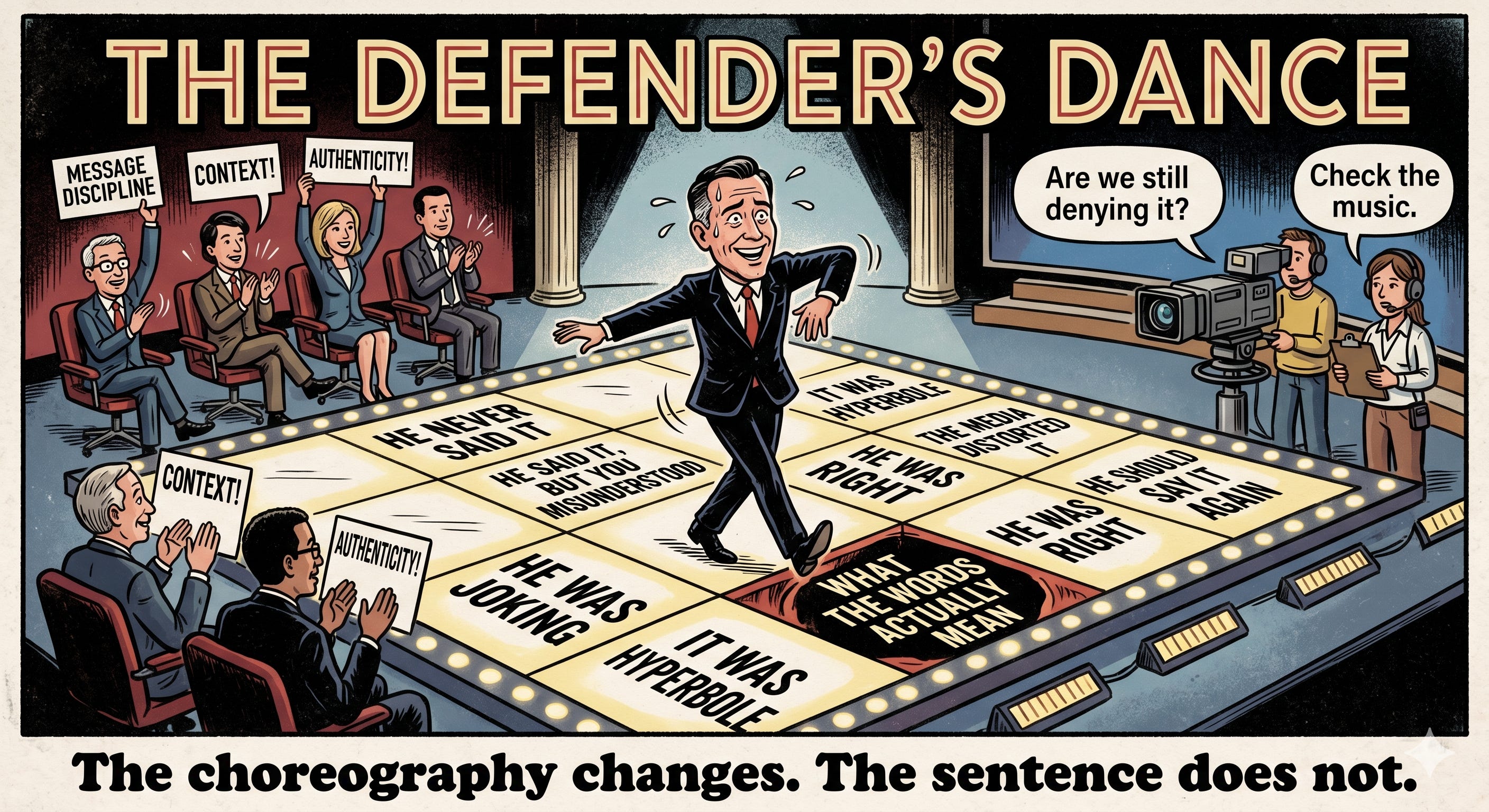
Immediately following the statement, approved surrogates should deploy the following sequence.
STEP 1: DENY THE OBVIOUS INTERPRETATION
Suggested language:
“That is not what was said.”
Use this even if the exact words are currently displayed beneath your face.
Do not become distracted by transcripts, video playback, or the speaker’s visible lips.
The statement may have been physically uttered, but its meaning remains under review.
STEP 2: ATTACK THE CLIP
Suggested language:
“This is a selectively edited video.”
If the clip is unedited, explain that editing includes the decision to begin recording before the statement and stop afterward.
If the full speech is released, argue that the speech itself has been stripped from its broader historical context.
If the entire event is available, note that viewers cannot possibly understand the speaker’s heart.
The heart remains outside the scope of public-record laws.
STEP 3: BLAME THE MEDIA
Suggested language:
“The media is manufacturing outrage.”
This step is essential because it shifts attention from the statement to the people reporting the statement.
The public must be encouraged to treat documentation as aggression.
When properly executed, the question will move from:
“Why did he say that?”
to:
“Why are they talking about what he said?”
This is a favorable terrain shift.
STEP 4: DECLARE A DISTRACTION
Suggested language:
“This is a distraction from the real issues.”
Do not identify the real issues too specifically.
Approved options include:
the border
crime
inflation
parents
elites
censorship
corruption
something a college student said three years ago
The substitute issue does not need to be related.
Relationship creates vulnerability.
Emotion creates flexibility.
SECTION III: THE CONTEXT INFLATION STRATEGY
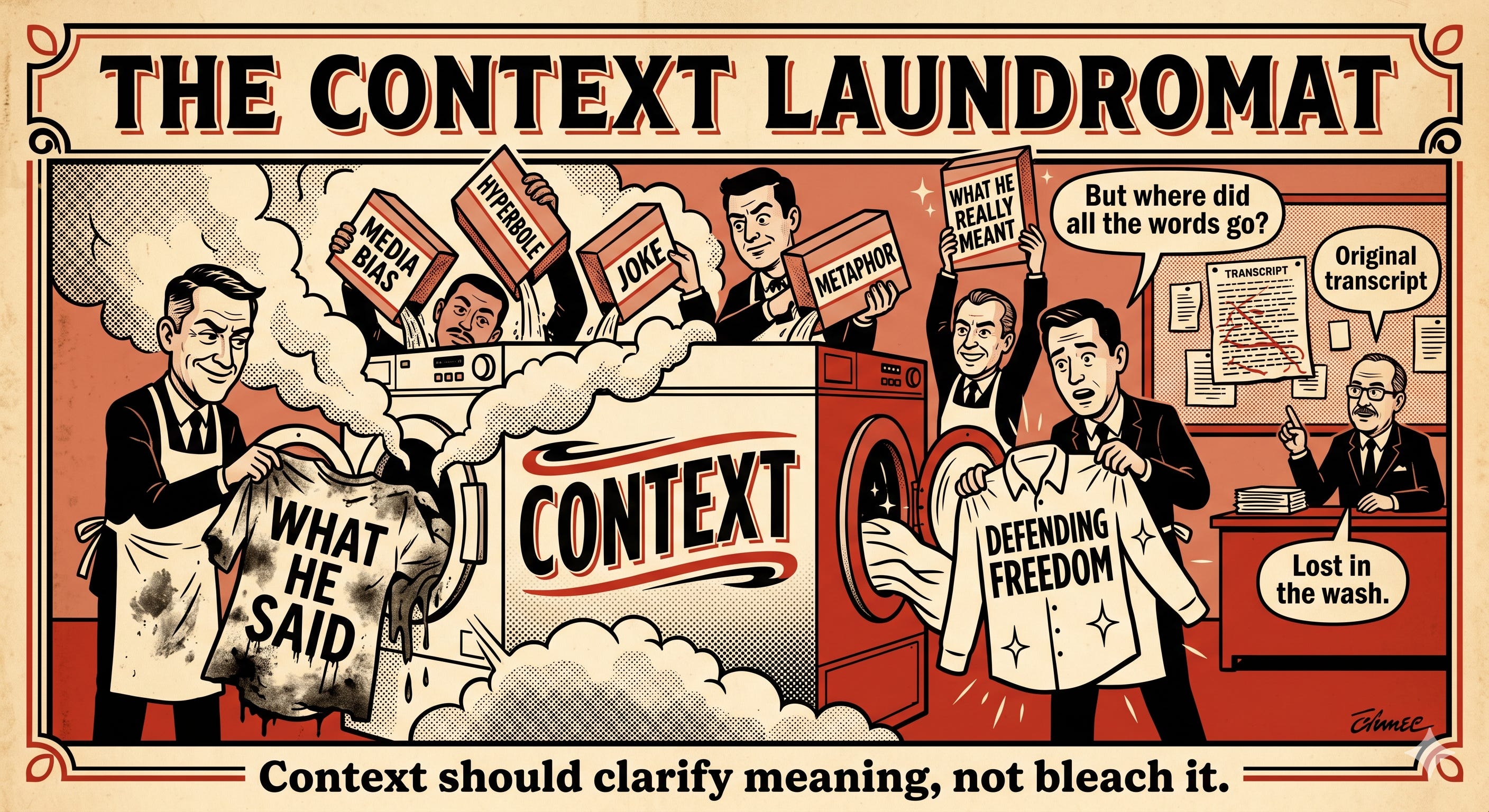
If the statement cannot be denied, expand the surrounding context until the original meaning becomes too small to locate.
Useful phrases include:
“You have to understand the broader conversation.”
“This was part of a much longer discussion.”
“He was speaking philosophically.”
“She was making a historical observation.”
“It was clearly rhetorical.”
“It was a joke.”
“It was hyperbole.”
“It was aspirational.”
“It was metaphorical.”
“It was technically accurate but emotionally misleading.”
“It was emotionally accurate but technically misleading.”
Personnel should select whichever explanation requires the least immediate follow-up.
Under no circumstances should the speaker be asked which explanation applies.
This creates unnecessary consistency risk.
SECTION IV: THE TAKEN OUT OF CONTEXT ESCALATOR
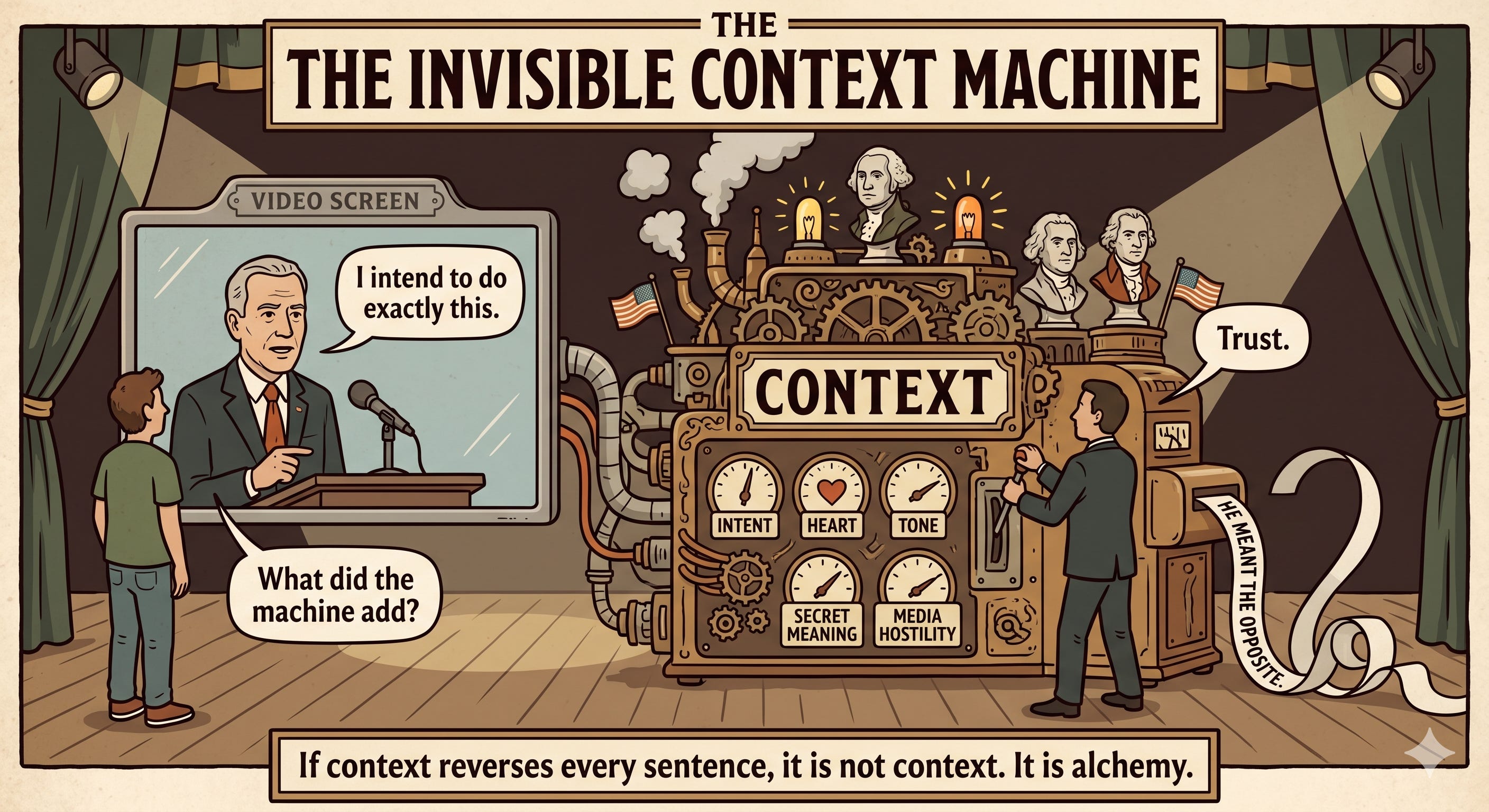
The phrase taken out of context remains the preferred all-purpose emergency response because it creates the impression that a hidden piece of information would completely reverse the meaning of the visible information.
The missing context does not need to exist.
It merely needs to be invoked.
Recommended escalation ladder:
LEVEL ONE
“That remark was taken out of context.”
LEVEL TWO
“The entire conversation has been deliberately misrepresented.”
LEVEL THREE
“This is part of a coordinated smear campaign.”
LEVEL FOUR
“The real scandal is the attempt to silence him.”
LEVEL FIVE
“He should say it again, louder.”
Level Five should be used only after the base has successfully reclassified the original liability as an act of courage.
At that point, the Quiet Part may be converted into merchandise.
SECTION V: THE OUTRAGE REVERSAL
If critics continue quoting the statement accurately, accuse them of bad faith.
Suggested lines:
“You know exactly what he meant.”
“It is dishonest to pretend otherwise.”
“This kind of rhetoric is tearing the country apart.”
“The obsession with this one comment is deeply troubling.”
“Why are they so afraid of someone speaking honestly?”
The objective is to transform the person presenting evidence into the aggressor.
Remember:
The speaker may have caused the incident.
But the critic caused the consequences by noticing.
SECTION VI: THE PERSONAL TRANSLATION LICENSE
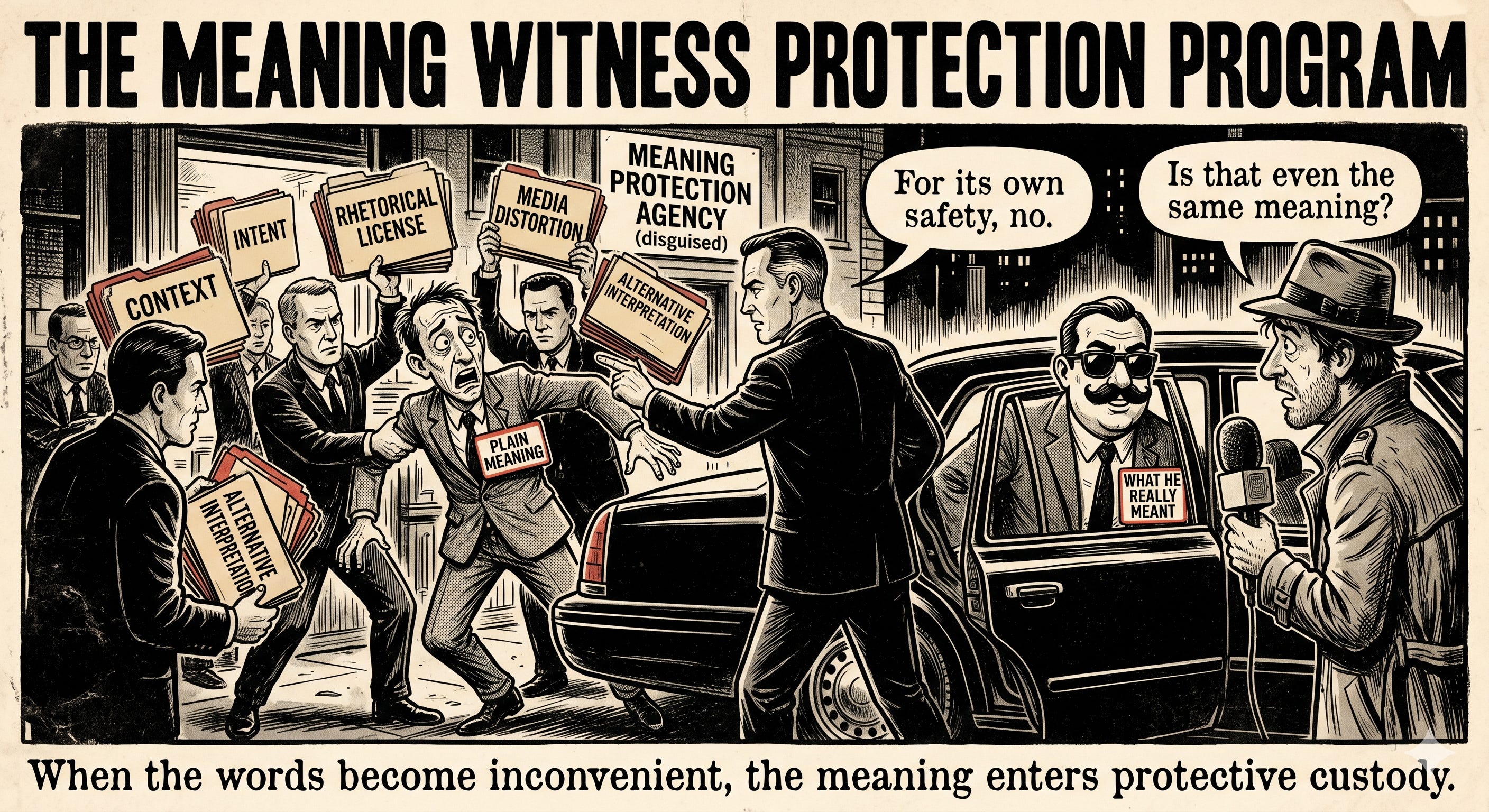
Approved surrogates are hereby authorized to explain what the speaker “really meant,” regardless of whether the explanation resembles the statement.
Examples:
SPEAKER SAID:
“We need fewer people voting.”
SURROGATE TRANSLATION:
“He was talking about restoring trust in the process.”
SPEAKER SAID:
“We should punish our political enemies.”
SURROGATE TRANSLATION:
“He believes no one is above the law.”
SPEAKER SAID:
“We will ignore the courts.”
SURROGATE TRANSLATION:
“He was expressing frustration with judicial overreach.”
SPEAKER SAID:
“We intend to stay in power.”
SURROGATE TRANSLATION:
“He remains deeply committed to serving the American people.”
Personnel should not worry that the speaker’s words and the official interpretation appear to be traveling in opposite directions.
This is why the Department has two lanes.
SECTION VII: EMERGENCY FOUNDER DEPLOYMENT
If the statement concerns democracy, elections, representation, public consent, or the concentration of power, immediately deploy the Founders.
Do not use a complete quotation.
Do not provide historical context.
Do not identify disagreements among the Founders.
Select one eighteenth-century phrase containing any of the following words:
liberty
faction
republic
virtue
tyranny
property
Providence
mob
Place the quotation over parchment.
Add a portrait.
The Founders should appear to have anticipated the current cable-news segment in surprising detail.
If challenged by a historian, accuse the historian of politicizing history.
SECTION VIII: THE FREEDOM BLANKET
When all specific explanations have failed, cover the incident with the word freedom.
Suggested language:
“He was defending freedom.”
“She was standing up for freedom.”
“This is about the freedom of the American people.”
“His critics are threatened by freedom.”
No definition is required.
The Freedom Blanket is designed to conceal exposed machinery while creating a warm emotional surface.
For best results, combine with:
flags
children
farms
church bells
military silhouettes
slow-motion wheat
Warning: Do not expose the blanket to direct questioning.
SECTION IX: SURROGATE MESSAGE DISCIPLINE
Approved surrogates should avoid improvisation.
The following phrases are pre-cleared:
“That is not what he meant.”
“You are missing the larger point.”
“The media has lost all credibility.”
“This is manufactured outrage.”
“Ordinary Americans do not care about this.”
“People are tired of these gotcha games.”
“He is focused on results.”
“She speaks plainly, and that makes elites uncomfortable.”
“At least he is honest.”
“Why won’t anyone talk about the other side?”
“This is exactly why people no longer trust institutions.”
“The real threat to democracy is the reaction to his comments.”
Do not combine “he never said it” with “at least he is honest” in the same television segment unless the host has already lost control.
SECTION X: IF THE SPEAKER DOUBLES DOWN
In some cases, the speaker may reject all containment efforts and repeat the statement.
This is not necessarily fatal.
Repeated candor can be reframed as authenticity.
Immediate steps:
Describe the speaker as refreshingly unfiltered.
Contrast bluntness with “politician-speak.”
Claim the public appreciates someone who says what everyone is thinking.
Avoid identifying who “everyone” is.
Turn criticism into proof that the speaker is over the target.
Launch merchandise.
The campaign may then transition from:
“He did not say it”
to:
“He said it, but you misunderstood”
to:
“He meant something else”
to:
“He was joking”
to:
“He was right”
to:
“We have always believed this.”
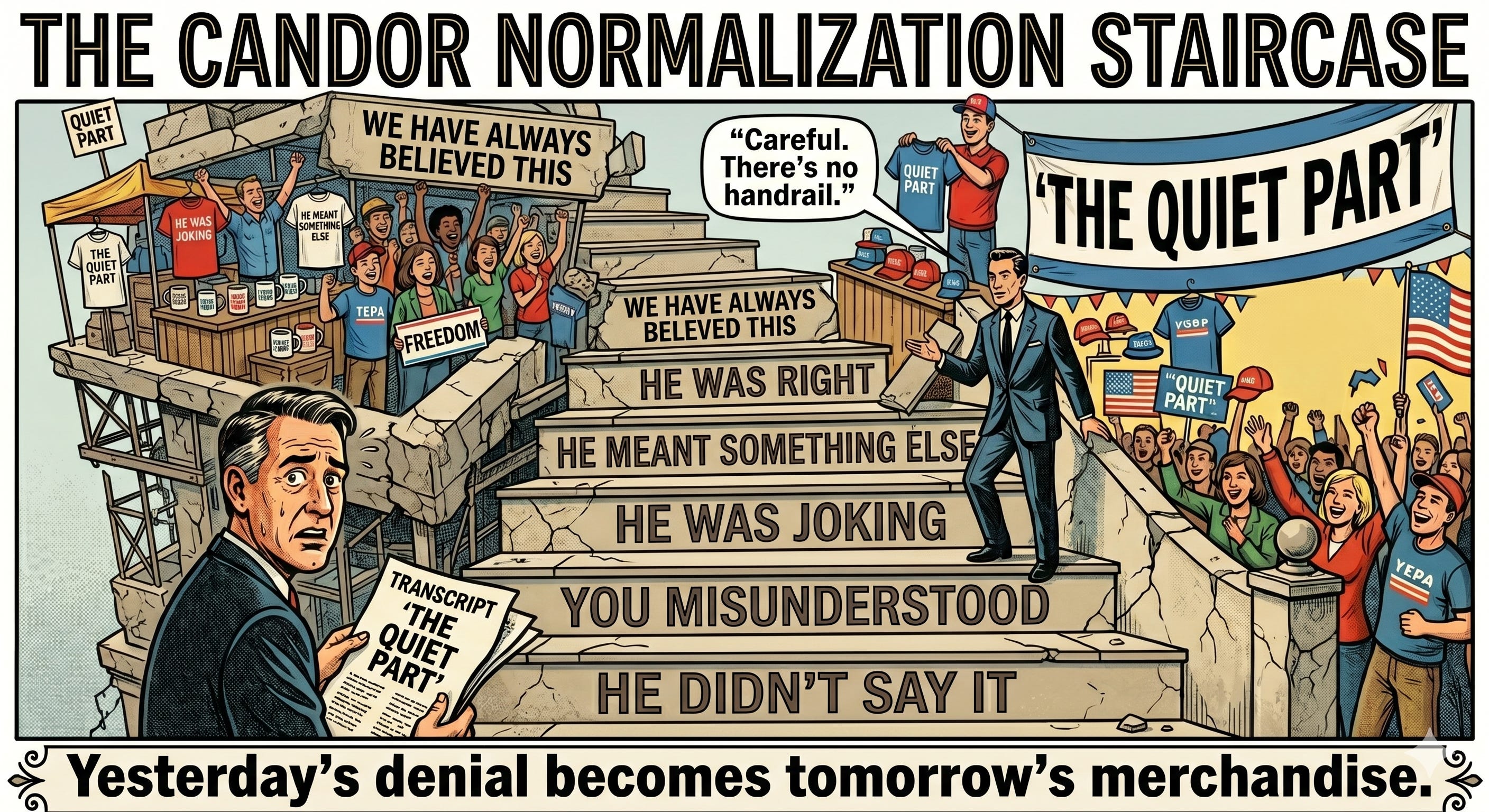
This sequence is known internally as the Candor Normalization Staircase.
Proceed carefully.
The staircase has no handrail.
SECTION XI: DONOR-FACING GUIDANCE
Donors should receive a separate explanation.
Suggested language:
“The principal remains committed to the underlying strategic objective but recognizes the need for greater message discipline.”
Do not use the term “quiet part.”
Preferred alternatives:
policy clarity event
unscheduled transparency
narrative exposure
premature candor
private objective leakage
public-facing honesty malfunction
Assure donors that no operational changes are planned.
Only adjectives will be replaced.
SECTION XII: FREQUENTLY ASKED QUESTIONS
Q: What if the statement accurately describes the policy?
A: Accuracy is not the relevant communications standard.
Q: What is the relevant standard?
A: Emotional survivability.
Q: What if voters believe their own ears?
A: Question the source of their ears.
Q: What if the speaker admits the statement was intentional?
A: Praise his courage.
Q: What if the statement is unpopular?
A: Call it principled.
Q: What if it is extremely unpopular?
A: Call it constitutional.
Q: What if it is unpopular and unconstitutional?
A: Litigation is ongoing.
Q: What if none of this works?
A: Announce an investigation into the leak.
FINAL REMINDER
The danger is not that the public heard the truth.
The danger is that the public may connect the truth to the policy.
Our task is to interrupt that connection.
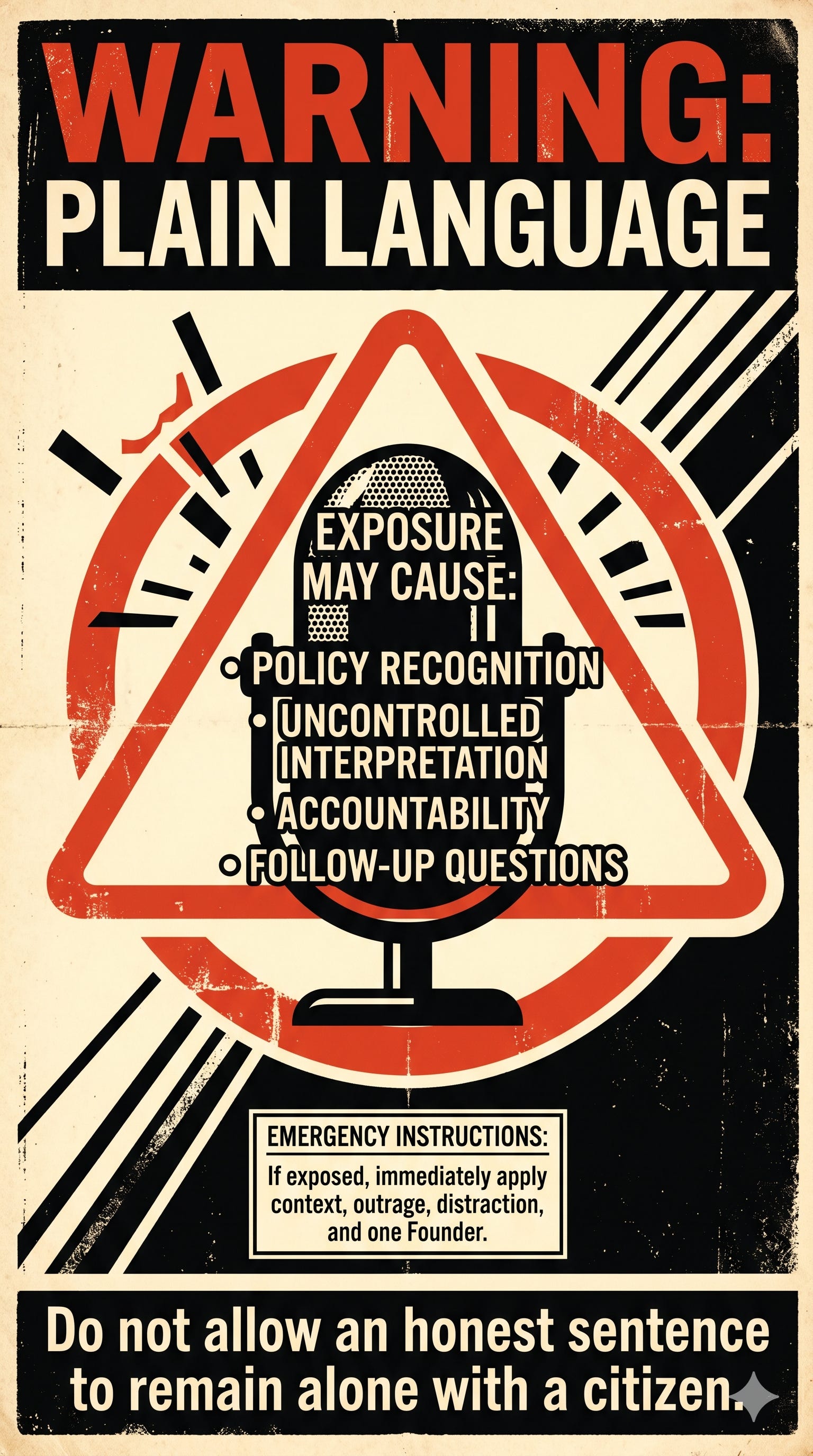
Do not allow an honest sentence to remain alone with a citizen.
Surround it immediately with denial, context, outrage, grievance, patriotism, confusion, and at least one Founder.
Most truths cannot survive that much professional assistance.
END OF DIRECTIVE
ATTACHMENT A
Emergency Founder Quotations, Context Removed
ATTACHMENT B
Approved Synonyms for “That Is Exactly What He Said”
ATTACHMENT C
How to Accuse a Video Recording of Partisan Bias
ATTACHMENT D
Merchandising Opportunities Following Successful Candor Normalization
Democracy Deprogramming Translation
The phrase
“That was taken out of context.”
The emotional payload
You are being manipulated by dishonest enemies who want you to misunderstand a decent person.
The hidden move
Shift the burden away from the speaker’s words and onto the critic, while implying that some unseen context reverses the meaning of what everyone just heard.
The reality check
Context can genuinely matter. Clips can be misleading, and quotations can be distorted. But “context” is not a magic eraser. The proper response is to provide the missing information and show how it changes the meaning.
The one-line response
“Show me the context that changes the sentence.”
The quiet part is not dangerous because it is shocking.
It is dangerous because it connects the noble packaging to the actual product.
That is why the response machinery moves so quickly.
The denial.
The reinterpretation.
The attack on the messenger.
The accusation of bad faith.
The sudden arrival of six Founders and a bald eagle carrying a dictionary.
The goal is not always to convince you that the statement was good.
Sometimes the goal is simply to exhaust your confidence that words can mean anything at all.
Because once every statement has an invisible alternative meaning, accountability becomes impossible.
The speaker did not say it.
And if he said it, he did not mean it.
And if he meant it, you misunderstood.
And if you understood correctly, the media forced him to say it.
And if none of that works, perhaps it was brave.
This is how candor gets converted into courage, liability into authenticity, and an accidental confession into a campaign slogan.
The machinery is absurd.
It is also effective.
So when the quiet part escapes, do not become hypnotized by the containment operation.
Listen to the sentence.
Look at the policy.
Follow the power.
And ask the one question the Slogan Factory cannot safely answer:
What if he meant exactly what he said?
Break the spell.