


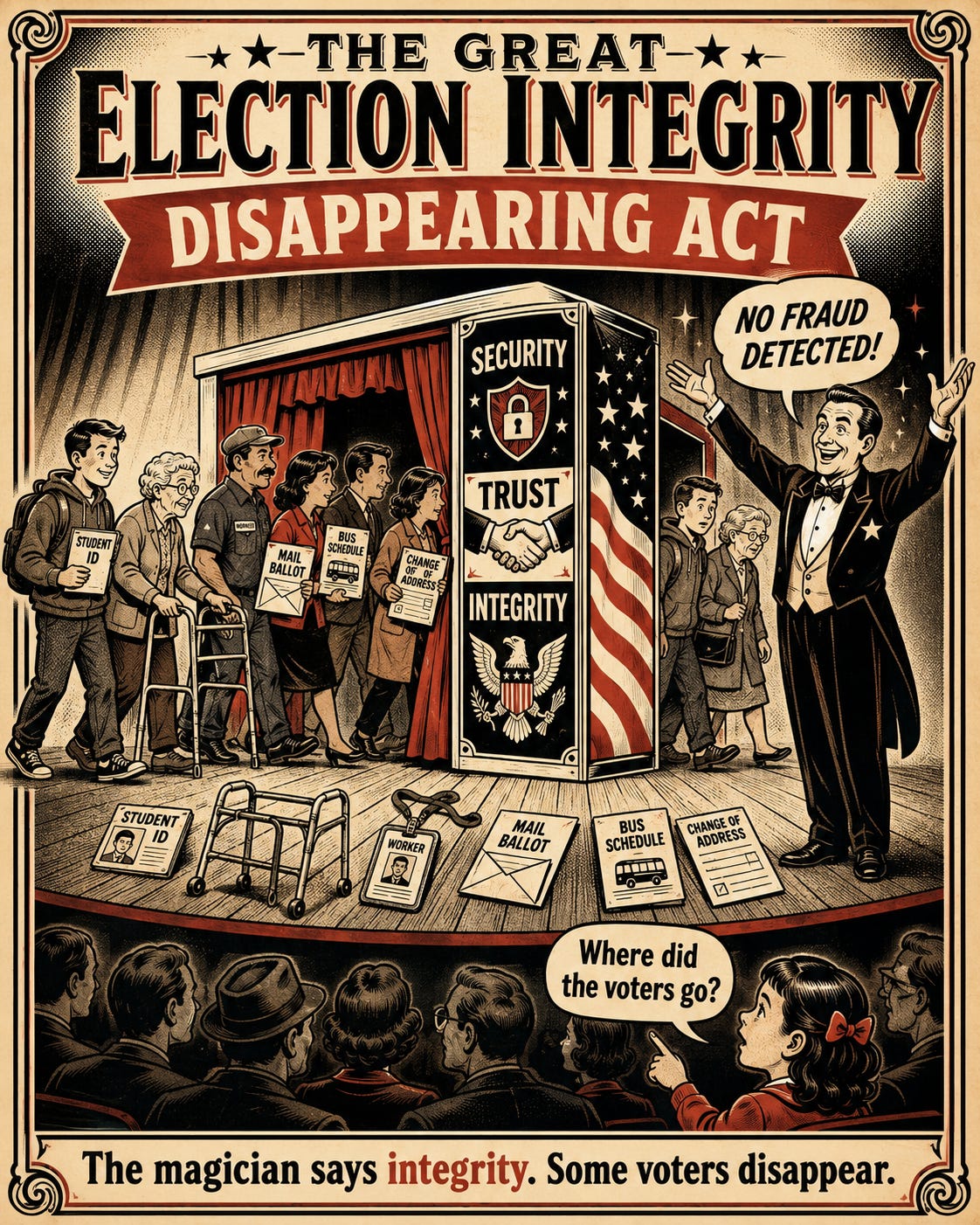
Election Integrity™: The Magic Phrase That Makes Voters Disappear
There are some phrases that walk into a room wearing a halo.
“Election integrity” is one of them.
Who could be against it?
You would have to be a villain, a fraudster, a raccoon in a trench coat, or the kind of person who thinks a smoke alarm is “anti-fire freedom.”
Of course, elections should have integrity.
They should be secure, accurate, auditable, transparent, lawful, fair, and accessible to all eligible voters. They should also be protected from intimidation, fraud, cyberattacks, administrative incompetence, insider manipulation, foreign interference, conspiracy sludge, and the guy on Facebook who watched one video about bamboo ballots and now thinks he has cracked the Davinci Code of county tabulation.
Election integrity is not the problem. The problem is what happens when a phrase that should mean every lawful vote counts gets repackaged to mean every inconvenient voter looks suspicious. That is where the magic trick begins.
Because in the normal world, integrity means the system works honestly. In the propaganda world, integrity often means the system has been made emotionally satisfying to the people who already distrust the outcome. That’s not the same thing.
One is a standard; the other is a sedative. And American politics has become very good at passing out sedatives in bottles labeled principle.
The word sounds clean. The machinery is not.
The genius of “election integrity” is that it arrives pre-approved by common sense. It feels like a civic hygiene product. Like flossing, but with precinct maps.
Nobody wants dirty elections. Nobody wants sloppy ballot handling, broken machines, cyber vulnerabilities, missing chain-of-custody procedures, or rules so confusing that voting starts to feel like assembling patio furniture from a Swedish store with one Allen wrench and a panic attack.
Genuine election integrity matters. Real election integrity means trained election officials, secure systems, accurate voter rolls, human-readable paper trails, risk-limiting audits, clear rules, transparent procedures, reliable equipment, accessible polling places, and a public that can trust the count without needing to understand every database field and ballot scanner firmware update before breakfast.
That is the honest version. But the phrase has been captured by a different operation.
In that operation, “integrity” is not a neutral standard applied to the whole system. It is a suspicion hose pointed mostly in one direction.
Some voters become “the people.” Other voters become “ballot harvesting.” Some neighborhoods represent democracy. Other neighborhoods represent “irregularities.” Some forms of participation are civic virtue. Other forms are “potential fraud.”
The trick is subtle until you see it. Then it becomes as subtle as a marching band falling down a staircase. The system does not start by proving that large numbers of unlawful votes are being cast. It starts by making certain voters feel like a risk category: Young voters. Urban voters. College voters. Naturalized citizens. Poor voters. Voters without flexible work schedules. Voters who move frequently. Voters who use mail ballots because they are elderly, disabled, deployed, caregiving, working two jobs, or simply living in the century where we can order a couch from our phone but somehow voting must still feel like a frontier hardship reenactment.
The word “integrity” creates the fragrance. The policy decides who gets sprayed.
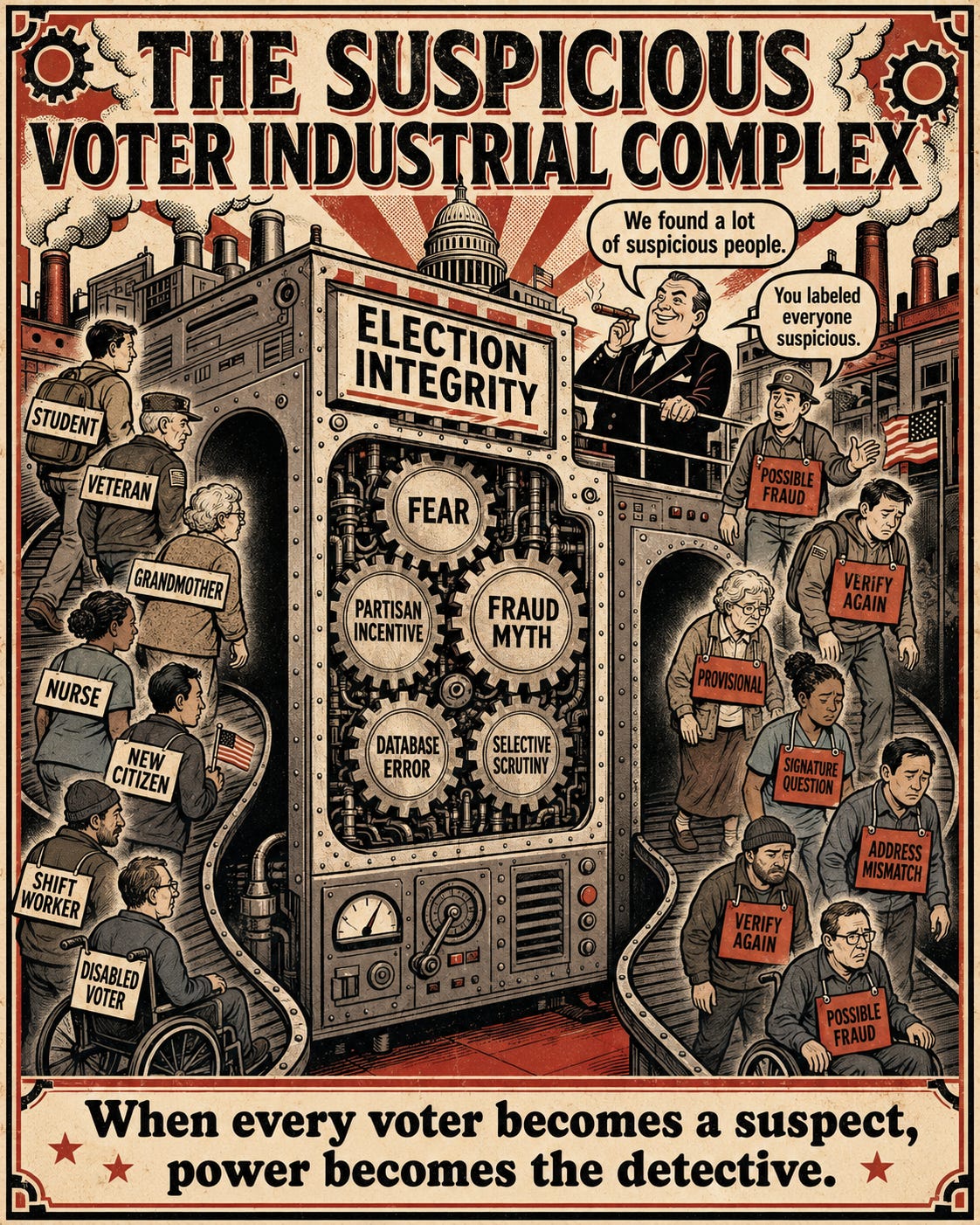
The suspicious voter industrial complex
One of the great accomplishments of modern propaganda is turning the voter from the central figure in democracy into a suspicious package left unattended near power.
In a healthy civic culture, the eligible voter is the customer, the stakeholder, the author, the principal, the person on whose consent the whole system claims to rest. In the suspicion machine, the voter becomes an intruder trying to sneak into the country club of self-government.
Please present identification.
Please prove residence.
Please prove citizenship.
Please prove signature consistency.
Please prove your name did not change.
Please prove the database did not hiccup.
Please prove your envelope was shaped correctly.
Please prove your ballot arrived at the correct minute.
Please prove your grandmother’s handwriting is still as vigorous as it was during the Carter administration.
Please prove you are not the imaginary criminal we invented during a fundraising email.
Some verification is legitimate. Of course it is. A democracy needs rules. It also needs eligibility standards, deadlines, and reliable administration. Democracy also needs procedures that make fraud difficult, errors correctable, and outcomes verifiable.
But a healthy democracy also needs a basic moral orientation toward the citizen.
The question cannot be:
How many obstacles can we place between eligible people and power while still calling the system free?
The question has to be:
How do we protect elections while helping every eligible voter cast a ballot that counts?
That’s the difference between election integrity and election anxiety management. One protects the vote, the other protects power from voters.
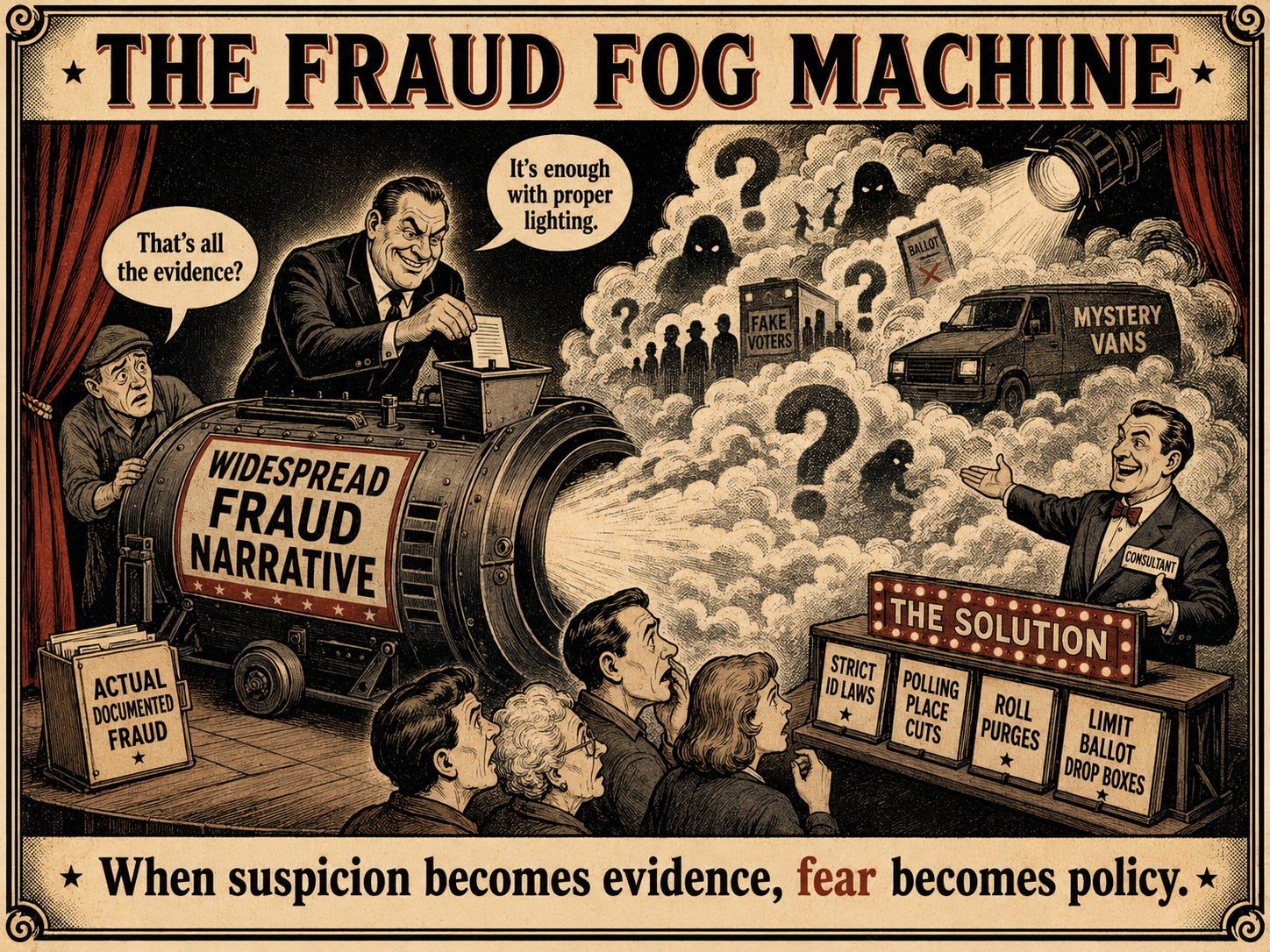
Fraud as a fog machine
Fraud exists. People occasionally do dumb, illegal things because human beings are nature’s unreliable beta test. There should be safeguards and investigations. There should be prosecutions when real crimes occur. But the myth of mass voter fraud is often used like a theatrical fog machine. A tiny amount of actual smoke, a lot of lighting, and suddenly the audience thinks the whole stage is on fire.
This is where the emotional engineering matters. You do not need to prove widespread fraud if you can make people feel as if widespread fraud is always about to be discovered. You don’t need evidence big enough to justify the remedy if you can make suspicion feel like evidence.
You don’t need to show that the house is full of burglars if you can keep shouting that the locks are weak, the shadows are moving, and your neighbor’s cousin saw something weird near the mailbox. At a certain point, fear stops being a warning system and becomes a business model. And once enough people have been trained to believe that fraud is everywhere, nearly any restriction can be sold as modest. The more imaginary the threat, the more theatrical the solution has to become.
That is how you end up with policies that treat voting less like a constitutional right and more like airport security run by a homeowners’ association.
Take off your shoes. Empty your pockets. Explain your address. Remove your belt.
Now prove you are not part of a secret coordinated plot involving nursing homes, ballot envelopes, and the ghost of Hugo Chávez.
Welcome to democracy. Please enjoy your provisional ballot.
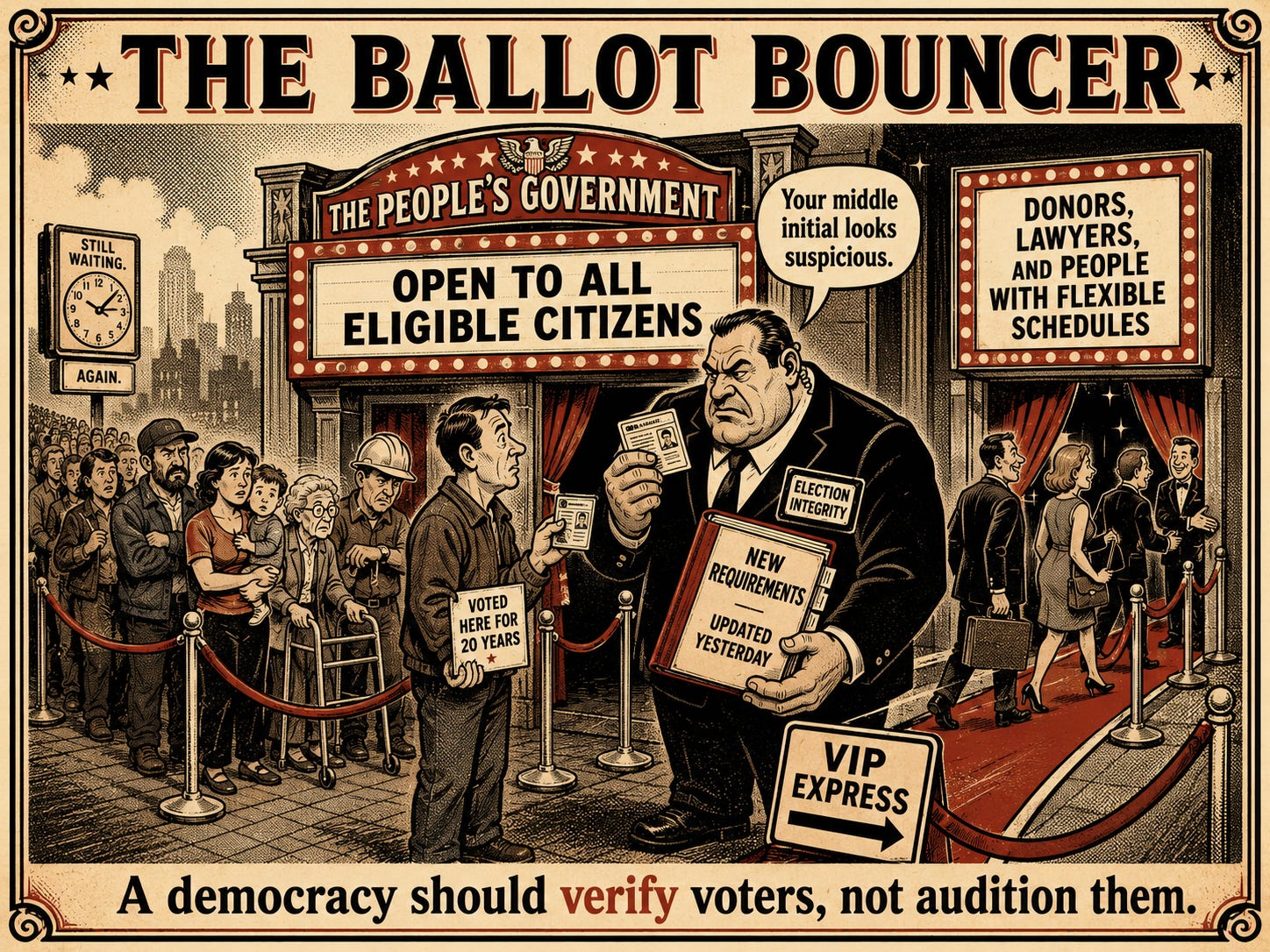
The Ballot Bouncer
A useful way to understand the “election integrity” rebrand is to imagine democracy as a nightclub.
Outside the door is a giant sign:
THE PEOPLE’S GOVERNMENT
Below that:
OPEN TO ALL ELIGIBLE CITIZENS
Then you reach the entrance and meet the Ballot Bouncer. The Ballot Bouncer wears a tiny earpiece, an enormous suit, and the facial expression of someone who has confused minor administrative discretion with a divine calling.
He looks at your ID. Then at you. Then at your ID again. Then at a laminated sheet of new rules passed last week. Then at your face like your cheekbones are attempting sedition.
“Sorry,” he says. “Your middle initial is missing.”
You explain that you have voted here for twenty years.
He nods, sadly, the way people nod before doing something unreasonable with confidence.
“Could be fraud.”
Behind you, the line grows.
Some people leave because they have work. Some leave because they need childcare. Some leave because the bus schedule is not in line with constitutional theory.
The Ballot Bouncer points proudly to the emptying line.
“Look,” he says. “No fraud.”
And that’s the scam in miniature.
A system can reduce fraud by reducing the number of voters, just as a restaurant can reduce food poisoning by refusing to serve food. Technically effective, philosophically deranged. Almost as derrangeed as thinking you can reduce the amount of recorded disease infections simply by reducing the number of tests you conduct to see who's infected.
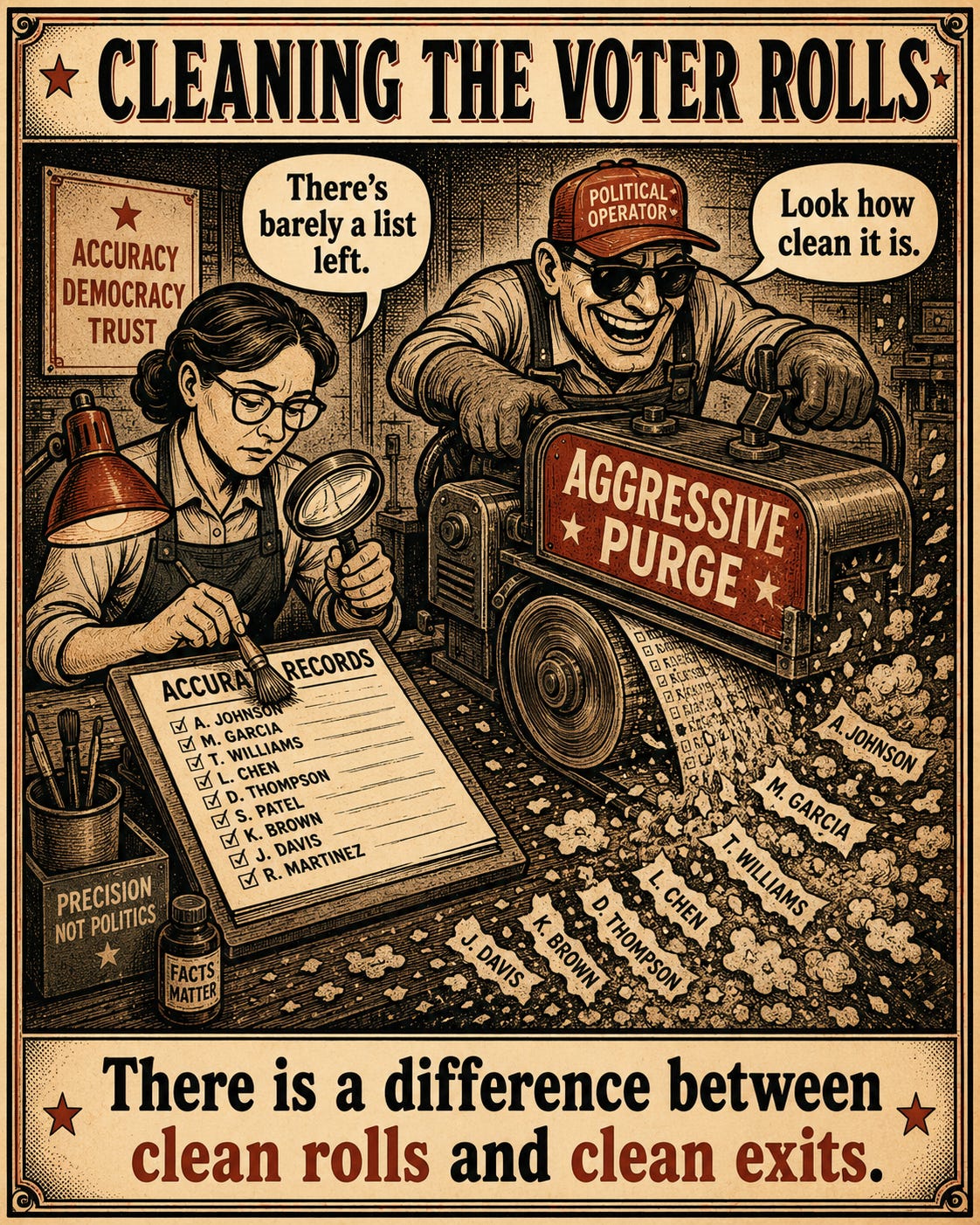
Clean rolls or clean exits?
Voter roll maintenance is another place where the word “integrity” does a lot of work.
Accurate voter rolls are important because people move, die, and become ineligible. Duplicate records happen. Administrative cleanup is real governance, the unglamorous plumbing of democracy. But there is a difference between maintaining clean rolls and creating clean exits.
One says: keep the list accurate so eligible voters can vote and ineligible records are removed through fair, careful procedures. The other says: purge aggressively, notify poorly, make corrections difficult, and then call the resulting confusion integrity.
That is not maintenance. That is civic exfoliation with a belt sander.
A voter roll is not just a database. It is the front door to democratic participation. Clean it, yes. Secure it, yes. Update it, sure, but do not set the door on fire and brag about reducing foot traffic.
The burden always lands somewhere
One of the laziest defenses of restrictive voting rules is the phrase: “It is not that hard.”
This is almost always spoken by someone for whom it is not that hard. That is the miracle of comfort. It mistakes itself for universal design.
It is not that hard to get the right ID, unless you are old, poor, disabled, young, recently moved, recently married, recently divorced, unhoused, rural, without reliable transportation, working hourly shifts, dealing with bureaucracy, caregiving, or trapped in the beautiful American scavenger hunt known as “finding the one document that proves the other document is real.”
It is not that hard to stand in line, unless the line is three hours long and your paycheck is allergic to civic virtue.
It is not that hard to vote on Election Day, unless Election Day is not a holiday, your employer is not flexible, your polling place changed, your childcare fell through, your car did what cars do when they sense moral importance, or the county decided that one voting site for half a civilization should be plenty.
It is not that hard to fix a rejected mail ballot, unless the notice comes late, the deadline is tight, the instructions are obscure, the office hours are ridiculous, and the whole process feels like being trapped in a customer-service maze designed by Franz Kafka’s least helpful nephew.
The burden is not evenly distributed, and that is the point.
A voting rule can look neutral on paper while landing like a piano on specific people in real life. And any conversation about election integrity that refuses to ask who bears the burden is not a conversation about integrity; it’s a product demo for selective friction.
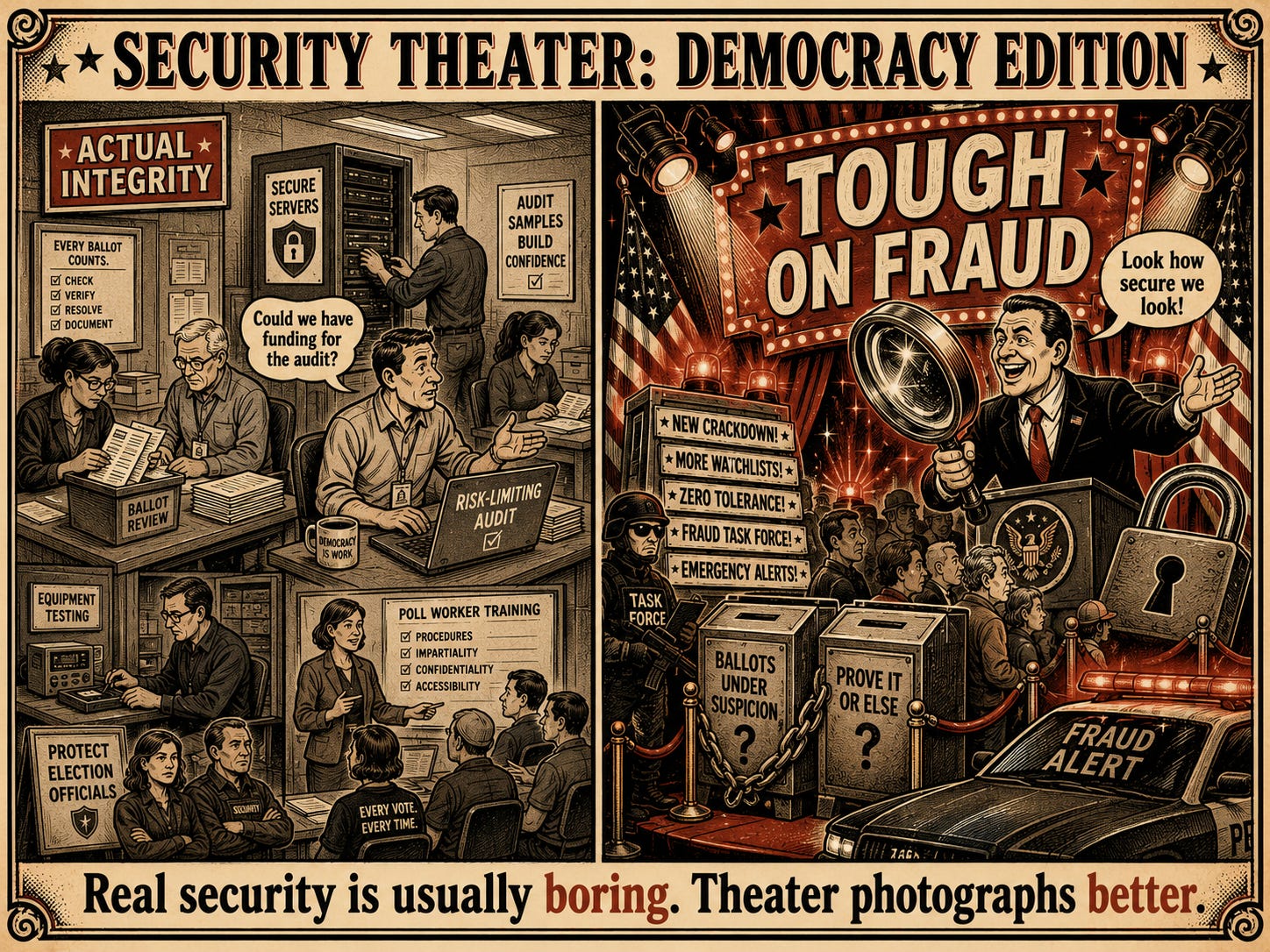
Security theater, democracy edition
After 9/11, America became familiar with security theater: visible rituals that make people feel safer even when the actual safety benefit is questionable, uneven, or mostly symbolic.
Election integrity has its own version. A rule may not solve a meaningful problem. It may not address the most serious vulnerabilities. It may not improve tabulation security, paper trails, audits, cyber defenses, poll worker training, election worker safety, or public confidence rooted in reality. But it looks tough.
And looking tough is politically useful because toughness photographs better than administrative competence. No one cuts a ribbon in front of a well-designed chain-of-custody protocol. No one chants at a rally for risk-limiting audits. Nobody puts “I’m With The County Clerk’s Backup Server” on a hat, although frankly, I might buy one.
The boring stuff is often the real stuff: paper ballots, audits, clear procedures, equipment testing, physical security, cybersecurity, professional election administration, public education, transparent canvassing, enough polling places, enough trained poll workers, enough time for voters to correct mistakes, enough protection for election officials so they are not chased out of public service by threats from people who learned civics from a comment thread.
That is election integrity. Not the performance of suspicion. Not the hunger to make voting feel harder because difficulty has been confused with seriousness. A locked door is not automatically a secure building. Sometimes it is just a locked door.
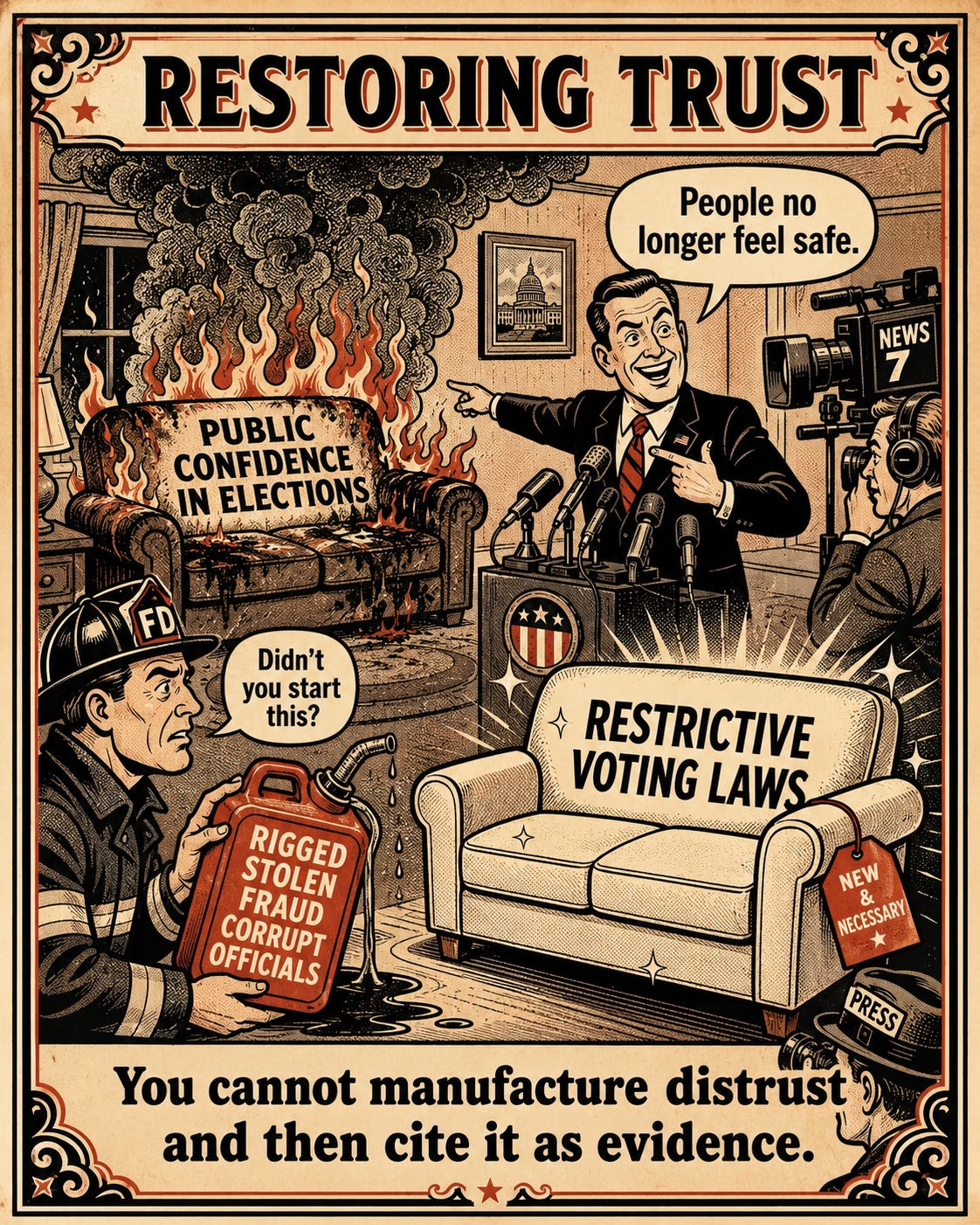
The two meanings of trust
Here is another subtle move. Election-integrity rhetoric often claims that restrictive laws are necessary to “restore trust.” That sounds reasonable until you ask a rude but useful question:
Restore trust in what?
There are two very different kinds of trust. The first is reality-based trust. It comes from evidence, transparent procedures, competent administration, credible audits, public education, and leaders who tell the truth even when they lose.
The second is appeasement trust. It comes from changing rules to satisfy people whose distrust was manufactured by lies.
That second kind is a trap because if leaders spend years telling their supporters that elections are rigged, corrupt, suspicious, stolen, invaded, manipulated, and controlled by shadowy enemies, they do not get to point at the resulting distrust as if it fell from the sky like weather.
That is like setting the couch on fire, then demanding a new couch because the room no longer feels safe.
And what’s worse is that appeasement trust never ends. If suspicion is politically useful, each concession becomes proof that more concessions are needed. Every new restriction validates the story that the old system must have been dangerous. Every reform passed to calm bad-faith panic becomes fuel for the next panic.
You cannot satisfy a conspiracy theory by feeding it policy. It will simply grow bigger teeth.
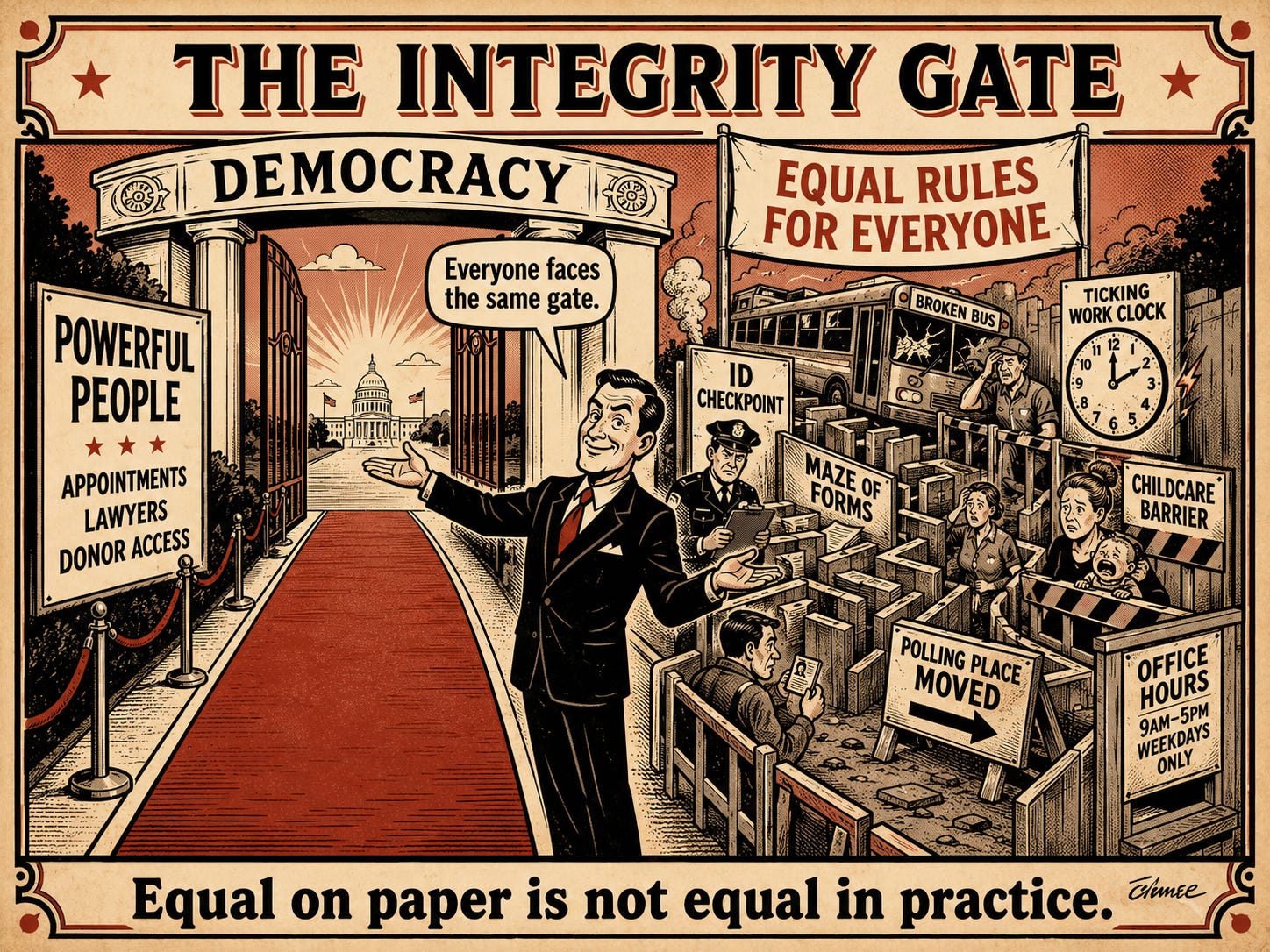
Equal suspicion is not equal justice
Some defenders of restrictive voting laws argue that the rules apply equally to everyone. This is the kind of statement that sounds tidy because it has been vacuum-sealed away from reality. A poll tax can be the same amount for everyone and still burden people differently. A literacy test can be formally universal and still function selectively. A single polling location can be equally available to everyone in theory, while being practically available only to those with cars, time, health, flexibility, and a life that does not collapse when bureaucracy sneezes.
Equality on paper is not the same as equal access.
A democracy is not judged only by whether the maze has one entrance. It is judged by whether eligible people can actually get through it. This is where the phrase “election integrity” does its most delicate work. It invites people to look at the rule’s stated purpose while ignoring its practical design.
But design reveals intent more reliably than slogans. If a rule claims to prevent fraud but mostly prevents eligible voters from voting, the rule has told you something. If a rule claims to increase confidence but is justified by claims that officials know are false, the rule has told you something. If a rule claims neutrality but consistently lands harder on the same communities whose participation threatens the party writing the rule, the rule has told you something.
Listen to the rule. Not just the press release.
The Deprogramming Translation
The phrase
“Election integrity.”
The emotional payload
The system is under threat. Fraud, chaos, illegal voting, or corrupt officials may be stealing power from the rightful people.
The hidden move
Shift attention from equal participation to suspicion, then make restrictions feel like common sense before anyone asks which eligible voters will be burdened.
The reality check
Real election integrity means secure elections and broad lawful access. A system is not more honest because fewer eligible voters can use it.
The one-line response
Integrity means every lawful vote counts, not that every inconvenient voter becomes a suspect.
The better test
The antidote is not to reject election integrity. The antidote is to define it correctly.
A real election-integrity test should ask:
Does this rule solve a demonstrated problem?
Is the problem serious enough to justify the burden?
Who bears that burden?
Does the rule make lawful voting harder?
Does it include safeguards so that eligible voters are not wrongly excluded?
Does it improve accuracy, security, transparency, or auditability?
Does it protect voters from intimidation and officials from threats?
Does it apply consistently, even when the other side benefits?
Does it expand reality-based trust, or merely appease people who were told not to trust the system?
Does it protect democracy, or protect a faction from democracy?
That last question is the one that the slogan cannot survive. Because “election integrity” should be measured by the integrity of the whole system, not by the satisfaction level of the people most offended by an unfavorable outcome. The goal is not a system where everyone’s preferred side always wins. The goal is a system where losing does not require inventing a crime scene.
Every lawful vote
Here is the simple version. Election integrity is not the enemy of voting rights. Election integrity requires voting rights.
A ballot cannot be secure if an eligible citizen is wrongly prevented from casting it. A roll cannot be clean if qualified voters are casually removed from it. A process cannot be trusted if officials lie about fraud to justify rules that help them win.
A democracy cannot be healthy if participation is treated as contamination. The integrity of an election is not found only in the lock on the ballot box. It’s found in whether the rightful voter can reach the box. It’s found in whether the ballot can be verified. It’s found in whether officials count the votes honestly. It’s found in whether losers accept lawful defeat. It’s found in whether power changes hands without someone trying to turn disappointment into an emergency doctrine.
The ballot box and the doorway both matter. Security without access is exclusion. Access without security is a vulnerability. Integrity means building a system strong enough to protect both.
The magic phrase
So the next time someone invokes “election integrity,” do not surrender the phrase. Do not let it float above the conversation like a holy drone. Bring it back to earth:
Ask what problem is being solved?
Ask where the evidence is?
Ask who is burdened?
Ask why the proposed solution so often seems to make voting harder for the people one side would rather not hear from?
Ask whether the same people demanding integrity are also supporting paper ballots, audits, election-worker protection, transparent administration, enough polling places, accessible voting, and honest public communication?
Ask whether integrity means counting every lawful vote or manufacturing new reasons to doubt the voters?
Because sometimes a phrase is not a principle.
Sometimes it is a magic trick.
The magician says integrity. The smoke rises. The spotlight moves. The crowd gasps. And when the curtain lifts, some voters have disappeared.
Break the spell.
The Receipts:
Real election integrity includes both secure systems and lawful access. CISA describes its election-security work as protecting the physical security and cybersecurity of the systems and assets that support U.S. elections. The National Academies’ Securing the Vote report recommended human-readable paper ballots as a core safeguard for election security and verifiability.
Source: https://www.cisa.gov/topics/election-security
Source: https://www.nationalacademies.org/news/securing-the-vote-new-report
Voter ID requirements vary widely by state. NCSL reports that 36 states have laws requesting or requiring voters to show some form of ID at the polls, while the remaining states and Washington, D.C. use other methods, often checking information such as a signature against records on file. NCSL also describes provisional ballots as a fail-safe mechanism for voters whose eligibility is uncertain, helping prevent administrative uncertainty from becoming exclusion.
Source: https://www.ncsl.org/elections-and-campaigns/voter-id
Source: https://www.ncsl.org/elections-and-campaigns/provisional-ballots
A useful neutral framing is that electoral integrity and voter participation should be protected together: the National Academy of Public Administration describes the challenge as ensuring that everyone with a legal right to vote can do so while protecting election infrastructure and information systems. MIT Election Lab summarizes the voter ID debate cleanly: supporters argue stricter ID deters fraud and increases confidence, while opponents argue fraud is rare and the practical effect is to raise voting barriers, especially for lower-income citizens.
Source: https://napawash.org/grand-challenges/protect-electoral-integrity-and-enhance-voter-participation
Source: https://electionlab.mit.edu/research/voter-identification