

The Republic Is Not a Democracy Escape Hatch
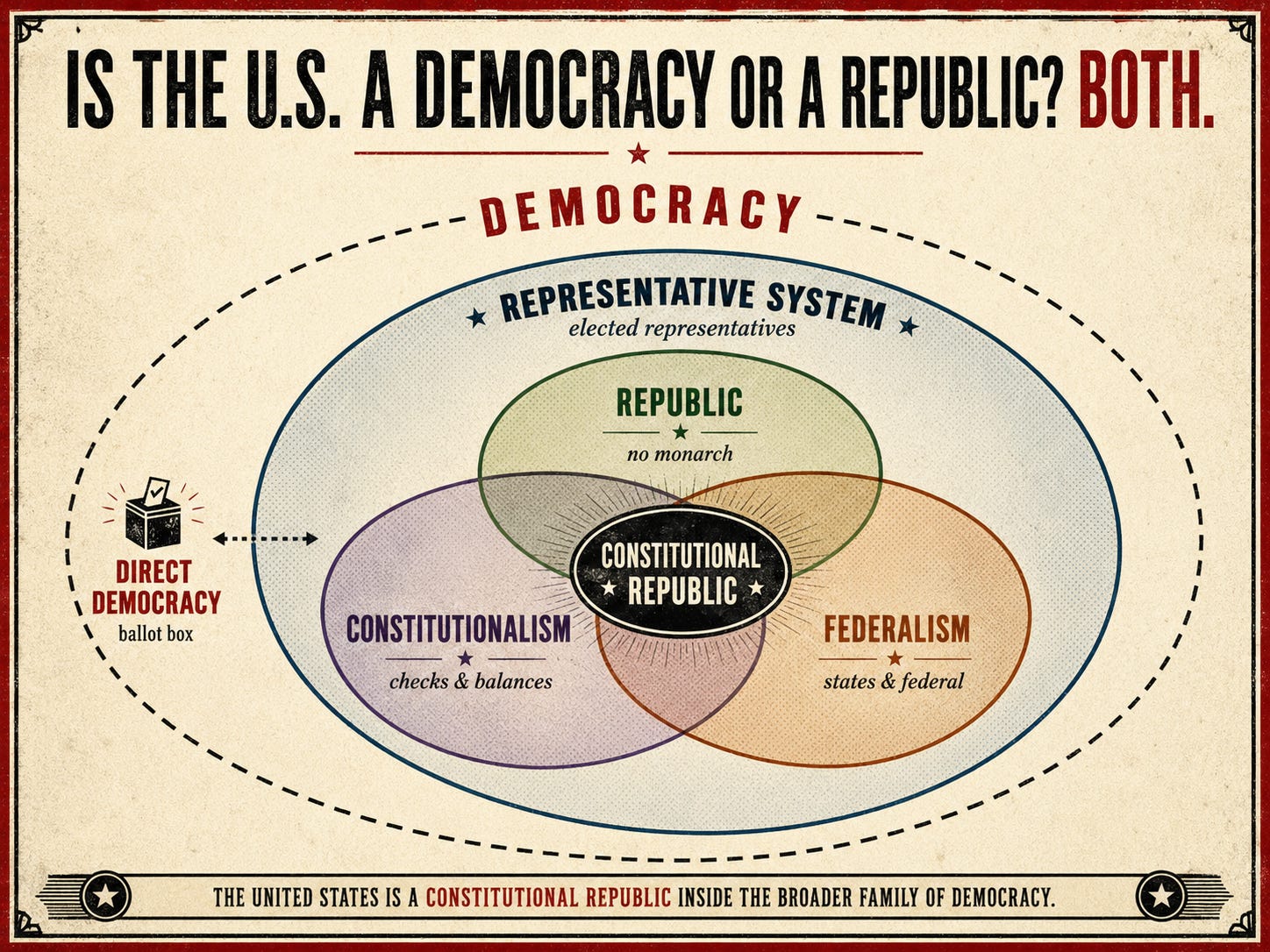
America is a constitutional republic and a representative democracy. The people pretending those words are enemies are usually selling something.

“We’re Not a Democracy, We’re a Republic”: The Dumbest Smart-Sounding Argument in Politics
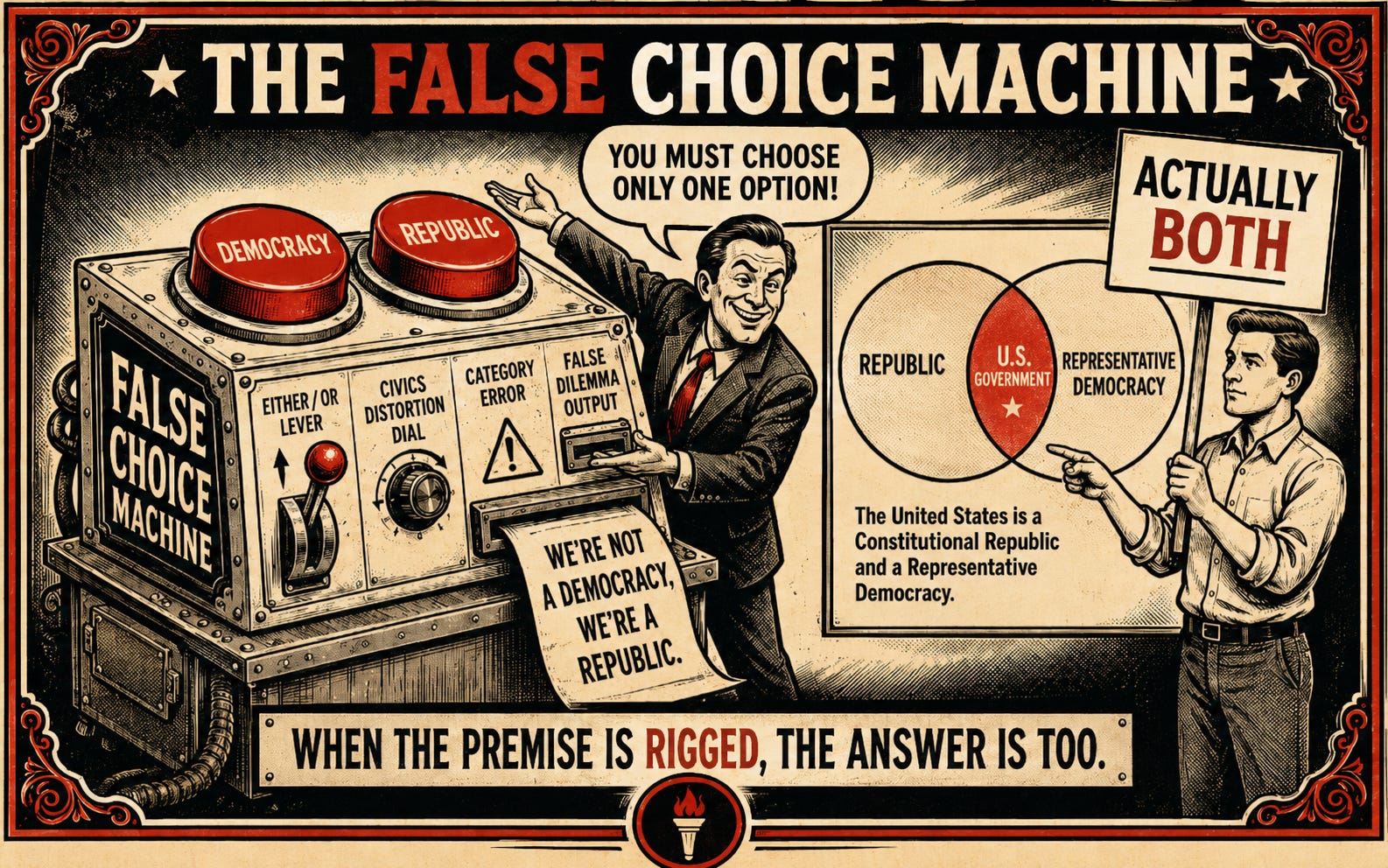
There are certain phrases in American politics that function less like arguments and more like little ceremonial hats people put on before saying something ridiculous.
“We’re not a democracy, we’re a republic” is one of them.
You have heard it before. Maybe from a cable-news guest with the facial expression of a man protecting a museum from teenagers. Maybe from a social media patriot whose profile picture is either an eagle, a truck, or a founding father rendered with the emotional subtlety of gym merch. Maybe from a local Facebook constitutional scholar who has done extensive research in the comment section of a meme.
The phrase always arrives with a certain posture. A little chin lift. A little courtroom pause. A little “I have just ended this debate by invoking parchment.”
Someone says, “We need to protect democracy,” and then, from the mist, comes the correction:
Actually, we’re not a democracy.
We’re a republic.
Checkmate, citizens.
And for a moment, if you are not careful, it can sound smart. It has that crisp, laminated quality of a fact learned in eighth-grade civics and then stored for decades in the same mental drawer as “mitochondria is the powerhouse of the cell.” It sounds constitutional. It sounds precise. It sounds like the speaker has access to the secret menu of the government.
But most of the time, it is not a correction. It is a trick.
Not always. Words matter, and there are real distinctions between direct democracy, representative democracy, republican government, constitutional government, federalism, and liberal democracy. Those distinctions are worth understanding because precision is useful when people are acting in good faith and a flamethrower when they are not.
But the popular use of “we’re a republic, not a democracy” is usually not an attempt to teach precision. It is an attempt to make the word democracy sound illegitimate.
That is the tell.
If someone says, “The United States is not a pure direct democracy; it is a constitutional republic with representative democratic features,” congratulations, you have found a person trying to be accurate, or at least a person who has spent enough time near footnotes to deserve hydration.
But if someone says, “We’re not a democracy, we’re a republic,” and then uses that line to dismiss voting rights, majority rule, public accountability, democratic norms, or the idea that government should reflect the consent of the governed, you are no longer in a civics discussion.
You are in a branding exercise.
And the product being rebranded is usually a minority rule.
The trick is not the word “republic.” The trick is the word “not.”
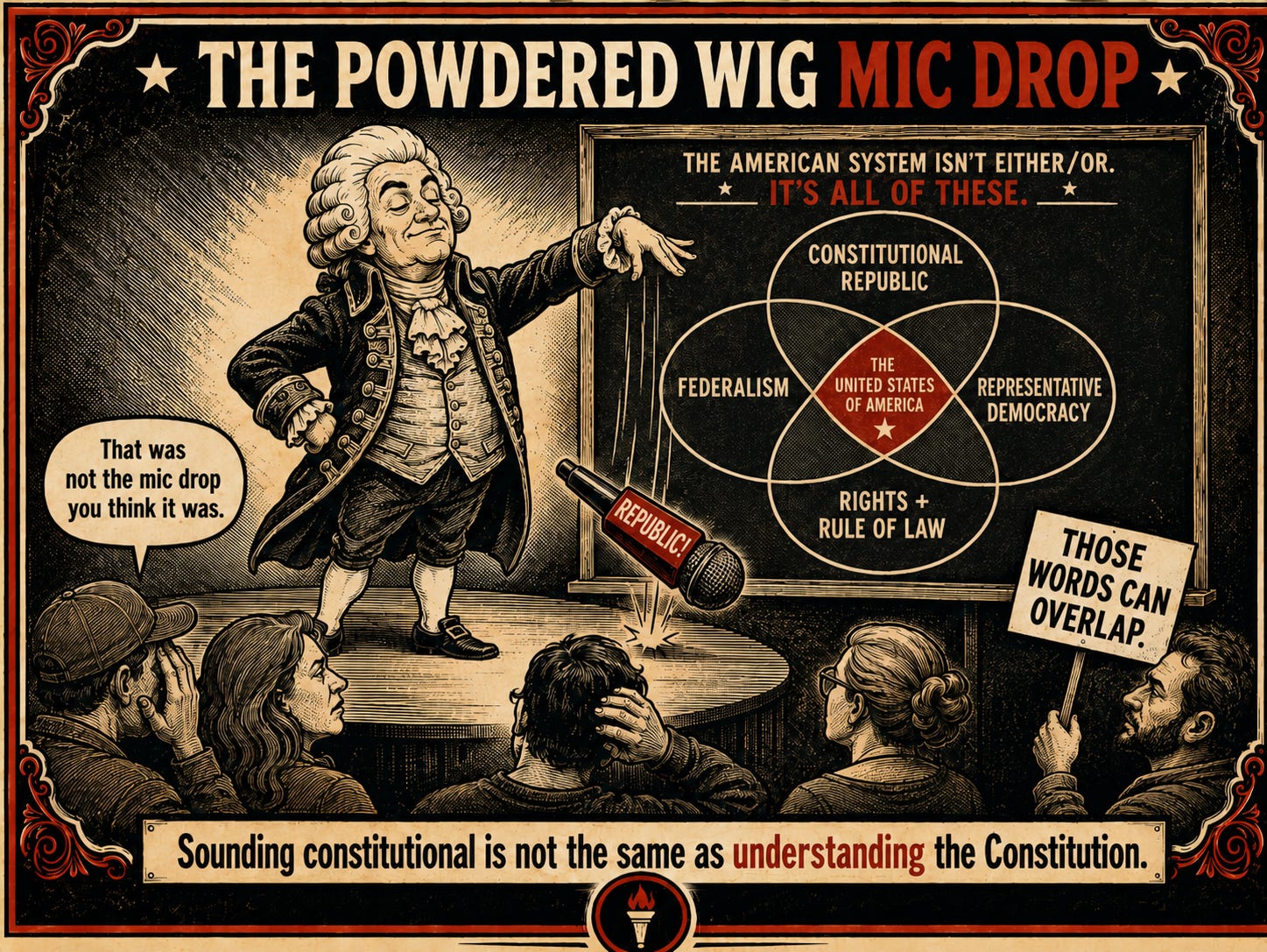
Let’s start with the actual civics, because apparently, democracy now requires a warranty label.
A republic is a system in which public power is not owned by a monarch, dynasty, or private ruler. In the American constitutional tradition, it generally means government through representatives, laws, institutions, and public accountability, rather than direct personal rule by a single sovereign.
Democracy, broadly, means rule by the people. In modern large nations, that usually means representative democracy, in which citizens elect representatives to govern on their behalf.
These concepts are not enemies. They overlap.
The United States is a constitutional republic. It is also a representative democracy. It is also a federal system. It is also, at least in aspiration and design, a liberal democracy, meaning majority rule is supposed to operate within a framework of individual rights, constitutional limits, independent institutions, and the rule of law.
This is not complicated unless someone is paid, spiritually or financially, to make it complicated.
A taco can be dinner and Mexican food. A golden retriever can be a dog and a mammal. A Taylor Swift song can be pop music and a public infrastructure project for emotional processing. Categories can overlap. This is not advanced theory. This is how nouns work.
Yet the “republic, not democracy” routine pretends that “republic” and “democracy” sit on opposite sides of a steel cage match, where only one may survive, and the loser has to be escorted from the Constitution by security.
That is the trick.
Not “we are a republic.”
That part is true.
The trick is “not a democracy.”
That little “not” is where the smoke machine lives.
Why the phrase feels smart
The phrase works because it flatters the speaker and unsettles the listener.
It tells the speaker: you know the hidden truth. You are not like these naïve democracy people with their yard signs and their dangerous faith in counting votes. You have discovered the constitutional backstage area, where the adults keep the republic and probably a tasteful decanter.
It tells the listener: maybe you have been using the wrong word. Maybe all this talk about democracy is sloppy. Maybe democracy is not really the thing we are supposed to defend. Maybe the people saying “save democracy” are either confused or trying to smuggle in something radical.
That is a very useful psychological move. It takes a word with broad moral legitimacy, democracy, and makes it seem unsophisticated, foreign, unstable, or even anti-American.
Then it replaces that word with “republic,” which sounds older, sturdier, more architectural, more Founders-approved, more likely to smell faintly of leather-bound books and institutional veto points.
This is not accidental. This is framing.
Good framing does not merely describe reality. It prepares the emotional room in which reality will be judged. Say “democracy,” and many people think of elections, consent, voting, representation, and public voice. Say “republic,” and many people think of Rome, restraint, order, laws, and powdered wigs doing difficult work under candlelight.
Say “not a democracy,” and now the whole conversation has moved.
You are no longer debating whether the public should have more or less power. You are debating whether the public was ever supposed to have power in the first place.
Very tidy.
Very dangerous.
The phrase is a false choice dressed as a civics lesson
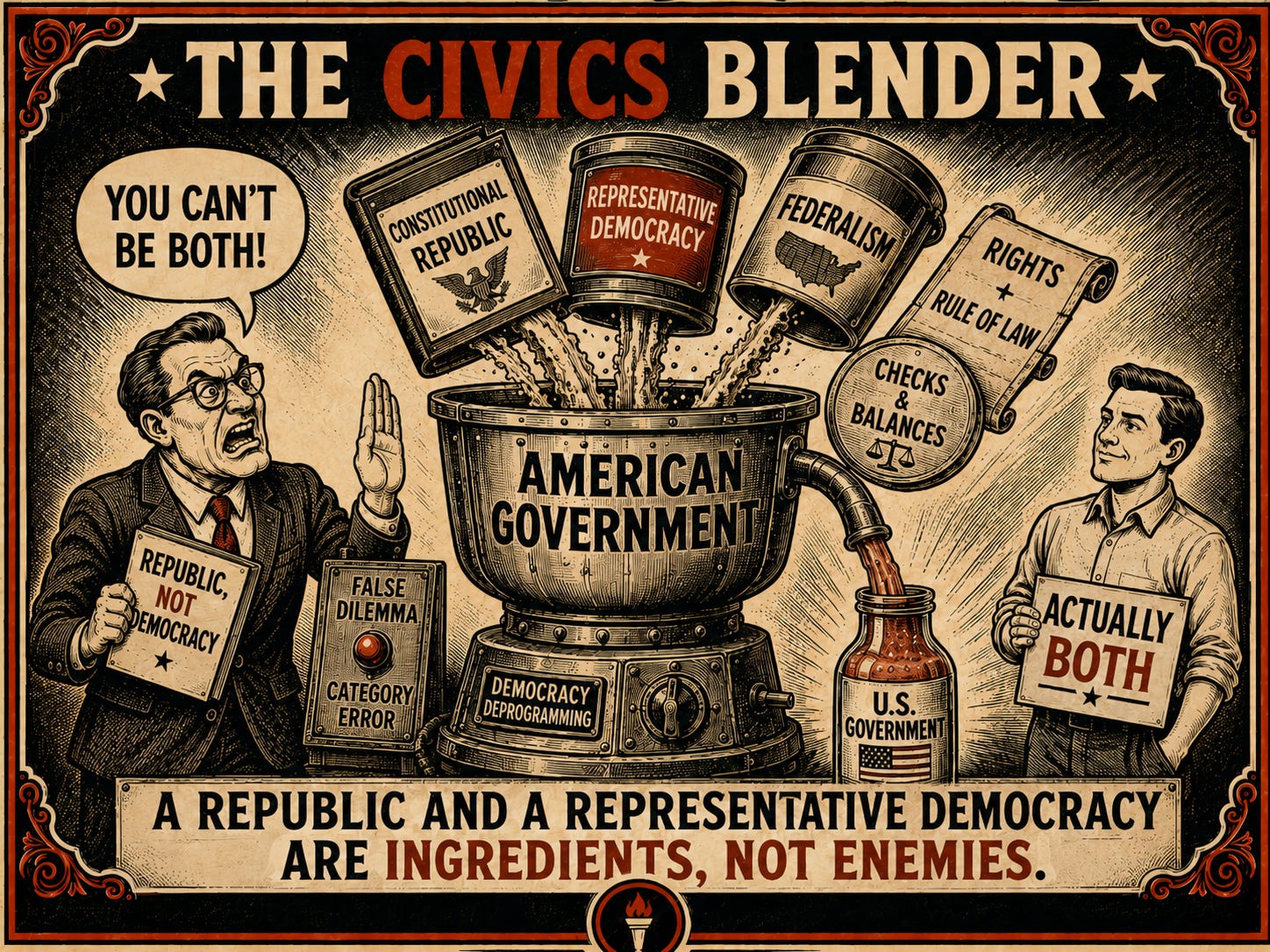
The central fallacy is a false dilemma.
Either a democracy or a republic.
Pick one.
But that is like saying, “We’re not a hospital, we’re a building,” then acting like you just solved medicine.
A republic describes one dimension of the system. Democracy describes another. Constitutionalism describes another. Federalism describes another. Liberal rights describe another. Representation describes another.
The American system is a layered cake of governing principles, baked by brilliant, flawed men who feared concentrated power, distrusted pure democracy, protected slavery, argued constantly, compromised unevenly, and left us both a framework for self-government and several unpaid invoices from history.
So yes, the word “republic” matters.
But using it as a weapon against democracy is like pulling one instrument out of an orchestra, holding up a trombone, and declaring music defeated.
There are people who hear “democracy” and immediately imagine fifty-one percent of the public voting to steal someone’s sandwich. That is not a serious theory of democratic government. That is a lunch crime with a straw-man problem.
A constitutional democracy does not mean the majority can do whatever it wants. It means the people are the source of political legitimacy, elected leaders are accountable to voters, majorities can govern through fair processes, and individual rights are protected against abuse.
That balance is not a contradiction.
It is the whole point.
The Founders were not writing bumper stickers for your uncle’s Facebook page
The people who use “republic, not democracy” as a mic drop often believe they are channeling the Founders. Sometimes they quote Madison. Sometimes they wave vaguely toward Federalist No. 10 like a person gesturing at a library from across the street.
Madison did distinguish between a pure democracy and a republic. In Federalist No. 10, he worried about factions and argued that a large republic, operating through representation, could better control the effects of faction than a small direct democracy. That matters, and it is worth reading instead of just borrowing the part that fits on a mug.
But Madison was not writing a LinkedIn endorsement for minority rule.
He was trying to solve the problem of faction, which he understood could come from majorities or minorities. A faction, in Madison’s argument, is a group united by passion or interest adverse to the rights of others or to the permanent and aggregate interests of the community. That definition does not magically become harmless when the faction has fewer people and better lawyers.
A majority faction can be dangerous.
So can a minority faction.
A faction of wealthy donors can be dangerous. A faction of ideological judges can be dangerous. A faction of state legislators drawing maps to keep power after losing voters can be dangerous. A faction of media figures turning civic ignorance into a revenue model can be dangerous. A faction that captures institutions and then calls the public a mob can be very dangerous indeed, especially if it has discovered the soothing powers of constitutional vocabulary.
Madison’s actual worry was not “too many citizens participating.”
It was a power serving narrow interests against the rights of others and the public good.
That distinction matters because modern anti-democratic rhetoric loves to treat majority power as the only tyranny worth fearing, while minority power floats through the conversation wearing a little halo and a donor badge.
The Constitution guarantees a republican form of government. It does not declare democracy a swear word.
Article IV, Section 4 of the Constitution provides that the United States shall guarantee to every state a republican form of government. Fine. That is real. It is in the text. Nobody needs to hide under the desk.
But the existence of a republican guarantee does not erase democratic principles from American government. We elect representatives. We vote for executives. We amend constitutions. We hold public officials accountable through elections. We argue over who gets access to the ballot because everyone understands, even when pretending otherwise, that the ballot is power.
The official civics materials used by the U.S. government call the United States a representative democracy, a republic, and a constitution-based federal republic. These are not mutually exclusive descriptions. They are different lenses on the same system, which is apparently a difficult concept for people who can simultaneously describe themselves as “constitutional conservatives,” “parents,” “taxpayers,” “patriots,” “small business owners,” and “alpha males” without collapsing from categorical overload.
The question is not whether America is a republic.
It is.
The question is why some people need that fact to mean America is not a democracy.
What political work is that little negation doing?
Who benefits when citizens are trained to flinch at the word democracy?
Who benefits when majority rule is treated as vulgar, but minority vetoes are treated as wisdom?
Who benefits when public power is rhetorically downgraded into public danger?
That is where the argument gets interesting.
And by interesting, I mean suspicious as hell.
This is not about precision. It is about permission.
The phrase “we’re not a democracy, we’re a republic” often functions as a permission slip.
Permission to treat voting access as optional.
Permission to treat the majority's preferences as dangerous.
Permission to treat public accountability as mob pressure.
Permission to treat institutions insulated from voters as inherently wiser, even when those institutions are captured, corrupted, or operating with the democratic legitimacy of a locked country club.
When someone uses “republic” to mean representative government, constitutional limits, and protection of rights, great. Welcome to the conversation. Please take a pamphlet and a normal-sized cookie.
When someone uses “republic” to mean “the public should matter less,” that is not civics.
That is a velvet rope around power.
It is the difference between saying, “We need rules so democracy does not become tyranny,” and saying, “We need rules so democracy does not become democracy.”
One is constitutionalism.
The other is minority rule asking if it can crash on your couch until the courts are sorted out.
The marketing genius of the phrase
What makes this slogan so sticky is that it takes a complex system and turns it into a status marker.
People repeat it not only because they believe it, but because it lets them perform knowledge.
It is the political equivalent of correcting someone’s pronunciation of “bruschetta” while setting the kitchen on fire. Maybe you are technically right about the “k.” Congratulations. The cabinets are burning.
This is the dark art of bad political marketing: find a phrase that feels like hidden knowledge, attach it to a grievance, repeat it until it becomes a reflex, then deploy it whenever democratic accountability gets too close to the furniture.
As a former marketing guy, I have a special contempt for this kind of thing because I know what persuasion can do when it is used responsibly. Good messaging can clarify. It can organize attention. It can make true things easier to understand, good ideas easier to share, and complicated choices easier to navigate.
But when professional persuasion is used to make people misunderstand the system that protects their own freedom, that is not clever branding. It is civic vandalism with a media plan.
It is the difference between a map and a funhouse mirror.
A map helps people get somewhere.
A funhouse mirror makes them laugh while it distorts their face.
Political propaganda loves the funhouse mirror because once people are trained to distrust their own reflection, you can sell them almost anything: less representation as stability, fewer voting rights as integrity, concentrated executive power as efficiency, institutional capture as restoration, minority rule as republican virtue.
And if the packaging is nice enough, some people will thank you for shrinking the room.
The “republic” costume
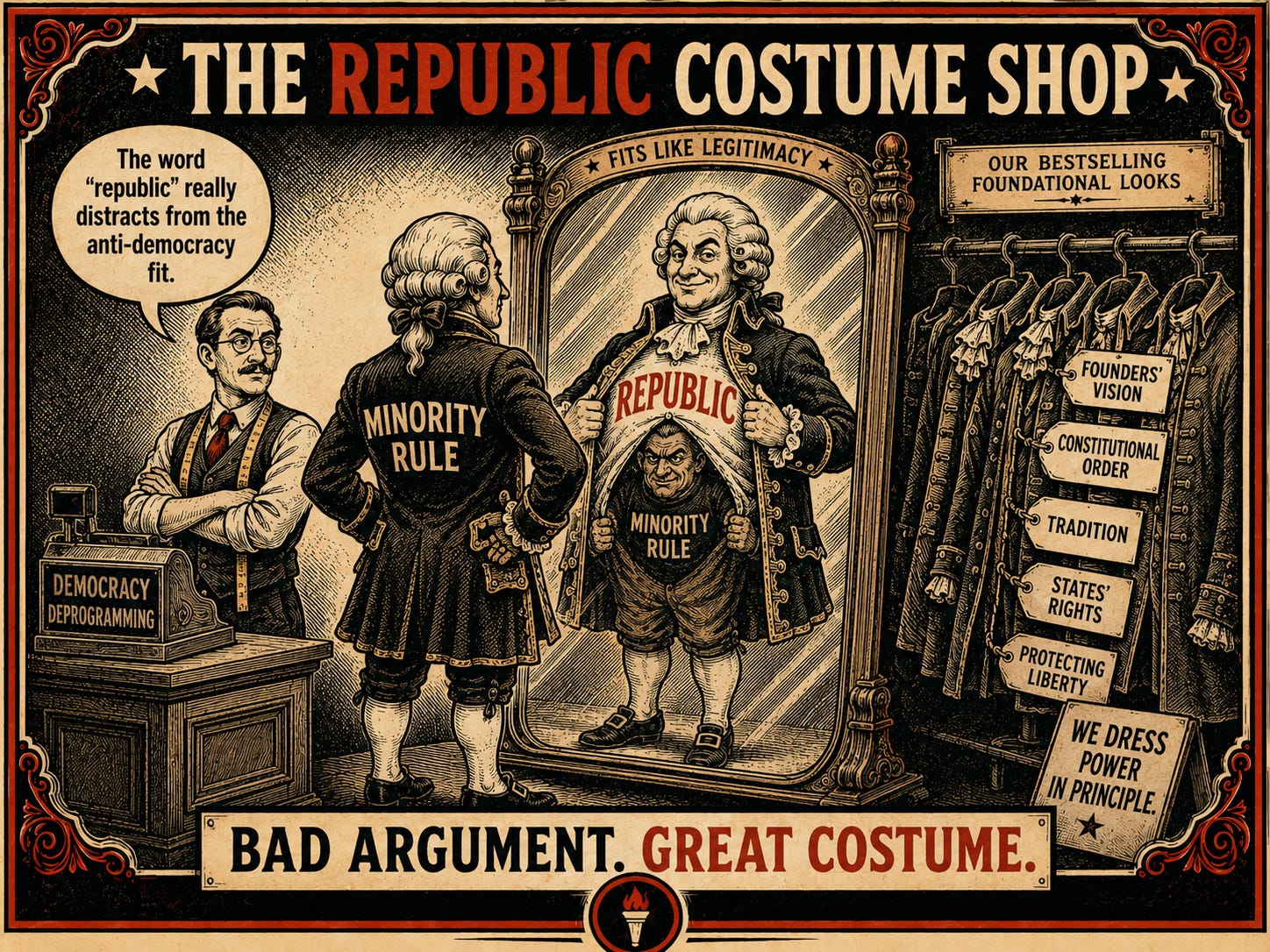
Minority rule rarely introduces itself honestly. That would be rude and also terrible for conversions.
Nobody opens a campaign rally by saying, “Friends, we are here tonight to ensure that our faction can govern even when most people reject us.”
No, the idea needs a costume.
So minority rule walks into the costume shop and tries on “republic.”
Looks respectable.
Then it tries “constitutional order.”
Very slimming.
Then “Founders’ vision.”
Pairs well with a selective history.
Then “states’ rights,” “tradition,” “freedom,” “election integrity,” “judicial restraint,” and “protecting liberty from the mob.”
By the time it leaves the shop, the original product is almost unrecognizable, except for the little tag still hanging off the sleeve that says: fewer people, more power.
This is why ridicule matters. Not cheap ridicule. Not lazy ridicule. The kind of ridicule that restores proportion.
Because propaganda survives by borrowing dignity. It wants to stand at the podium in a dark suit, speak slowly, invoke history, and make the absurd sound inevitable.
Sometimes the necessary response is not another twenty-page white paper.
Sometimes the necessary response is: nice costume, Count Voteless.
The word democracy is being targeted for a reason
If democracy were meaningless, nobody would work so hard to launder it out of public language.
The attack on the word democracy is not random. It is part of a larger effort to make democratic claims sound naïve or radical while making anti-democratic constraints sound mature and constitutional.
That does not mean every person who says “republic, not democracy” is an authoritarian mastermind. Many are just repeating a phrase they have heard from people who sounded confident, and confidence is basically cologne for bad arguments.
But phrases matter because repetition builds reflex. If enough people repeat that America is not a democracy, they become more open to the idea that democratic erosion is not really erosion. Maybe it is restoration. Maybe it is correction. Maybe it is finally putting the “republic” back where democracy got too loud.
That is how programming works.
Not usually through one giant lie that demands full belief all at once, but through hundreds of little frames that teach people what to fear, what to dismiss, what to revere, and what to stop questioning.
Democracy becomes mob rule.
Public accountability becomes harassment.
Voting rights become suspicious.
Independent institutions become enemies.
Pluralism becomes a weakness.
Civil servants become conspirators.
The press becomes the opposition.
The courts are sacred until they say no.
The people are sovereign until the wrong ones show up.
At that point, “we’re a republic, not a democracy” is not a civics correction. It is a gateway drug to democratic contempt.
The actual correction
So what should you say when someone drops the line?
You do not need to turn into a constitutional law professor. Nobody wants that at dinner. Constitutional law professors do not even want that at dinner.
You can simply say:
America is a constitutional republic and a representative democracy. Those are not opposites.
Then, if the person is operating in good faith, you can have the real conversation: pure direct democracy is different from representative democracy; constitutional limits matter; minority rights matter; majority rule must be restrained by rights and law; republican institutions matter because representation and deliberation can improve self-government.
But if the person is using “republic” to dismiss democracy itself, the next sentence is:
The question is why you need the word republic to mean the public should have less power.
That is where the slogan starts to sweat.
Because once you remove the false choice, the argument has to stand on its own. If someone wants to defend the Electoral College, gerrymandering, voter restrictions, lifetime judicial power, the Senate’s anti-majoritarian structure, or any other feature of American government, fine. Make the argument. Be specific. Bring receipts. Wear comfortable shoes.
But stop hiding behind “republic” as if it is a magic word that turns democratic accountability into a peasant uprising.
A republic without democracy is not a solution. It is a warning.
Here is the part that should be obvious but apparently needs to be embroidered on a throw pillow:
A republic without meaningful democratic accountability can become an oligarchy.
A republic without voting rights can become a shell.
A republic without fair representation can become a museum exhibit maintained by donors.
A republic without public consent can become a monarchy with extra paperwork.
The word republic does not save you. Institutions do not defend themselves merely by having Latin ancestors. A constitution does not leap off the page and tackle authoritarians in the hallway, although, to be fair, that would improve C-SPAN.
Republics can decay. Republics can be captured. Republics can preserve the outward forms of law while hollowing out the substance of self-government. Republics can maintain elections while making them less fair, maintain courts while making them less independent, maintain legislatures while making them less representative, and maintain patriotic vocabulary while draining the words of democratic meaning.
That is why the democracy part matters.
Not because democracy means unlimited majority power.
Because democracy means the people still count.
Literally.
The Deprogramming Translation
This is where we have to be careful, because not everyone who repeats a bad phrase fully understands the job that phrase is doing.
Some people say “we’re not a democracy, we’re a republic” because they are trying to make a serious distinction between direct democracy and representative government. Fine. Those people can stay. There are folding chairs in the back.
But many people repeat the phrase because it has been turned into a little civic trapdoor. It sounds like precision, but it often functions as permission: permission to treat democracy as sloppy, majority rule as dangerous, voting rights as negotiable, and public accountability as something the serious people should manage from a safer distance.
So the point of translation is not always, “Here is what every speaker secretly means.”
The point is:
Here is what the phrase is doing.
That is the spell-breaking move.
Phrase 1
The phrase:
“We’re not a democracy, we’re a republic.”
The emotional payload:
Democracy is naïve, unstable, unsophisticated, or somehow not really American.
The hidden move:
Make the word democracy feel illegitimate before anyone asks whether the public has enough power.
The reality check:
The United States is a constitutional republic and a representative democracy. Those terms are not opposites. They describe different parts of the same system.
The one-line response:
A republic is the structure. Representative democracy is how the people are supposed to keep that structure accountable.
Phrase 2
The phrase:
“The Founders feared democracy.”
The emotional payload:
Wanting more democratic accountability means you are betraying the Founders, who apparently left us a government and a permanent HOA board for public opinion.
The hidden move:
Use selective history to turn a real Founding-era concern about faction and instability into a blanket suspicion of democratic power.
The reality check:
The Founders argued intensely about representation, factions, rights, federalism, popular sovereignty, and institutional design. They did not create a system where the public was supposed to be decorative.
The one-line response:
The Founders feared concentrated power, too, including concentrated minority power wearing respectable clothes.
Phrase 3
The phrase:
“Democracy is mob rule.”
The emotional payload:
The people are dangerous when they have too much say.
The hidden move:
Make majority rule look chaotic so minority rule can look responsible.
The reality check:
Liberal democracy is not unlimited majority power. It is majority rule through fair elections, restrained by constitutional rights, law, institutions, and equal protection.
The one-line response:
The cure for mob rule is constitutional democracy, not minority rule with a powdered wig.
Phrase 4
The phrase:
“Republics protect liberty.”
The emotional payload:
Republic sounds mature, restrained, and liberty-loving; democracy sounds like a crowd spilling soup on a marble floor.
The hidden move:
Treat the word republic as if it automatically guarantees freedom, even when the actual system being defended reduces public accountability.
The reality check:
A republic can protect liberty when its institutions remain accountable, representative, rights-protecting, and governed by law. A republic without meaningful democracy can become an oligarchy with nicer stationery.
The one-line response:
A republic does not protect liberty by making the public powerless.
Phrase 5
The phrase:
“Majority rule is dangerous.”
The emotional payload:
More public power means less freedom.
The hidden move:
Ask people to fear majority abuse while ignoring minority capture.
The reality check:
Majority abuse is real. So is minority abuse. The whole democratic project is about preventing any faction, large or small, from turning power into domination.
The one-line response:
If only one side of the danger gets a monster costume, you are watching propaganda, not civics.
The better sentence
If we want to be accurate, the better sentence is this:
The United States is a constitutional republic that depends on representative democracy, protected rights, fair elections, accountable institutions, and the rule of law.
That is less punchy, sure.
Harder to print on a bumper sticker.
Difficult to chant unless the crowd has jazz training.
But it has the benefit of being true.
And truth matters here, because the goal of Democracy Deprogramming is not to replace one slogan with another slogan. The goal is to break the spell that makes bad slogans feel like wisdom.
“We’re not a democracy, we’re a republic” is a smart-sounding phrase that too often does dumb work.
It teaches people to treat democracy as sloppy language instead of the living principle that gives republican institutions their legitimacy.
It takes a real distinction and turns it into a false opposition.
It turns civic complexity into a trapdoor.
And once people fall through it, they are more willing to accept the next lesson:
That the public is dangerous.
That majority rule is chaos.
That voting is suspicious.
That power is safer when fewer people can reach it.
That is not a republic defending liberty.
That is minority rule practicing ventriloquism.
Break the spell.
Sources & Footnotes - AKA The Receipts
The Constitution really does guarantee a “Republican Form of Government.”
Article IV, Section 4 says the United States shall guarantee every state in the Union a republican form of government. That is the real constitutional hook behind part of the “republic” argument, but it does not mean the United States is not also democratic in structure and practice.
The U.S. government’s own civics materials describe the United States as a representative democracy.
USCIS educational materials state that the United States is a representative democracy because citizens elect government officials. The 2025 USCIS civics test also lists “Republic,” “Constitution-based federal republic,” and “Representative democracy” as acceptable answers to the question, “What is the form of government of the United States?”
Annenberg Classroom describes the U.S. system as both a representative and a constitutional democracy.
Annenberg’s civic education materials describe the United States as a representative democracy because the people elect representatives, and as a constitutional democracy because the system is limited and empowered by the Constitution for the protection of rights. Its definition of a republic also emphasizes the consent of the people and the election of representatives by the people.
Madison’s Federalist No. 10 is more nuanced than the bumper-sticker version.
Madison distinguished pure democracy from a republic and argued that representation and a large republic could help address the problem of faction. But his definition of faction includes groups “whether amounting to a majority or minority of the whole,” which means the danger was not only majority passion. Minority factions can be dangerous, too.
The core democratic idea is not unlimited majority power.
Modern constitutional democracy combines representative government, majority rule, constitutional limits, rights protection, and the rule of law. That is why the better correction is not “democracy good, republic bad,” but “constitutional republic and representative democracy are overlapping descriptions of the American system.”