


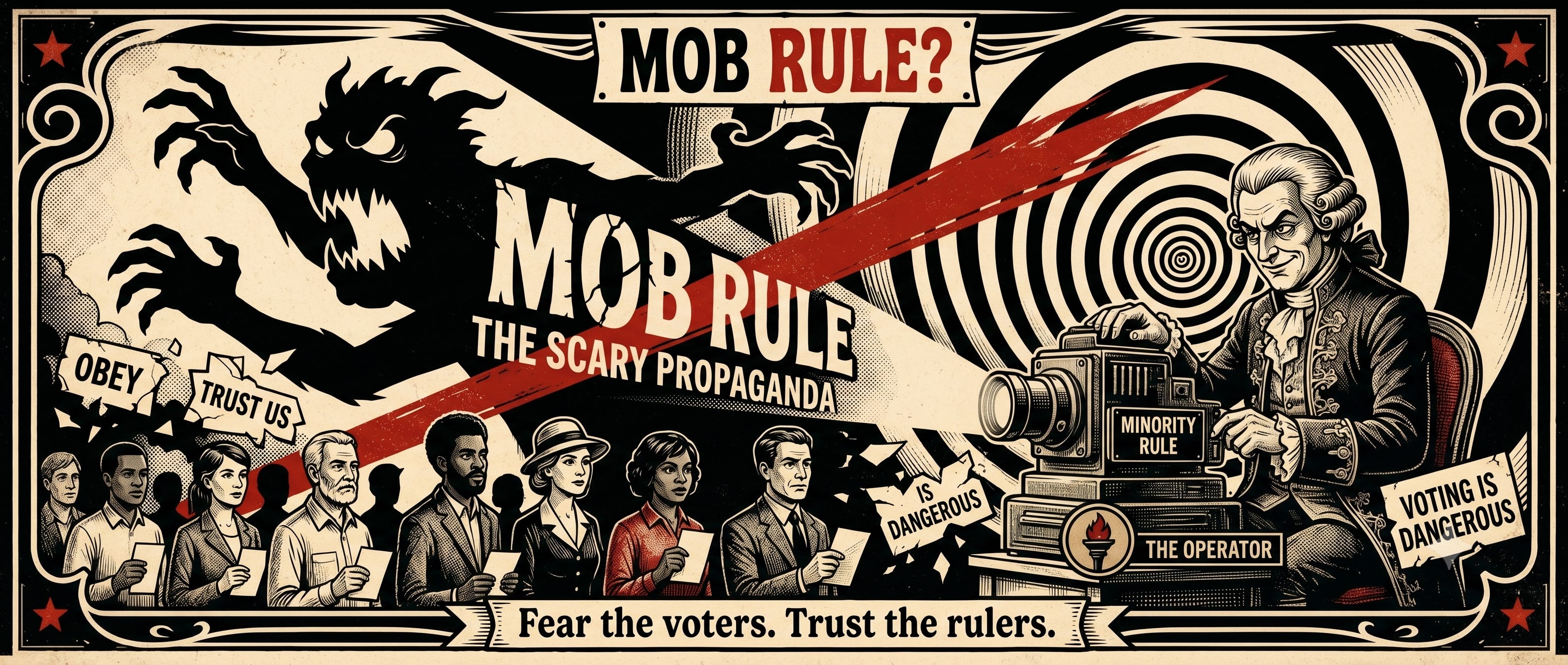
“Mob Rule” Is a Scare Phrase for People Who Need You to Fear Majority Rule
There is a special little trick in anti-democratic messaging where someone points at democracy, makes a spooky face, and whispers:
Mob rule.
Very serious. Very grave. Very “I own several books with eagles on the cover.”
The phrase is designed to do one job: make democratic participation sound like a riot.
Not voting.
Not majority rule.
Not public accountability.
Not people having a meaningful say in the government that governs them.
Just a mob with visualizations of torches, pitchforks. broken windows, and someone always yelling near a fountain.
It is one of the most efficient little pieces of propaganda in American politics because it does not have to prove much. It just has to make you feel something.
Fear.
Shocker, but that’s the whole game.
When people hear “mob rule,” they are not being invited into a careful discussion about constitutional design, minority rights, representation, federalism, deliberation, separation of powers, judicial review, or the complicated balance between popular sovereignty and individual liberty.
No. That would require civics, patience, and perhaps a small snack.
They are being given a picture so they can switch off their critical thinking minds.
A crowd.
An angry crowd.
An irrational crowd.
A dangerous crowd.
Then, after that emotional picture is installed, the salesperson arrives with the product:
Less democracy.
Not called that, of course. Because in the indomitable spirit of Bill Hicks, “…it’s terrible branding...”
Nobody wants “less democracy.” Nobody sees a billboard that says “Now With 40% More Minority Rule!” and thinks, finally, a governing philosophy for my family.
So the product gets rebranded.
“Constitutional order.”
“Republican government.”
“Checks and balances.”
“Founders’ vision.”
“Stability.”
“Protection from mob rule.”
Some of those phrases can describe real democratic principles. That is why they are useful camouflage.
Good propaganda rarely invents entirely new words. It steals good words and rents them to bad ideas.
The Magic Trick
Here is the basic trick:
Label majority rule as “mob rule.”
Make majority power feel reckless, emotional, and dangerous.
Present minority rule as mature, constitutional, and responsible.
Hope nobody notices the swap.
Because that is the part they really do not want you to examine.
The opposite of majority rule is not automatically liberty.
The opposite of majority rule is often minority rule.
And minority rule is not some sacred constitutional incense that floats down from the rafters of Philadelphia.
It means fewer people get more power over more people.
That is it.
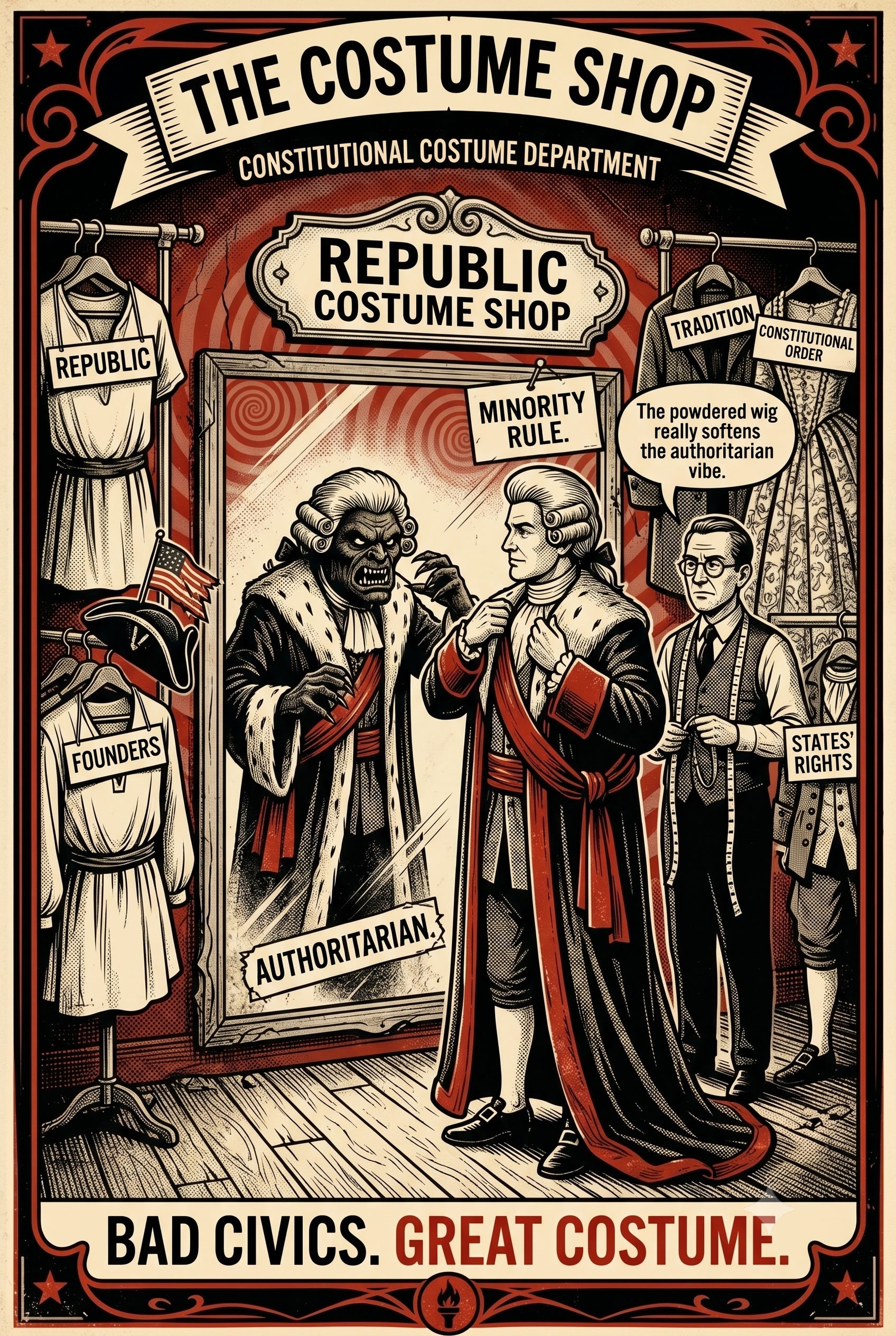
Dress it in a waistcoat if you want. Give it a powdered wig. Teach it to quote Madison at dinner parties. The body underneath is still minority rule.
Now, to be fair, democracies do have to protect against majoritarian abuse. That is real. The rights of individuals and minorities matter precisely because democracy is not just a headcount machine.
Liberal democracy is not “51% gets to do whatever it wants.”
It is majority rule within a constitutional system that protects rights, limits power, holds leaders accountable, and prevents temporary passions from becoming permanent oppression.
That balance matters.
But the “mob rule” crowd is often not trying to defend that balance. They are trying to use one half of the democratic system to discredit the other half.
They love constitutional limits when those limits block popular majorities they dislike.
They get much quieter when power is concentrated in an executive, captured by a faction, protected by gerrymandering, distorted by voter suppression, amplified by dark money, or insulated from public accountability.
Then suddenly, the mob is not the problem.
The people are.
“Mob rule” is an emotional shortcut
“Mob rule” works because it is not really an argument.
It is a frame. A frame tells people what emotional room to enter before the facts arrive.
Say “majority rule,” and people think: elections, voting, legitimacy, consent of the governed.
Say “mob rule,” and people think: chaos, violence, danger, irrationality.
Same basic democratic anxiety, totally different emotional furniture.
That is why marketers love this stuff.
A good frame gets into the nervous system before the mind has finished tying its shoes.
The phrase “mob rule” activates a fear response. It invites people to imagine themselves as the threatened minority, even when the actual political agenda being sold would empower a smaller faction over a larger public.
This is where the marketing gets morally ugly.
Because persuasion is not automatically manipulation. Persuasion can be ethical. You can use storytelling, psychology, and emotion to help people understand something true.
But when you use those tools to make people misunderstand reality in a way that benefits power, congratulations, you have crossed the line from marketing into civic vandalism.
Or, if we are being less polite:
You are using professional-grade persuasion equipment to sell democratic decline.
With great power comes great responsibility.
Apparently, with great polling data comes a focus group and a slogan that makes minority rule sound like a fire extinguisher.
The villain is not rhetoric. The villain is dishonest rhetoric.
I am not against rhetoric. Rhetoric is how humans make meaning public.
Every political tradition uses stories. Every movement uses language. Every argument has a frame. Every campaign is trying to make some ideas feel more urgent than others.
The question is not whether language is being used.
The question is whether language is being used to clarify or conceal.
“Mob rule” often conceals.
It takes a legitimate democratic concern, majority abuse, and turns it into a broad attack on democratic power itself.
It suggests that ordinary people having more influence over the government is inherently dangerous.
It trains citizens to distrust the public and trust the gatekeepers.
It takes the central democratic idea, that government derives legitimacy from the people, and makes “the people” sound like a biohazard.
The phrase does not say:
“We need democracy plus constitutional rights.”
It says, or at least strongly implies:
“Careful. Too much democracy and the animals get loose.”
That is not civic education.
That is elite anxiety in a powdered wig.
The Fallacy Buffet
The “mob rule” move usually comes with several bad arguments stacked on top of each other like a terrible wedding cake.
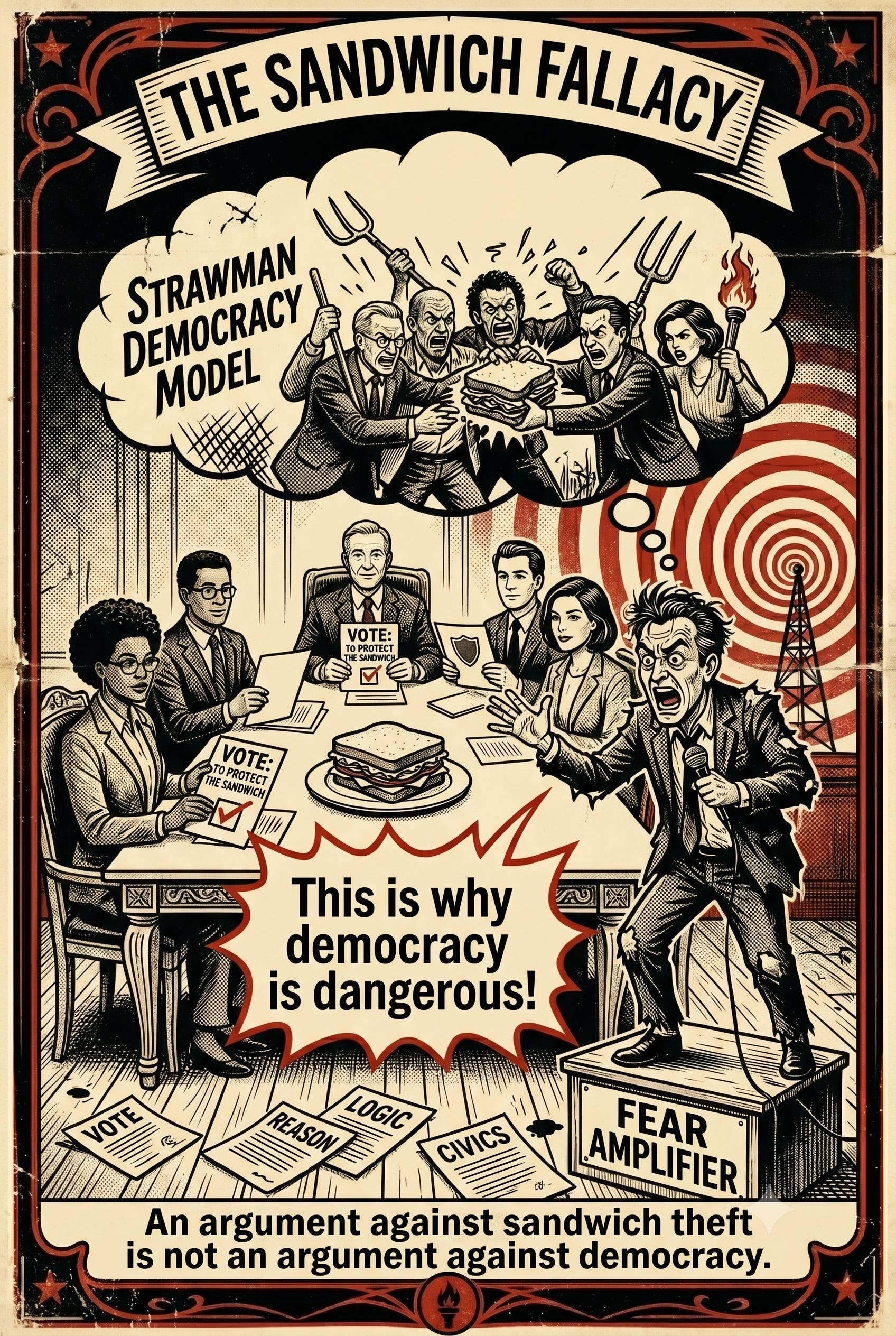
1. The straw man
First, it misrepresents democracy as raw, immediate, unlimited majority will.
That is the straw man.
Instead of engaging with constitutional democracy, representative democracy, liberal democracy, or democratic republicanism, it attacks the easiest cartoon version:
Five people in a room vote to steal the sixth person’s sandwich.
Is that bad? Yes.
Is that an argument against democracy? No.
It is an argument against sandwich theft.
2. The false dilemma
Then it creates a fake choice:
Either you support constitutional republicanism, or you support mob rule.
This is nonsense.
A constitutional republic can use representative democracy. A representative democracy can include constitutional limits. Majority rule can exist alongside individual rights.
These are not enemies.
They are ingredients.
The “republic, not democracy” line tries to turn the recipe into a knife fight.
3. Equivocation
The word “democracy” gets quietly redefined mid-conversation.
Sometimes they use it to mean direct democracy.
Sometimes they use it to mean majoritarian tyranny.
Sometimes they use it to mean any system where popular majorities can actually matter.
Then, when convenient, they contrast this distorted version with “republic,” a word they use as if it means “government by the wise people who already agree with me.”
Very tidy.
Very fraudulent.
4. Appeal to fear
“Mob rule” is fear-based messaging.
It asks people to respond emotionally to the imagined danger of majority power, while ignoring the very real danger of concentrated minority power.
Fear is not always irrational. But fear is very easy to aim.
And the people aiming it know exactly what they are doing.
5. Motte and bailey
This one is my favorite because it is the intellectual equivalent of hiding in a shed after setting fire to the barn.
The bailey, the aggressive claim, is:
“Democracy is dangerous and overrated.”
The motte, the safer retreat, is:
“We only mean that pure direct democracy without constitutional protections can be dangerous.”
Fine. Almost nobody disagrees with that.
But that is not how the phrase gets used in the wild.
In the wild, “mob rule” is used to make voting rights, majority preferences, public accountability, and democratic legitimacy sound suspicious.
When challenged, the speaker retreats to the modest point:
“Well, surely you agree that unlimited majority power can be dangerous.”
Yes. Congratulations. You have defeated a position held by approximately nine people and one angry raccoon.
Madison was worried about factions, not trying to sell you rule by the few
One reason this argument sounds sophisticated is that it borrows Founder language.
James Madison really did worry about factions. Federalist No. 10 is one of the classic texts on the problem. Madison distinguished between a pure democracy and a republic, and he argued that representation and an extended republic could help control the dangers of faction.
That is a real argument.
But notice what Madison was worried about:
Factions.
Not just majorities. Factions.
A faction could be a majority or a minority.
That part matters because modern “mob rule” marketing often acts as if the only dangerous faction is a majority of voters.
But a minority faction can be dangerous too.
A wealthy faction.
A religious faction.
A party faction.
A corporate faction.
A propaganda faction.
A faction with control of courts, maps, money, media, militias, or executive power.
Madison’s problem was not “the people are gross.”
It was: how do you build a system where no faction, whether majority or minority, can sacrifice the rights of others or the public good to its own narrow interest?
That is a much more serious question than “Democracy scary, republic good.”
But the serious version does not fit on a bumper sticker, and nobody has yet focus-grouped “Beware factional capture through institutional asymmetry” into a chant.
The marketing department of minority rule
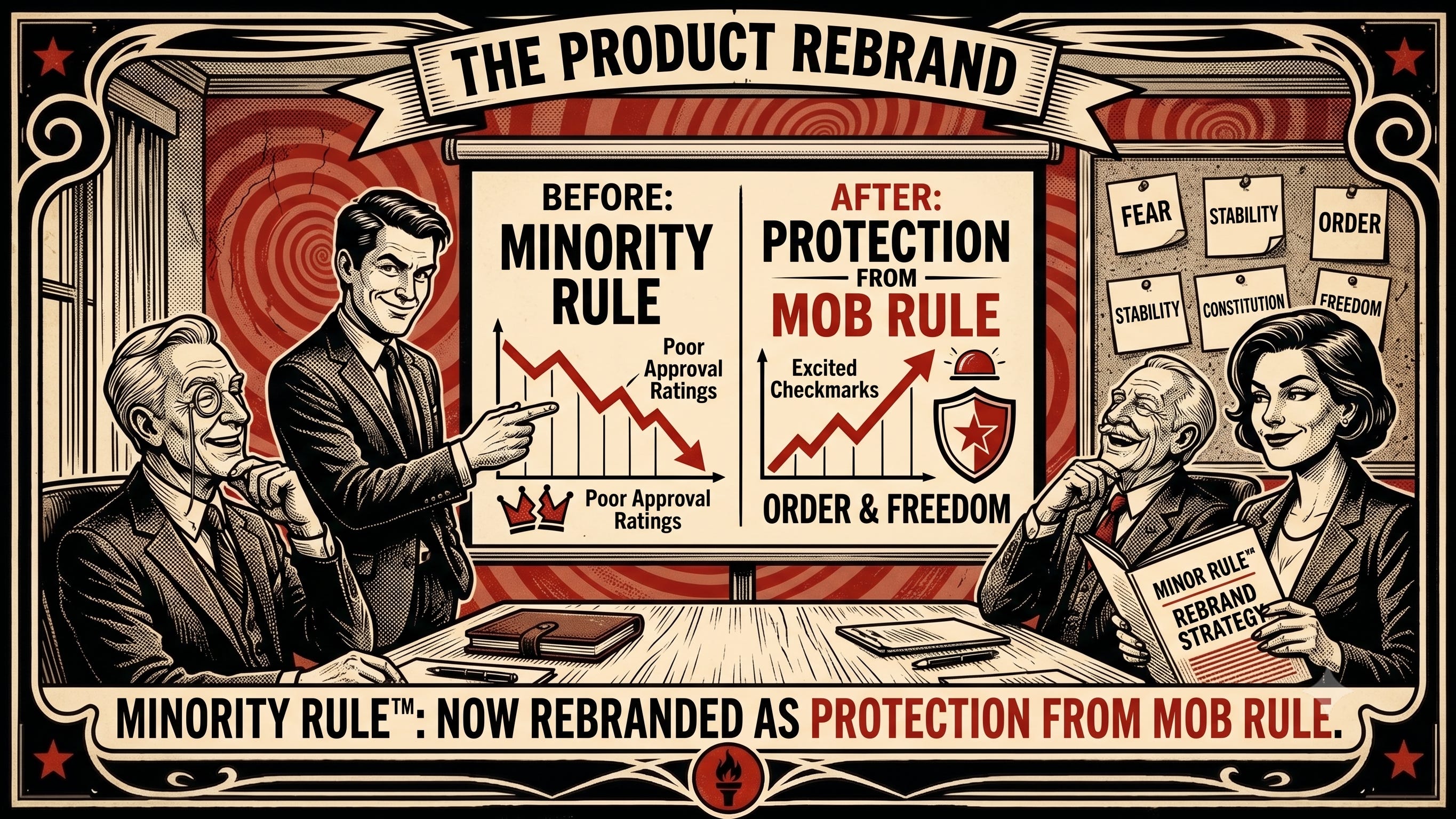
Let’s imagine the meeting.
A conference room.
Bad coffee.
A whiteboard.
A consultant named Chad, who says “freedom architecture” without blinking.
The client walks in and says:
“We need a way to convince people that fewer voters should have more power.”
The room goes quiet.
Someone suggests:
“Minority rule?”
No. Too honest.
“Elite control?”
Tested poorly with suburban moms.
“Anti-majoritarian entrenchment?”
Great for law reviews. Bad for hats.
Then Chad stands up.
“What if we call it protection from mob rule?”
The room exhales.
Beautiful.
Now the public is not being asked to surrender democratic power. They are being asked to protect civilization from chaos.
That is the marketer’s dark art at its worst:
Find the fear.
Name the villain.
Offer the cure.
Hide the invoice.
And the invoice is always power.
Why this works psychologically
The phrase “mob rule” plugs into several human vulnerabilities.
People fear disorder
Humans are order-seeking creatures. Chaos feels dangerous. “Mob” is chaos compressed into three letters and one aggressive vowel.
People overestimate vivid threats
A violent crowd is easier to imagine than slow institutional capture. One is cinematic. The other is a committee hearing, a district map, a court appointment, a procedural rule, and a donor network wearing a nametag.
Our brains are not naturally good at fearing boring things.
Authoritarian politics thrives in that gap.
People like feeling prudent
Nobody wants to think of themselves as anti-democratic.
But “I oppose mob rule” sounds responsible.
It lets people feel like adults in the room while they support systems that make public accountability weaker.
People trust familiar patriotic language
Say “the Founders” and some people lower their guard.
Say “constitutional republic” and the room suddenly smells like parchment.
Say “mob rule” and the alternative sounds less reckless by contrast.
This is how bad arguments get dressed for court.
The real pro-democracy position
A healthy democracy is not mob rule.
A healthy democracy is not minority rule.
A healthy democracy is a system where the people are the source of political legitimacy, majorities can govern through fair elections, individual rights are protected, power is limited, institutions are accountable, and no faction gets to convert temporary advantage into permanent domination.
That is the thing worth defending.
Not an imaginary pure democracy where 51% can steal your sandwich.
Not a fake republic where 41% can steal the whole government and call it constitutionalism.
The American system is complicated. It is representative. It is constitutional. It is federal. It is republican. It is democratic.
Those words are not mutually exclusive.
Anyone who tells you they are probably has a product to sell.
The Translation
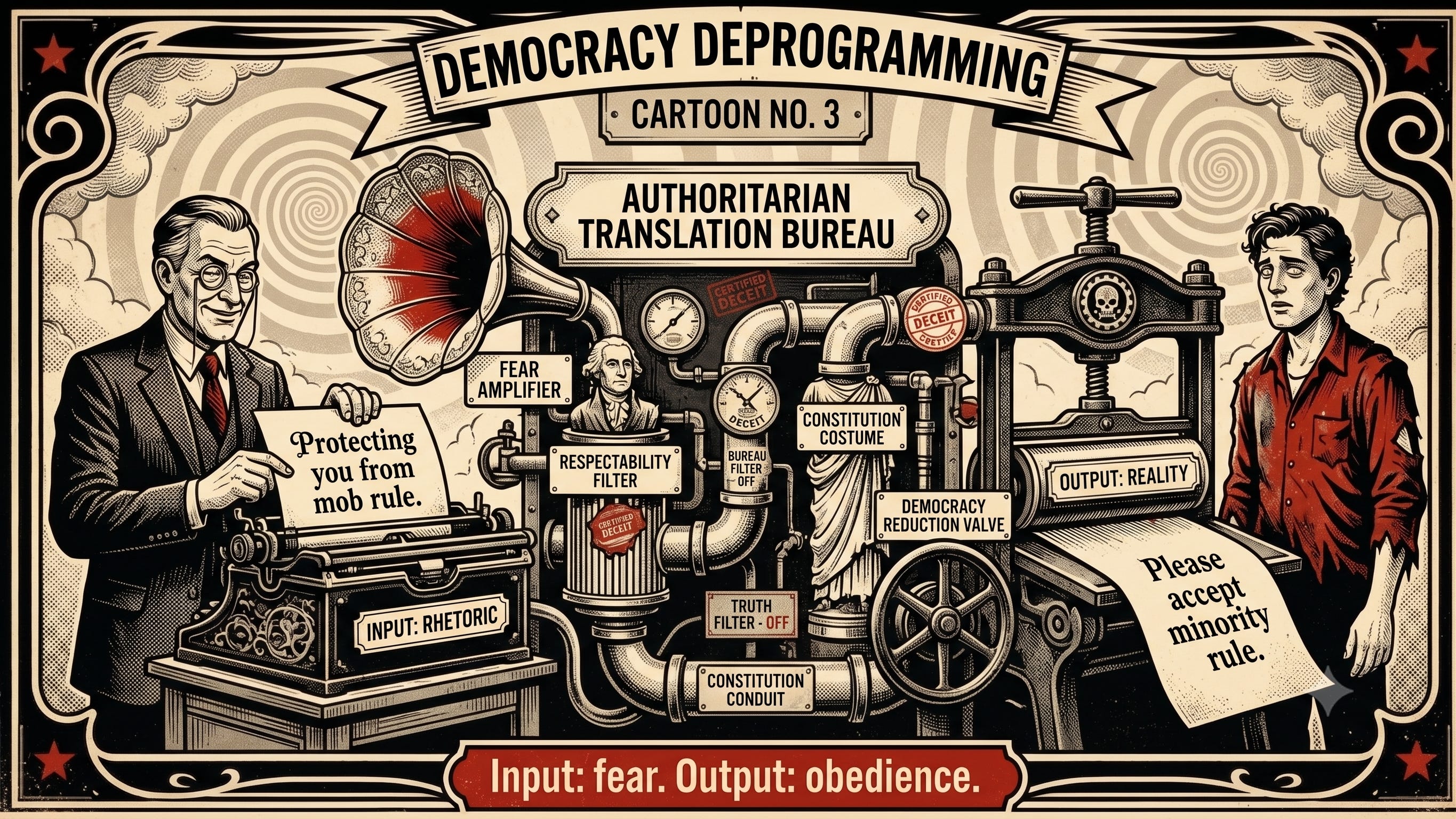
So the next time someone says “mob rule,” do the Democracy Deprogramming translation.
They say: “We have to protect against mob rule.”
Translation: “We need you to fear majority power enough to overlook minority power.”
They say: “We’re a republic, not a democracy.”
Translation: “Please stop using the word democracy while asking why the public has so little say.”
They say: “The Founders feared democracy.”
Translation: “I have selected the parts of the Founders that support my preferred veto points and placed the rest in a decorative historical basket.”
They say: “Majority rule threatens liberty.”
Translation: “Sometimes true, but wait until you hear what concentrated minority rule can do.”
The punchline
The people screaming about “mob rule” often do not want less mob.
They want a smaller mob.
Their mob.
A mob with better shoes.
A mob with donor access.
A mob with judges.
A mob with district maps.
A mob that says “constitutional order” while quietly moving the locks.
That is why this phrase deserves ridicule.
Not because majority tyranny is impossible. It is possible.
Not because constitutional safeguards are unimportant. They are essential.
But because “mob rule” is so often used as a cheap magic spell to make democracy itself seem vulgar, dangerous, and childish.
And once people accept that framing, the anti-democratic project gets easier.
You do not have to say, “We want minority rule.”
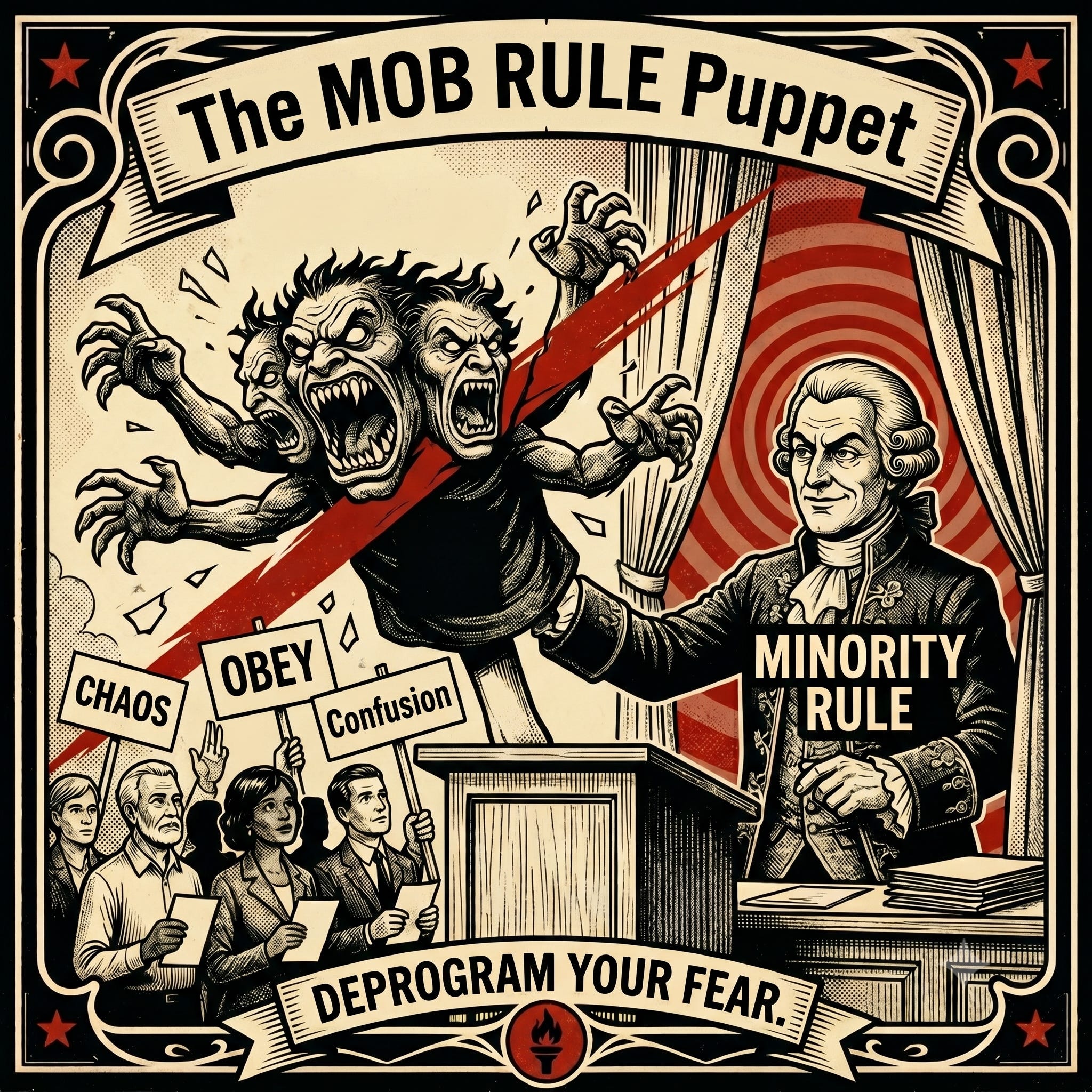
You just say, “We are protecting you from the mob.”
Then you point at the voters.
Break the spell.
***Footnotes & Sources:
Madison’s Federalist No. 10 is the primary source for faction and the republic/direct-democracy distinction, and it explicitly treats factions as capable of being a majority or minority.
USCIS provides plain-English civic support and describes the United States as a representative democracy.
Annenberg Classroom describes the U.S. as both representative and constitutional democracy.
The Stanford Encyclopedia of Philosophy’s entry on manipulation frames manipulation as influence that can bypass conscious reasoning or offer bad reasons disguised as good ones.
Cialdini’s own institute emphasizes ethical persuasion, which provides a useful contrast between persuasion used responsibly and persuasion used as civic vandalism.
This Substack is reader-supported. To receive new posts and support my work, consider becoming a free or paid subscriber.