

What's So Great About Democracy Anyways?
It's the worst governing system until you look at all the others.

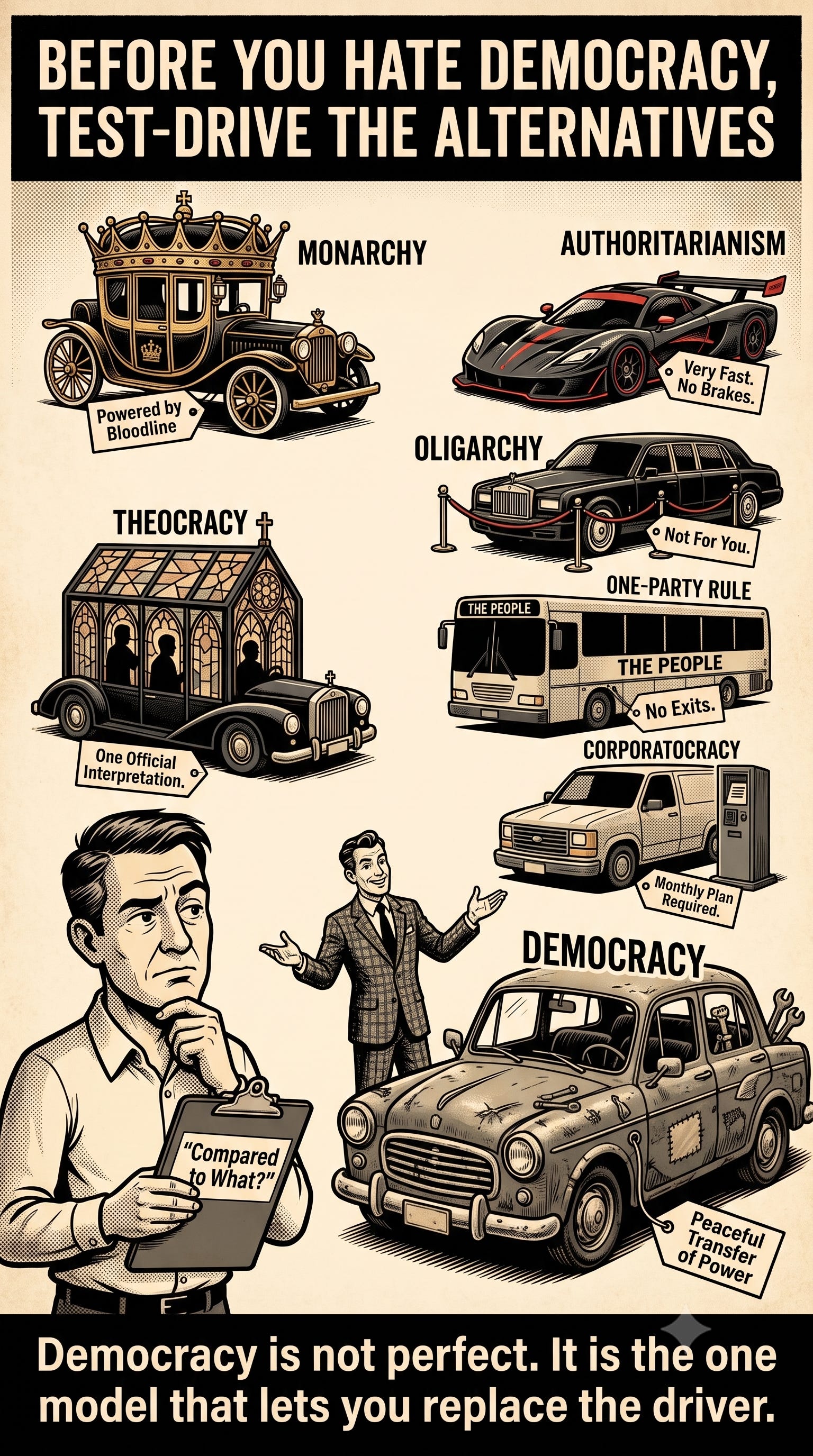
Before You Hate On Democracy, Test-Drive the Alternatives
A Democracy Deprogramming field guide to the anti-democratic sales pitch
Democracy has been taking a beating lately, which is strange when you consider that most of the people attacking it still very much enjoy the parts where they get to complain in public, sue the government, publish their grievances, vote people out, start podcasts, sell supplements, refuse expert advice, join political movements, insult elected officials, and tell everyone else they are the only ones brave enough to understand freedom.
This is one of democracy’s more exhausting features. It gives people enough liberty to spend their liberty arguing that liberty is overrated.
Still, the sales pitch is working.
A lot of Americans are being trained to see democracy as weak, decadent, chaotic, fake, rigged, inefficient, immoral, or vaguely embarrassing; like a family minivan with a “coexist” sticker and a check-engine light. The people pushing this story rarely come right out and say, “We would like fewer citizens to have less power so our preferred faction can rule with fewer interruptions,” because that sounds bad on a yard sign.
So they dress it up.
They say we are a republic, not a democracy.
They say democracy means mob rule.
They say America needs order.
They say experts should run things.
They say the people are too confused.
They say the courts are in the way.
They say the press is the enemy.
They say opposition is sabotage.
They say rights are loopholes.
They say elections only count when the right people win.
They say we need strength.
And at some point, after enough repetition, people begin to absorb the emotional message underneath the words: Democracy is the problem.
Before we accept that, we should do something very simple, very adult, and apparently now very radical. We should test-drive the alternatives.
Because democracy should not be compared to an imaginary system where wise, noble, competent, restrained, selfless leaders glide into office, make perfect decisions, ignore personal ambition, resist corruption, tell the truth, protect everyone’s rights, and voluntarily leave power when their time is up. That system does not exist. That is not a government. That is a Pixar short about municipal ethics.
Democracy must be compared to the actual alternatives humans have built, defended, endured, survived, overthrown, romanticized, regretted, and occasionally rebranded with better fonts.
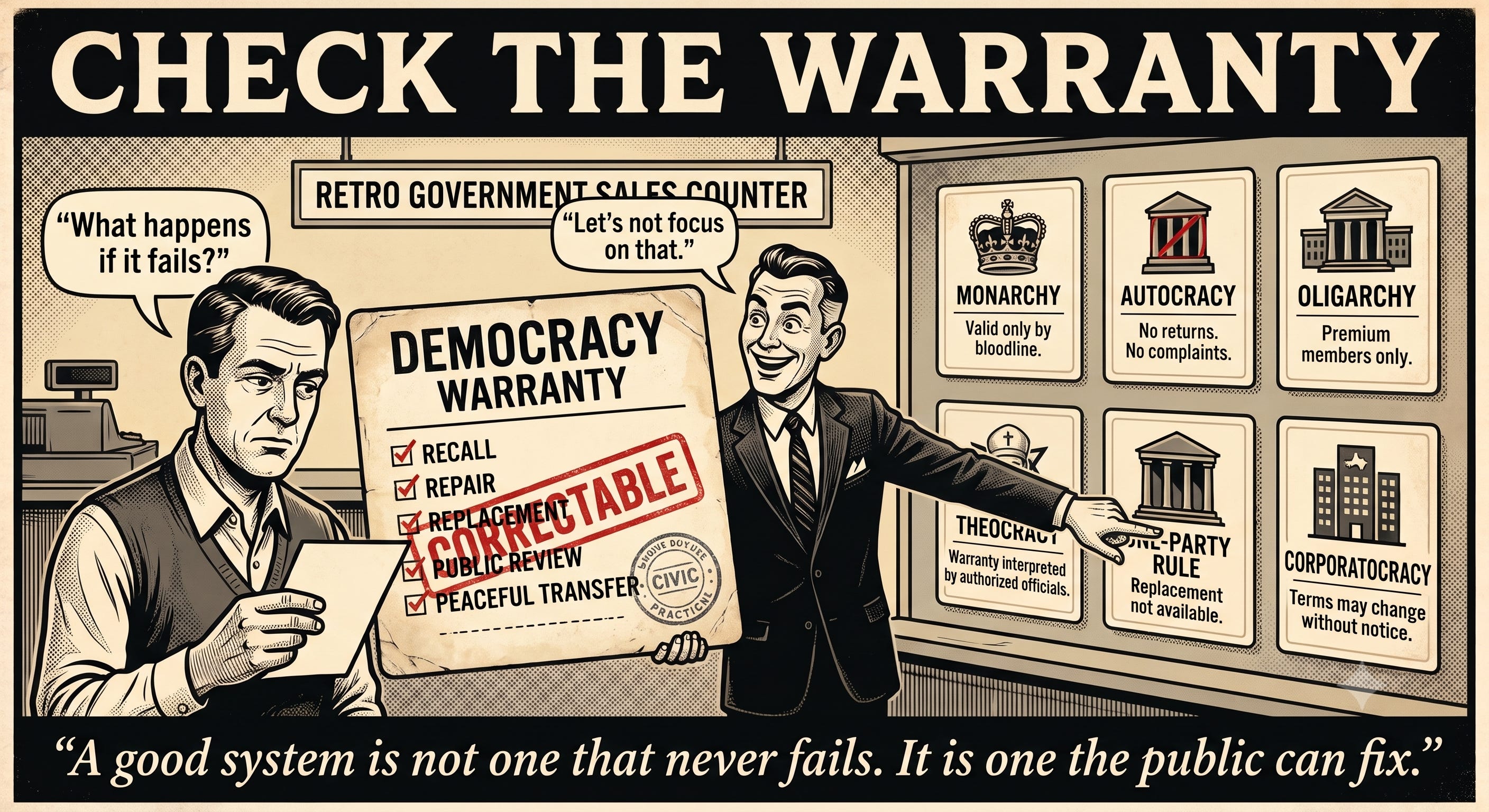
So let’s walk the showroom.
Model One: Monarchy
“Runs on bloodline. Warranty expires at birth.”
Monarchy has a certain aesthetic appeal. Crowns, ceremonies, balconies, uniforms, horses, swords, ancestral estates, oil paintings of men who look like they have never once been told no by someone holding a clipboard.
It feels old, and people often confuse old with wise, which is how humanity got both monarchy and fruitcake.
The monarchy pitch is simple: continuity, tradition, stability, national unity, the dignity of a ruler above politics. Lovely brochure. Now read the fine print.
Monarchy says public power can be inherited. Not earned. Not consented to. Not reviewed. Not competitively renewed. Inherited. That means the basic theory of government is: hopefully the next baby is good at it. This is not a serious philosophy of human freedom. It is ancestry cosplay with tax authority.
Yes, monarchies can produce competent rulers, just as a family restaurant can produce one good chef, but no sane society should build its political future around the assumption that wisdom, restraint, humility, moral judgment, and geopolitical competence move reliably through bloodlines like male-pattern baldness.
And when monarchy goes wrong, the public does not get a normal correction mechanism. It gets court intrigue, succession drama, factionalism, dynastic conflict, or a national waiting game called “maybe the next one will be less weird.”
Modern constitutional monarchies that work well usually work precisely because the monarchy has been politically declawed and democratic institutions do the real governing. In other words, the best version of monarchy is the version where monarchy mostly stops being monarchy.
The democracy lesson here is not complicated: No family owns the future.
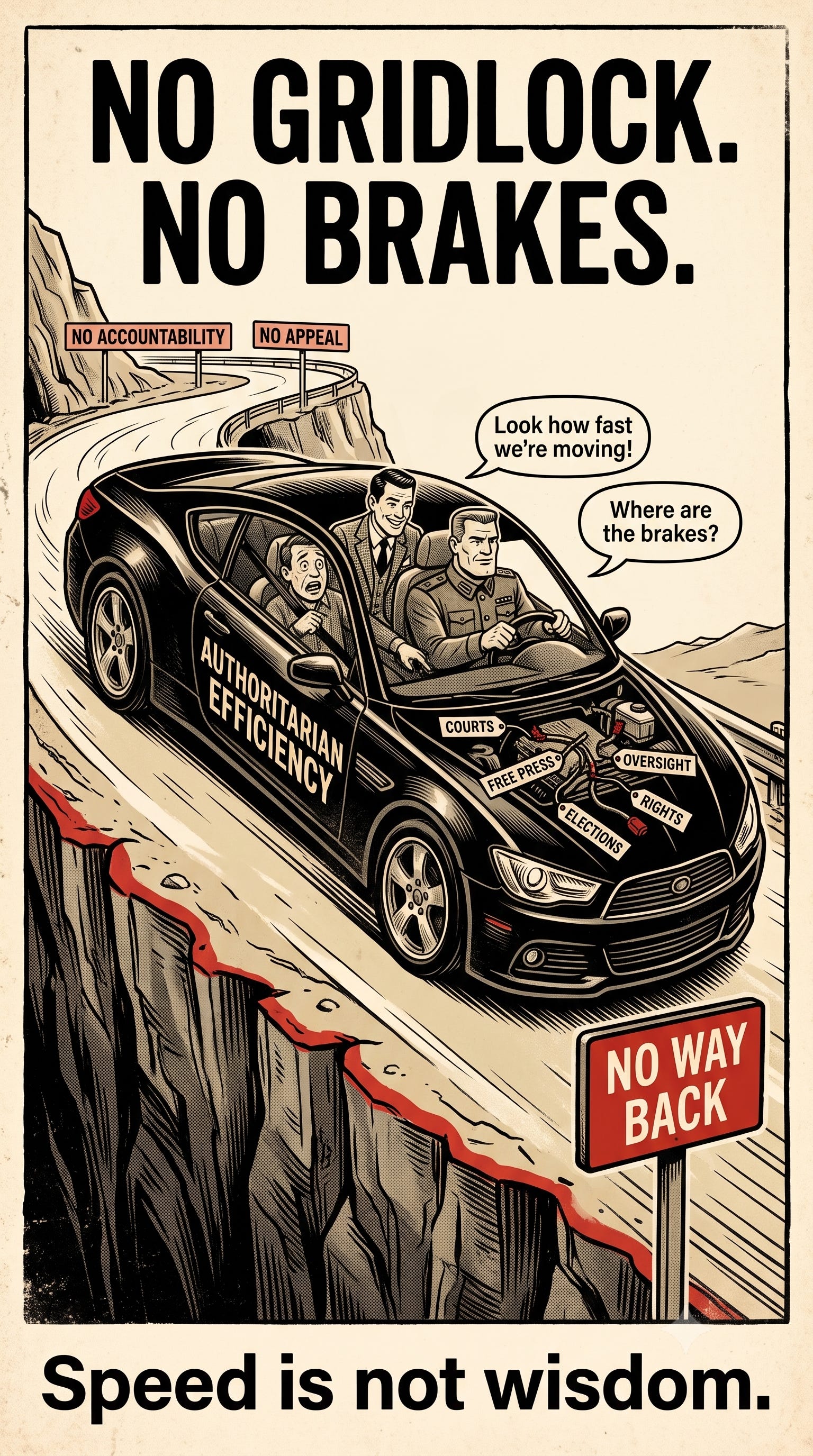
Model Two: Authoritarianism
“No gridlock. No brakes.”
The authoritarian model is always parked under dramatic lighting.
Very sleek. Very decisive. Very masculine in a cologne-commercial kind of way. The salesman leans in and says, “Tired of messy democracy? Try strength. Try order. Try action. No committees. No activist judges. No hostile press. No procedural delays. No weak leaders begging for consensus. This baby can make decisions fast.”
And yes, authoritarian systems can move fast. So can a water balloon dropped from a helicopter.
Speed is not the same as wisdom. A government can act quickly because it is efficient, or it can act quickly because everyone capable of saying “that is a terrible idea” has been fired, frightened, jailed, exiled, bought, or promoted into silence.
The authoritarian fantasy imagines a strong leader who cuts through bureaucracy and gets things done. The historical reality often produces a closed-loop stupidity machine, where leaders punish bad news, subordinates bring flattering news, journalists cannot expose failure, judges cannot restrain abuse, agencies become obedience machines, and citizens learn that truth is safest when whispered.
That is the thing about authoritarian systems. They do not eliminate error. They protect error from correction. A democracy can make terrible decisions in public, which is ugly but useful because public ugliness can still generate accountability. An authoritarian system makes terrible decisions behind curtains, then punishes anyone who notices the smoke.
This is why the “efficiency” argument is so seductive and so stupid. Brakes also slow a car down, but only a maniac describes brake failure as liberation. Democracy is full of brakes. Courts, elections, journalists, inspectors general, legislative oversight, whistleblowers, civil society, local resistance, public protest, opposition parties, independent agencies, rights protections, and procedural limits all slow power down.
That is not a design flaw. That is why the vehicle does not wrap itself around a tree every time the driver gets emotional.
The democracy lesson here: A government that cannot be criticized cannot be trusted.
Model Three: Oligarchy
“Luxury model. But it’s not for you.”
Oligarchy is what happens when a society decides the many are too messy, emotional, uninformed, impatient, distracted, or economically inconvenient to govern themselves, so public power should be placed in the hands of the few.
The responsible few. The serious few. The educated few. The wealthy few. The few who already own enough of the room to claim they understand how rooms work.
The pitch is competence. The reality is often privilege with a governance strategy.
Oligarchy does not remove selfishness from politics. It simply gives better access to people whose selfishness has attorneys, tax counsel, lobbyists, media contacts, donor networks, and a reserved table near the kitchen where public policy gets quietly seasoned before the rest of us see the menu.
The oligarch says democracy is dangerous because ordinary people vote from resentment, emotion, fear, identity, and self-interest, which is hilarious because oligarchs are also human beings and have never, in the history of hoarding, demonstrated a consistent talent for transcending self-interest.
They are not a superior species. They are people with better furniture.
Oligarchy’s failure mode is predictable. Government becomes a defense system for existing power. Tax policy, labor policy, regulatory policy, land policy, campaign finance, procurement, media ownership, and access to justice begin bending toward those already inside the gates.
The public is not necessarily forbidden from participating. That would be gauche. The public is simply priced out, talked over, procedurally exhausted, and then given a commemorative sticker that says “Your Voice Matters.”
Democracy does not reject expertise. It needs expertise. Planes should be designed by engineers, trials should be run by judges, disease policy should involve doctors, and no one should crowdsource bridge safety to a comment thread.
But expertise deserves influence, not ownership.
A society can listen to experts without surrendering sovereignty to a permanent class of people who believe credentials, wealth, or proximity should count more than consent.
The democracy lesson here: No class gets to confuse access with legitimacy.
Model Four: Theocracy
“Comes with one official interpretation.”
Theocracy has the most dangerous sales pitch because it borrows the language of moral seriousness. It says politics is corrupt because it has drifted from sacred truth, and therefore society must be restored by placing law under divine authority.
This sounds noble until you notice the important middleman. Theocracy does not put God in charge. It puts interpreters in charge. Very human interpreters. Often male interpreters. Frequently ambitious interpreters. Interpreters with institutions, enforcement power, property interests, factional loyalties, and a remarkable tendency to discover that God’s will aligns with their preferred social order.
The problem with theocracy is not faith. Faith can inspire courage, compassion, humility, sacrifice, abolition, civil rights, human dignity, resistance to tyranny, and movements of conscience that shame politics into becoming more humane. The problem is state power wearing God’s name tag.
Once a political faction claims divine authorization, disagreement stops being ordinary disagreement. It becomes heresy, corruption, impurity, apostasy, treason, blasphemy, or rebellion against sacred order. The opposition is no longer wrong. It is evil. And once your opponents are evil, there is no reason to share power with them, respect their rights, count their votes, or let their children read unauthorized books.
That is the trap. Democracy protects religious freedom because it prevents any one faction from turning its theology into everyone else’s cage. It allows faith to speak in public, organize in public, persuade in public, and shape conscience in public, while still refusing to let one interpretation become the police department of the soul.
Theocracy says truth must rule. Democracy says truth must persuade. That difference is everything.
The democracy lesson here: A government may protect faith, but it must not become the enforcement arm of one faction’s certainty.
Model Five: One-Party Rule
“The people are represented, whether they like it or not.”
One-party rule often begins with a moral promise: equality, unity, revolution, liberation, purification, national renewal, anti-corruption, class justice, religious restoration, patriotic discipline, or the final triumph of the supposedly real people over the supposedly corrupt enemies inside the gates.
Different flags using the same machinery. The central move is always the same. A party, movement, vanguard, leader, or revolutionary apparatus claims to embody the people so completely that actual people become suspicious when they disagree.
This is how “the people” become a slogan used against people. Independent unions become threats. Free press becomes sabotage. Opposition parties become traitors. Courts become instruments. Elections become theater. Civil society becomes infiltration. Art becomes propaganda. History becomes curriculum enforcement. Truth becomes whatever keeps the ruling structure intact until tomorrow morning.
One-party systems are especially dangerous because they transform political disagreement into existential betrayal. If the party is the people, then opposing the party means opposing the people. If the leader speaks for the nation, then criticizing the leader means attacking the nation. If the movement owns history, then dissent becomes an assault on destiny.
At that point, politics is no longer a contest over public choices. It becomes a loyalty ritual.
Democracy does not solve every economic, social, racial, religious, regional, or class conflict, but it keeps open the political means to fight over them without requiring one side to disappear. Workers can organize. Parties can compete. Journalists can investigate. Courts can intervene. Protesters can mobilize. Voters can replace governments. Movements can become law without becoming the only lawful movement.
The democracy lesson here: When a party claims to be the people, real people become administratively inconvenient.
Model Six: Corporatocracy
“Subscription required.”
Corporatocracy is the model with the cleanest branding.
No crown. No tanks. No sacred robes. No giant portraits of the leader staring down from a ministry wall. Just dashboards, lobbyists, trade associations, sponsored research, procurement language, regulatory capture, algorithmic incentives, data extraction, dark money, and the warm institutional smell of a hotel conference room where everyone has a lanyard, and no one says “bribe” out loud.
Corporations are not evil because they seek profit. That is what they are designed to do, and healthy markets can produce innovation, employment, investment, convenience, productivity, and the occasional miracle of being able to order replacement refrigerator parts at 11:43 p.m. while eating cereal.
The problem is not business. The problem is when business logic becomes governing logic. A corporation does not owe the public what a democracy owes the public. It owes duties to shareholders, investors, customers, contracts, markets, and regulators. That is not scandalous. It is structural.
But when corporate power captures public power, citizenship begins to feel like a user agreement nobody read before clicking accept. Privacy becomes inventory. Speech becomes engagement. Attention becomes yield. Childhood becomes a market segment. Public policy becomes lobbying architecture. Civic life becomes a funnel. Human anxiety becomes monetizable behavior.
The most dangerous corporatocracy does not abolish elections. It surrounds them, funds them, distracts them, data-mines them, gamifies them, polarizes them, sponsors them, and then announces that the people have spoken after spending billions teaching the people what to say.
Democracy requires markets to remain tools. Not gods. Not governments. Not invisible monarchs with quarterly earnings calls.
The democracy lesson here: Markets are useful servants and dangerous sovereigns.
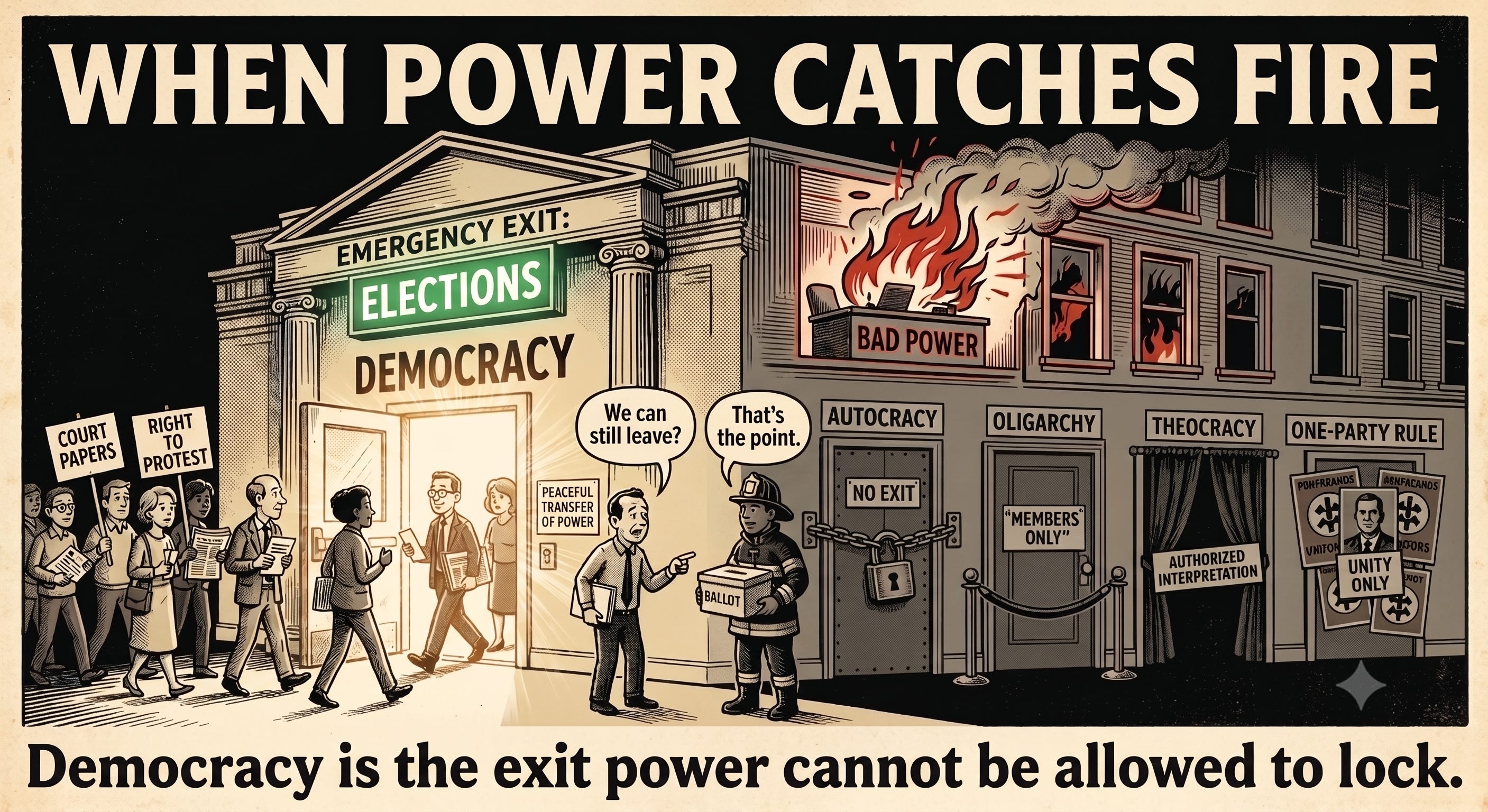
The One Question Every Alternative Hates
There is one question every anti-democratic system tries to avoid:
What happens when power is wrong?
Not when it is benevolent. Not when it is competent. Not when it is disciplined. Not when it is building roads, quoting scripture, invoking the people, praising efficiency, or promising national greatness.
What happens when power lies?
What happens when power steals?
What happens when power gets paranoid?
What happens when power breaks the law?
What happens when power targets enemies?
What happens when power protects friends?
What happens when power loses consent?
What happens when power refuses to leave?
Democracy has an answer: criticize it, investigate it, sue it, organize against it, publish against it, protest it, campaign against it, vote it out, and transfer power peacefully.
Every anti-democratic alternative has a much shorter answer: Good luck.
That is the whole showroom. That is the whole test.
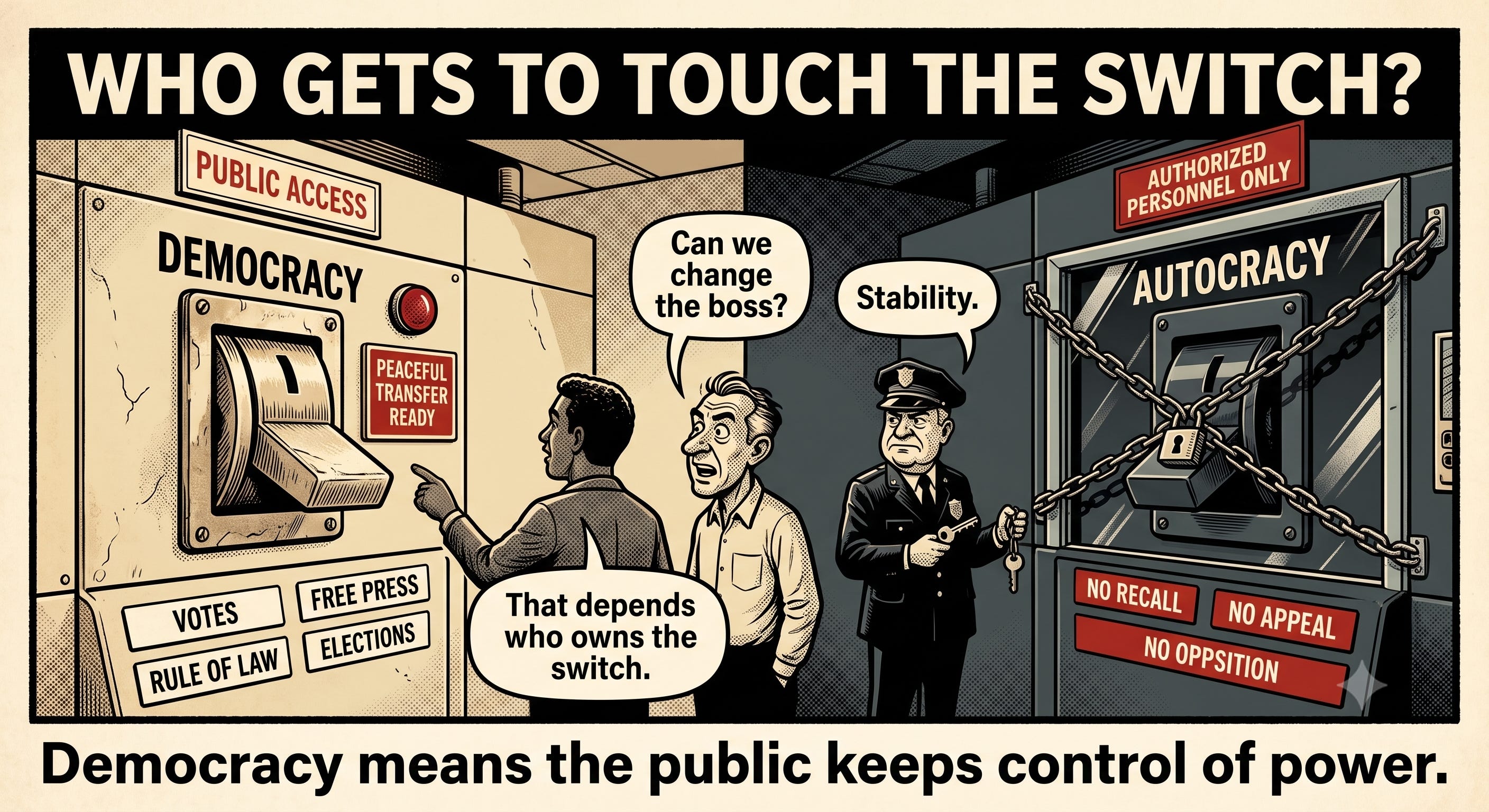
Democracy Is the Uninstall Button
The peaceful transfer of power may be the least appreciated miracle in politics because, when it works, it looks boring. A person wins. A person loses. The votes are counted. The loser leaves. The winner enters. The public argues. The institutions continue. No palace coup. No civil war. No assassination lottery. No divine succession dispute. No party purge. No shareholder revolt over who gets command of the army.
Just the almost ridiculous idea that the most powerful office in a nation can change hands because citizens marked ballots, officials counted them, courts resolved disputes, and the losing side accepted that temporary power is not ownership.
That is not weakness. That is civilization wearing a cardigan.
Democracy is the public’s uninstall button. It means we can remove the government without removing the country. It means we can fire the bastards without burning down the operating system.
This is precisely why authoritarians attack elections first, or attack trust in elections, or attack the legitimacy of counting votes, or attack the people who administer elections, or attack the press that reports on elections, or attack courts that enforce election law.
They are not just attacking a process. They are attacking the public’s right to say, “No more.”
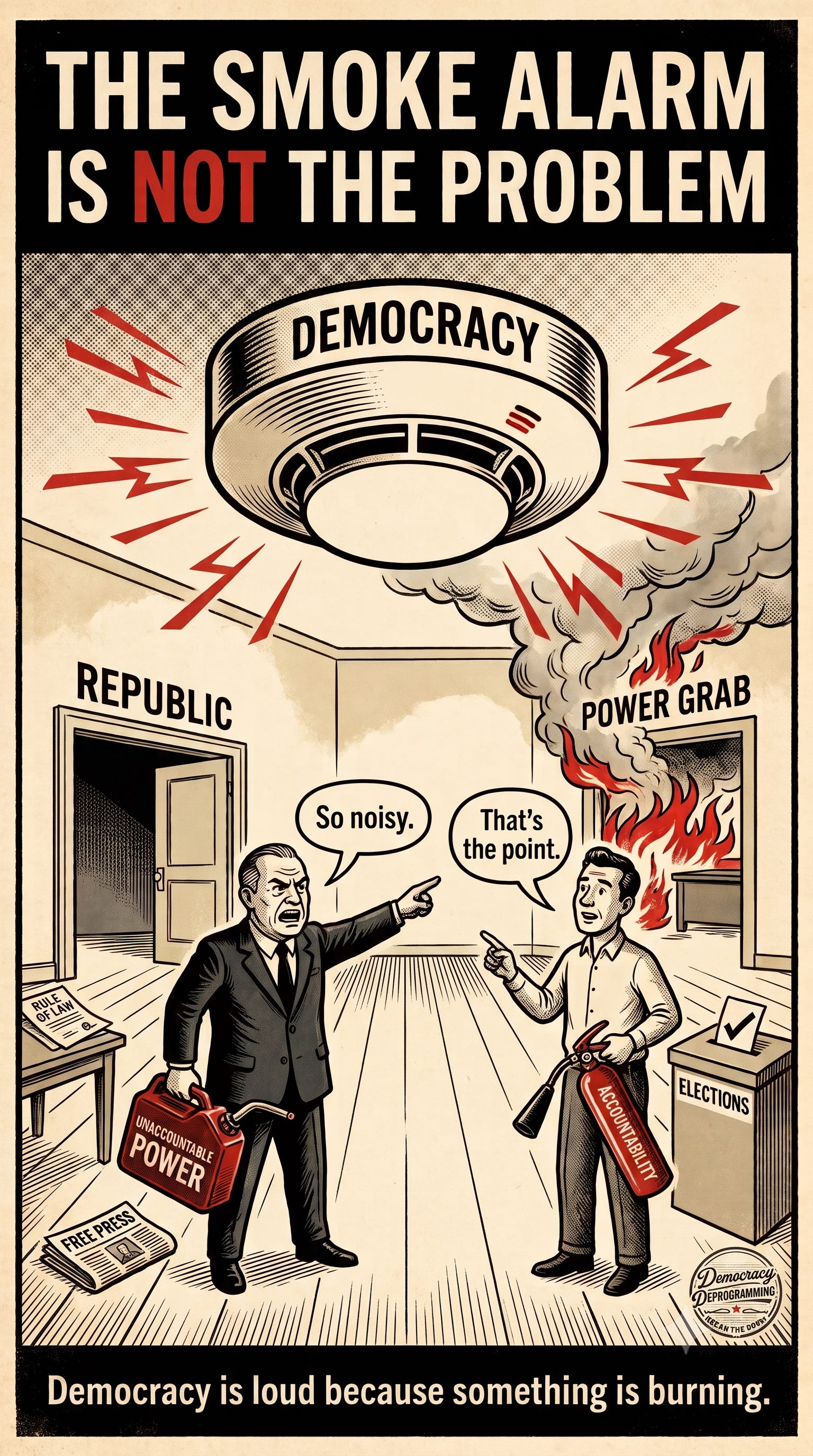
Democracy Is Annoying Because Freedom Is Annoying
Democracy is not tidy because people are not tidy.
Pluralism is noisy because disagreement is noisy. Free speech is uncomfortable because other people keep using it wrong. Elections are stressful because outcomes are uncertain. Courts are frustrating because law is slow. Rights are irritating because they apply to people you dislike. Due process is maddening because even villains get procedures. Press freedom is obnoxious because journalists ask questions at exactly the moment power would prefer a nice parade.
But every one of those annoyances is part of the same architecture. The noise is not incidental. The noise is the sound of people refusing to become subjects.
This is where the anti-democratic sales pitch becomes most dangerous, because it does not usually ask people to hate freedom all at once. It asks them to hate the inconveniences that make freedom possible.
Hate the courts.
Hate the press.
Hate the protesters.
Hate the opposition.
Hate the bureaucrats.
Hate the vote counters.
Hate the watchdogs.
Hate the teachers.
Hate the experts.
Hate the unions.
Hate the civil rights lawyers.
Hate the inspectors general.
Hate anyone standing between raw power and immediate gratification.
Eventually people forget that the annoying parts of democracy are often the parts protecting them from becoming politically disposable. Brakes are annoying until the road turns. Smoke alarms are annoying until the house is on fire. An immune system is annoying until infection arrives. A free press is annoying until the government is lying to you. Courts are annoying until your rights are the ones being violated.
Elections are annoying until you need to remove someone who has decided power belongs to him.
Compared to What?
So, yes, democracy is flawed. It can be bought, manipulated, polarized, corrupted, distracted, exhausted, misinformed, gerrymandered, captured, weakened, and slowly converted into a theatrical shell of itself if citizens stop defending the substance underneath the ritual. But the answer to wounded democracy is not less democracy. The answer is better democracy.
More accountable institutions. Stronger voting rights. Less corruption. Better civic education. Healthier media. More local engagement. More transparent government. More protected opposition. More rights-conscious courts. More resilient election systems. Less billionaire capture. Less propaganda. Less algorithmic radicalization. Less public despair dressed up as sophistication.
The answer is not to throw away the only system that lets the public correct power because powerful people have spent years making correction feel exhausting.
That is the oldest trick in the authoritarian book: break trust in democracy, then offer domination as relief. Before accepting the offer, take one more walk through the showroom.
Monarchy gives you heritage and asks you to gamble your future on a bloodline.
Authoritarianism gives you speed and removes the brakes.
Oligarchy gives you competence and quietly changes the definition of “the public” to “people in the room.”
Theocracy gives you moral certainty and hands enforcement power to human interpreters.
One-party rule gives you unity and turns disagreement into betrayal.
Corporatocracy gives you innovation and converts citizenship into customer behavior.
Democracy gives you noise, conflict, elections, rights, courts, argument, accountability, opposition, investigation, peaceful succession, and the permanent insult to every would-be ruler:
You do not own us.
That is why democracy remains worth defending.
Not because it is perfect.
Because every alternative gives someone else more power and gives you fewer ways to take it back.
The Translation
When someone says democracy is the problem, ask what they are selling instead.
When someone says we need strength, ask who gets restrained.
When someone says elections are rigged, ask whether they accept elections they lose.
When someone says the courts are in the way, ask in the way of what.
When someone says the press is the enemy, ask why power is so afraid of questions.
When someone says the people cannot be trusted, ask which people they mean and who appointed the replacements.
When someone says freedom requires obedience, check your wallet, your rights, and the nearest exit.
Democracy is not faith that the public will always be wise.
It is the refusal to let any ruler, faction, class, party, church, corporation, or movement become permanently unaccountable.
That is the whole spell they are trying to break.
And that is why we should break theirs first.